14.6-14.9 - Electrochemical Cells
Build and investigate electrochemical cells, calculate their standard emf and write cell diagrams. Connect each apparatus choice and controlled condition to the reliability of the voltage measurement.
What The Voltmeter Measures
A simple electrochemical cell separates two redox half-reactions so that electrons have to move through an external wire. The wire is connected to a high-resistance voltmeter, so the cell can be measured without drawing a large current and quickly changing the half-cell concentrations.
[DIAGRAM: asset_name: Zinc copper cell showing external electrons and salt bridge ions; asset_slug: edexcel_a_level_chemistry_l065_zinc_copper_cell; recommended_method: deterministic_chart; description: Zinc copper cell showing external electrons and salt bridge ions.]
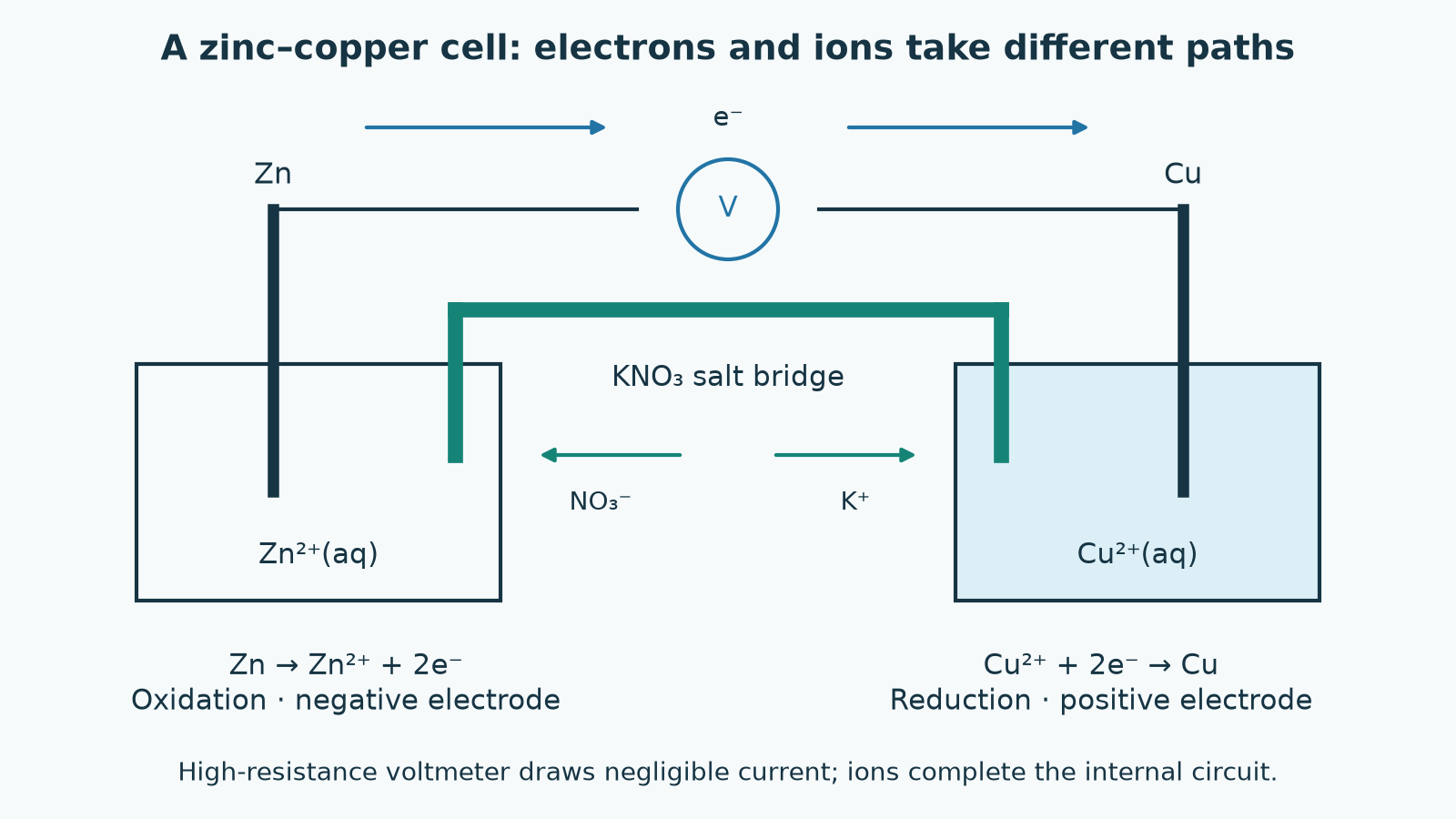
A typical metal-ion cell can be built from:
| Part | Example | Purpose |
|---|---|---|
| Left half-cell | in | A metal in contact with a solution of its ions |
| Right half-cell | in | Another metal/metal-ion half-cell |
| Salt bridge | Filter paper soaked in inert electrolyte such as | Allows ions to move and completes the circuit |
| External circuit | Wire and high-resistance voltmeter | Measures potential difference while drawing negligible current |
For the zinc-copper cell, zinc is oxidised:
Copper(II) ions are reduced:
The electrons move through the wire from the zinc electrode to the copper electrode. The salt bridge does not supply electrons; it allows ions to migrate so that charge does not build up in either half-cell.
For the zinc–copper cell, ions migrate towards the zinc half-cell, where is produced. ions migrate towards the copper half-cell, where is removed. This maintains electrical neutrality. A voltmeter measures potential difference, not electron flow directly; high resistance makes the current very small, so its reading approximates the open-circuit emf.
Common-error contrast
Do not say that electrons travel through the salt bridge. Electrons travel through the metal wire; ions move through the salt bridge. This distinction matters because the voltmeter is measuring the tendency for electrons to be pushed around the external circuit by the two half-reactions.
Different Half-Cells Need Different Methods
Standard electrode potentials are not all measured with the same physical arrangement. The half-cell has to give the reacting species a conducting surface where electron transfer can happen.
When the aim is to measure a standard electrode potential rather than just a cell emf, the half-cell is connected to a reference half-cell under standard conditions. The previous lesson dealt with why the standard hydrogen electrode is assigned ; here the focus is how the unknown half-cell is physically built.
| Type of half-cell | Practical arrangement | Example half-equation | Why this arrangement is needed |
|---|---|---|---|
| Metal in contact with its ions | Dip the solid metal into a solution of its ions | The metal itself conducts and is one of the reacting species | |
| Non-metal in contact with its ions | Use an inert platinum electrode with the non-metal and its ion | The non-metal/ion mixture needs a conducting inert surface | |
| Ions of the same element in different oxidation states | Use an inert platinum electrode in a solution containing both ions | There is no solid metal in the half-equation to act as the electrode |
Platinum is used because it conducts electrons but does not take part in the redox reaction under the conditions used. Inert does not mean "chemically magical"; it means it provides a surface for electron transfer without appearing in the half-equation.
Method logic for Core Practical 10
Core Practical 10 is about investigating electrochemical cells, so the practical reasoning matters as much as the arithmetic. To compare different cells fairly, keep the ion concentrations, temperature, electrode surfaces, salt bridge and voltmeter arrangement consistent. If one half-cell uses a gas, the gas pressure also has to be controlled.
Good practical notes link a method choice to the measurement:
| Method decision | Reason |
|---|---|
| Clean metal electrodes before use | Oxide or grease can slow electron transfer and affect the measured potential |
| Use the same salt bridge electrolyte | Different ions may react with half-cell species or change junction potentials |
| Keep solutions separate except through the salt bridge | Direct mixing would let the redox reaction happen without forcing electrons through the wire |
| Use a high-resistance voltmeter | Limits current, helping the reading approximate the cell emf |
| Record temperature and concentrations | Electrode potential depends on conditions, so these are part of the result |
A reproducible CP10 investigation. Clean and rinse the metal strips. Place labelled equal-concentration ion solutions in separate beakers and immerse the appropriate electrodes. Connect a fresh electrolyte-soaked bridge, then connect the electrodes to a high-resistance voltmeter. Record the stable reading and which lead is positive, together with concentration and temperature. Repeat with fresh connections to check reproducibility. Change one half-cell at a time against a fixed reference to compare a series; reverse the meter leads to confirm the sign reverses without changing the magnitude.
Use an electrolyte that does not precipitate or complex either ion: chloride is unsuitable for a silver-ion half-cell because it forms . Wear eye protection, use small volumes and collect transition-metal waste. A gas half-cell additionally needs controlled gas contact and pressure; hazardous gases require the laboratory’s assessed apparatus and ventilation.
No iron nail in an Fe³⁺/Fe²⁺ half-cell
Dipping iron into a solution of and does not make an half-cell: the half-equation involves only aqueous ions, so there is no solid iron in that redox couple. A platinum electrode is needed as an inert conducting surface; using iron would introduce another possible half-reaction involving .
Calculating Standard Cell Emf
Standard electrode potentials are listed as reduction potentials. To combine two of them, decide which half-cell is being reduced and which is being oxidised.
Continue this lesson.
You’re previewing NovaLearn without an account. Create a free account to read the rest.
Create free account