10.3-10.4 - Industrial Equilibrium And Kc Expressions
Industrial conditions balance equilibrium yield, production rate and cost. Evaluate that compromise using data, then write equilibrium-constant expressions from balanced equations and the phases of the substances present.
Equilibrium Yield And Production Rate
Problem opener. A reversible reaction may give an excellent equilibrium yield at one temperature, but reach that equilibrium so slowly that a factory would make very little product per hour. A different set of conditions may give a lower equilibrium yield but a much faster rate, so the useful output per day can be higher.
For many industrial equilibria, chemists are balancing two different questions:
- Equilibrium question: what proportion of the mixture could become product?
- Kinetics question: how quickly is product made?
- Industrial question: which conditions give enough product, fast enough, at acceptable cost and risk?
[DIAGRAM: asset_name: Industrial Compromise Reactor; asset_slug: edexcel_a_level_chemistry_l050_industrial_compromise_reactor; recommended_method: deterministic_chart; description: Pale-background colour industrial equilibrium reactor with inlet gases, product outlet, catalyst bed, pressure gauge, thermometer and a balance motif for rate-yield compromise.]
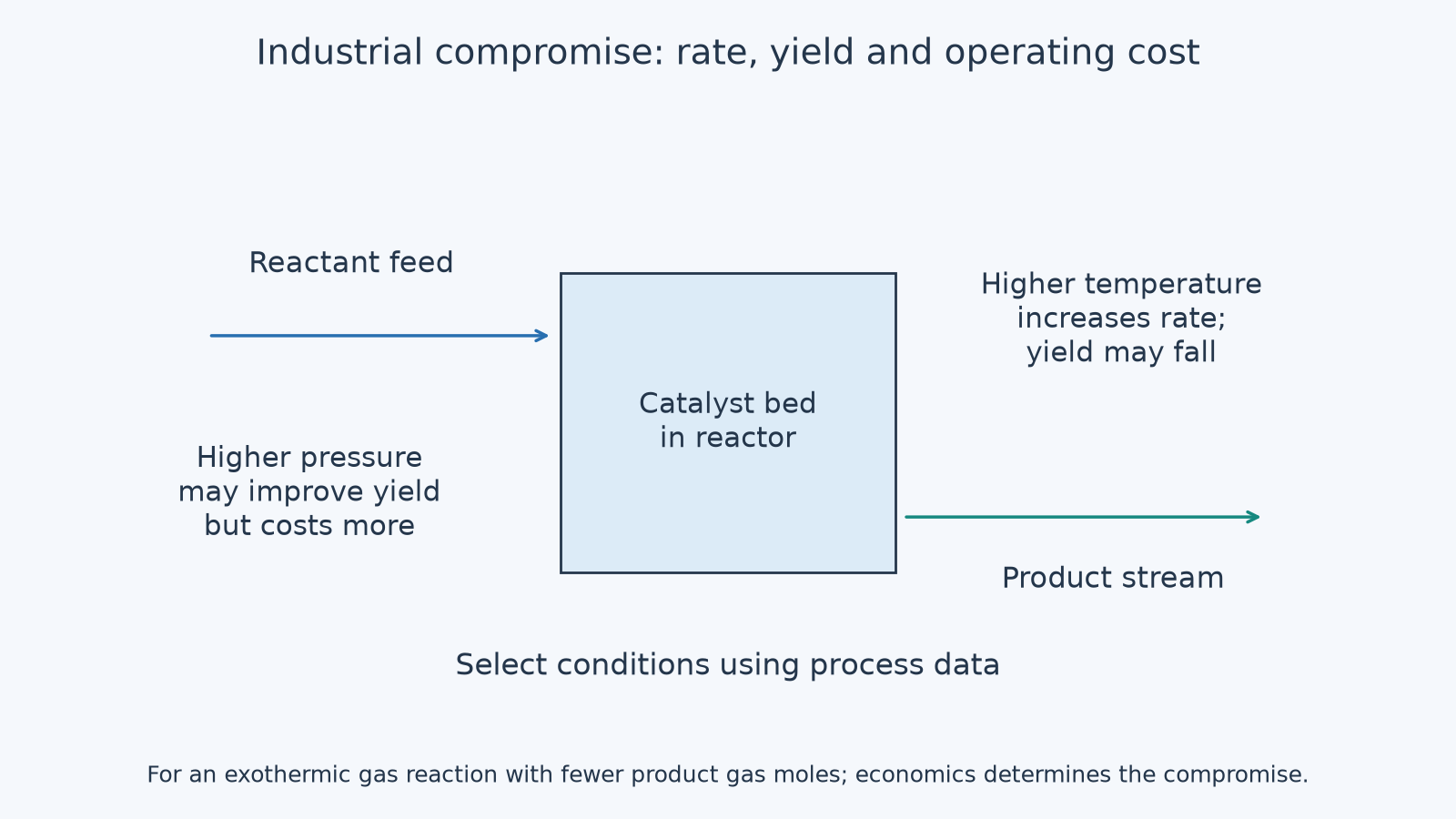
Take an exothermic gas-phase equilibrium in which the forward reaction forms fewer gas molecules, such as the simplified model:
Lower temperature favours the exothermic forward reaction, so it increases the equilibrium yield of . The problem is that particles have less kinetic energy at lower temperature, so fewer collisions have enough energy to react and the rate is lower.
Higher pressure favours the side with fewer gas molecules, so it increases the equilibrium yield of in this example. It can also increase collision frequency in the gas mixture, but high pressure needs strong equipment, more energy for compression and stricter safety control.
A catalyst provides an alternative pathway with lower activation energy. It increases the rate of both forward and reverse reactions, so equilibrium is reached faster. It does not change the equilibrium yield, the position of equilibrium at equilibrium, or the value of .
Evaluating A Compromise From Data
The command word evaluate needs more than a trend statement. Use the data, identify the conflict, and make a supported judgement.
Suppose a pilot plant tests the exothermic equilibrium from the previous part. The product side has fewer gas molecules.
| Condition set | Temperature / K | Pressure / atm | Relative initial rate | Equilibrium yield of / % |
|---|---|---|---|---|
| A | 620 | 150 | 1.0 | 74 |
| B | 720 | 150 | 4.1 | 48 |
| C | 720 | 250 | 5.0 | 63 |
| D | 820 | 250 | 12.0 | 36 |
Worked evaluation. Which condition set is the best starting point for an industrial process?
A has the highest equilibrium yield, , but its relative rate is only 1.0, so the reactor would produce product slowly. D has the fastest rate, 12.0, but the equilibrium yield is only , so much of the mixture remains as reactants and more separation or recycling would be needed. C improves both measured rate and yield compared with B, although its higher pressure costs more, because the same temperature gives a higher yield at higher pressure, rather than , and the rate is also slightly higher. Without compression and separation costs there is no uniquely proved economic optimum. C is a defensible starting point because it keeps a much better yield than D while still being five times faster than A.
That answer is not just "choose the highest yield" or "choose the fastest rate". It weighs the evidence and gives a judgement.
How to write the reasoning chain.
- State the equilibrium effect shown by the data.
- State the rate effect shown by the data.
- Identify why the two effects conflict.
- Choose conditions and justify them with numbers.
- Mention an industrial limitation if it matters: cost, pressure safety, catalyst cost, recycling or energy input.
Common-error contrast. Equilibrium yield and production rate are related, but they are not the same. A high equilibrium yield tells you the final composition if the system is allowed to reach equilibrium; it does not tell you how long the system takes to get there.
What A Kc Expression Means
is the equilibrium constant written in terms of equilibrium concentrations. The square brackets mean concentration at equilibrium, usually in .
For a homogeneous equilibrium where all reacting species are in the same phase:
Continue this lesson.
You’re previewing NovaLearn without an account. Create a free account to read the rest.
Create free account