18C.22 - Organic Purification And Aspirin Preparation
A successful preparation produces a dry, purified substance with convincing evidence of identity and purity. Use aspirin preparation in Core Practical 16 to connect reaction, crystallisation and yield, then compare the apparatus used to purify solids and liquids.
Properties Used In Organic Purification
Organic preparation usually gives a crude mixture, not a pure labelled product. In aspirin preparation, the useful product is formed in a mixture that can still contain acid catalyst, ethanoic acid, unreacted ethanoic anhydride, unreacted 2-hydroxybenzoic acid, solvent and water. The practical problem is to move from "reaction has happened" to "solid product has been isolated, purified, dried and checked".
The reaction context is:
2-hydroxybenzoic acid + ethanoic anhydride → aspirin + ethanoic acid
This equation is useful because it shows a 1 : 1 mole ratio between 2-hydroxybenzoic acid and aspirin. It does not, by itself, tell you whether the sample you collect is pure, dry or even mostly aspirin. Practical evidence has to do that job.
| Technique | Main property or problem | What the step is for |
|---|---|---|
| Refluxing | volatility and reaction rate | heat the reaction mixture without losing volatile material |
| Purification by washing | soluble impurities | rinse away unwanted soluble substances while losing as little product as possible |
| Solvent extraction | different solubilities in immiscible layers | move or separate an organic compound from an aqueous layer |
| Recrystallisation | solubility changes with temperature | purify a solid by dissolving it hot and crystallising it cold |
| Drying | water or solvent contamination | remove liquid from the isolated product before weighing or testing |
| Distillation, including steam distillation | volatility and boiling-temperature difference | separate or purify volatile liquids |
| Melting temperature determination | sharp melting range of a pure solid | judge purity of a solid sample |
| Boiling temperature determination | narrow boiling range of a pure liquid | judge purity of a liquid sample |
A strong practical answer always names both the action and the reason. "Wash the crystals" is incomplete. "Wash the crystals with a minimum volume of cold solvent to remove soluble impurities while limiting loss of product by dissolving" is the chemistry.
Common-error contrast
| Tempting answer | Why it loses force | Better reasoning |
|---|---|---|
| Reflux is used to evaporate the mixture | Reflux returns condensed vapour to the flask | reflux heats while preventing loss of volatile reactants or products |
| Washing always means adding lots of water | Too much solvent can dissolve product | use the minimum suitable cold solvent needed to remove soluble impurity |
| Recrystallisation makes more product | It purifies product but usually lowers mass | some desired product remains dissolved or is lost during transfer |
| A melting temperature proves identity | It is purity evidence, not a full structural proof | a narrow range close to the data value supports purity and possible identity |
Controlled Heating And Reflux
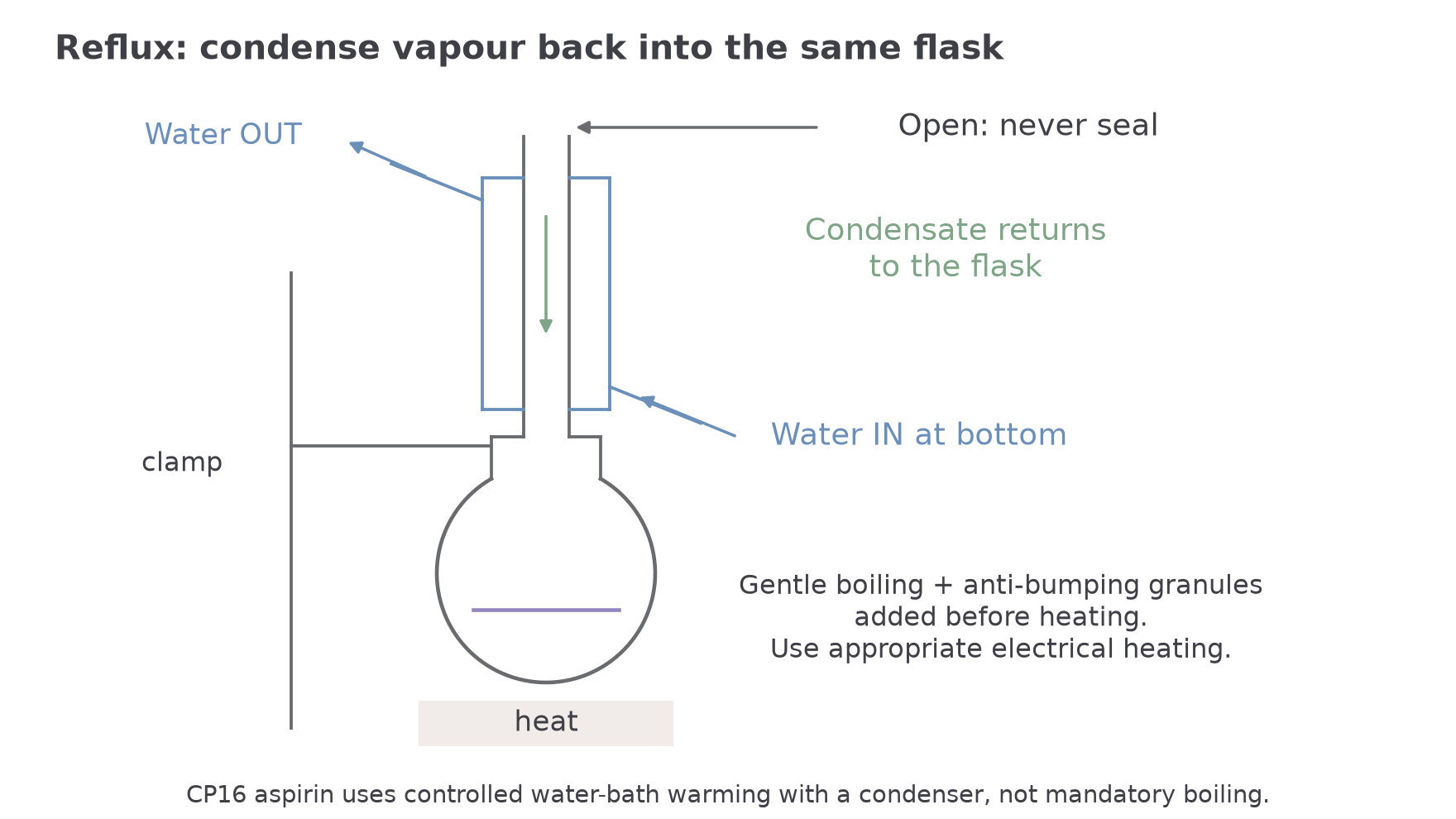
A condenser allows heated vapour to cool and return to the vessel; whether the mixture is actually boiling determines whether the procedure is reflux.
Refluxing
Heating a reaction mixture with a vertical condenser fitted so that vapour cools, condenses and runs back into the flask.
The mixture can be kept hot for long enough to react, but volatile reactants and products are not allowed simply to escape into the room.
In aspirin preparation, 2-hydroxybenzoic acid reacts with ethanoic anhydride in the presence of concentrated sulfuric acid catalyst. Heating speeds up the reaction and helps the solid dissolve, but ethanoic anhydride and acidic vapours must be controlled. A condenser reduces loss of vapour during controlled heating; boiling under reflux is a separate technique.
The Core Practical 16 method specifies gentle water-bath warming with a condenser, until the solid dissolves and for a further period; it does not require boiling under reflux. After removing the flask from the hot bath, water/ice hydrolyses unused ethanoic anhydride, then ice cooling precipitates crude aspirin. The solid is suction-filtered, washed with little ice-cold water, recrystallised, filtered and dried. Follow the stated method: a condenser can limit vapour loss during warming without the mixture actually boiling.
The apparatus logic:
- the condenser is fitted above the reaction flask
- the system is not sealed, because pressure must not build up during heating
- cooling water enters at the lower side-arm and leaves at the upper side-arm, keeping the jacket full
- the flask is clamped securely and heated in a suitable bath or on an appropriate heater
- anti-bumping granules or controlled heating reduce sudden boiling where the method uses them
Risk management is part of the chemistry, not a separate memory list. Ethanoic anhydride and concentrated sulfuric acid are corrosive, and 2-hydroxybenzoic acid is harmful, so the preparation belongs under teacher supervision with eye protection, a lab coat, good ventilation or a fume cupboard where required, and care with hot apparatus. The important exam habit is to connect the risk to the control: corrosive liquids need eye and skin protection; volatile or irritating vapours need ventilation; hot glassware needs heat-safe handling.
Reflux or distillation?
Both involve boiling, but in reflux vapour condenses and returns to the same flask, so the reaction mixture can keep reacting without losing volatile substances. In distillation, vapour condenses and is collected in a different vessel, so a volatile component is separated from the mixture.
[DIAGRAM: asset_name: Open vertical condenser, lower water inlet, upper outlet, return path and heated reaction flask; asset_slug: edexcel_9ch0_reflux_apparatus; recommended_method: deterministic_chart; description: Open vertical condenser, lower water inlet, upper outlet, return path and heated reaction flask]
Washing, Extraction And Drying
Washing removes soluble impurities from the product phase. The product may be a solid on a filter paper or a liquid organic layer in a separating funnel, but the same reasoning applies: choose a washing liquid that dissolves the impurity better than the product, and use only as much as is needed.
For crude aspirin crystals, a small volume of cold water can remove soluble acidic impurities such as ethanoic acid and sulfuric acid from the crystal surface. The water is cold and the volume is small because aspirin is not completely insoluble; using warm water or a large volume would dissolve more product and reduce the yield.
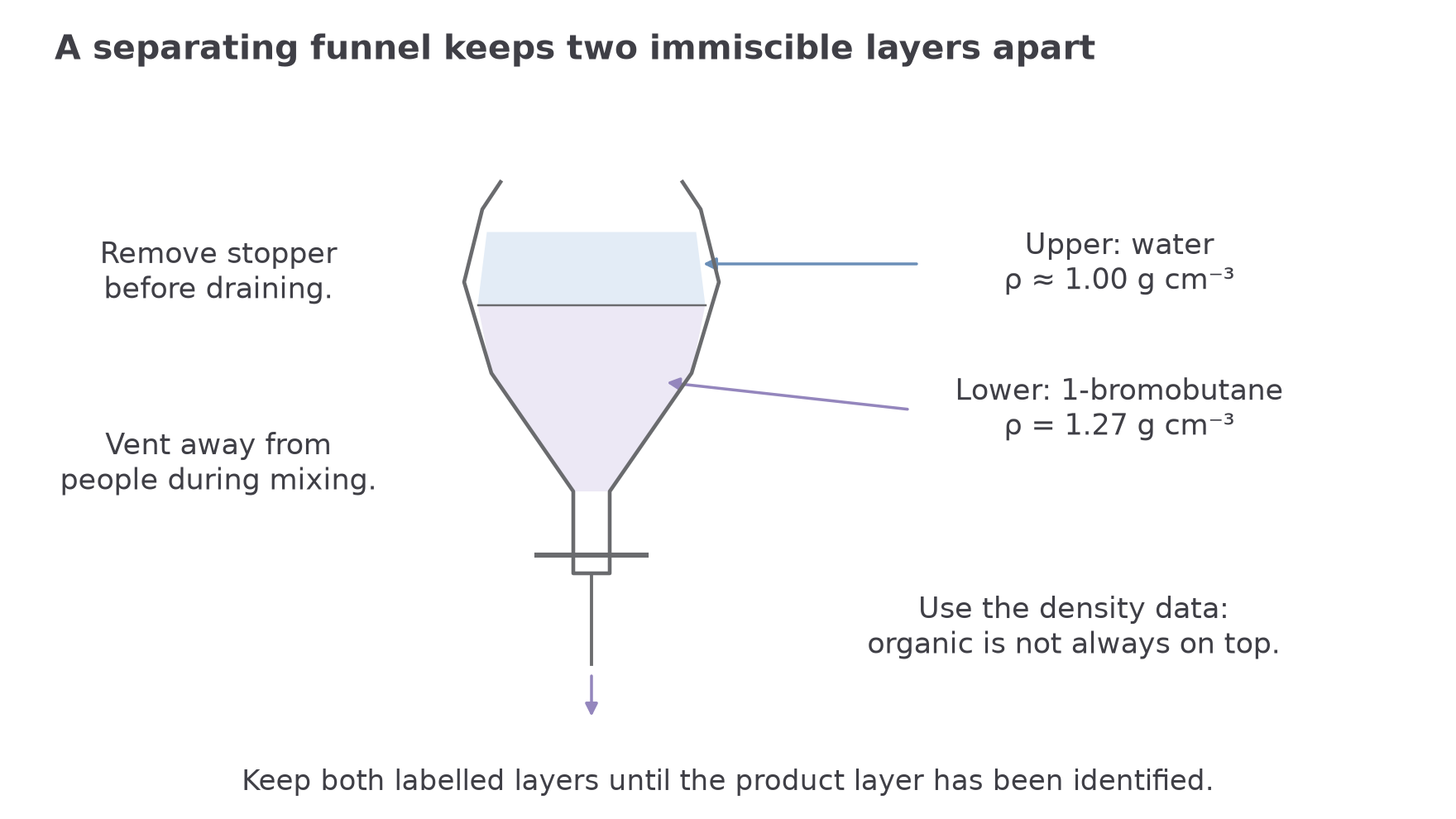
Solvent extraction is used when a compound distributes between two immiscible layers, commonly an organic layer and an aqueous layer. The separating funnel lets the two layers settle and then allows one layer to be drained away. Do not assume the organic layer is always the top layer: density data or the method decides which layer contains the product.
Good separating-funnel technique protects both safety and yield:
- shake gently enough to mix the layers, then allow them to settle
- vent carefully when gas or vapour pressure could build up
- remove the stopper before draining so the liquid flows smoothly
- keep track of which layer is product and which is waste
- repeat small extractions or washes when the method asks for better removal of impurity
Drying means removing unwanted liquid from the product. For an organic liquid, an anhydrous salt such as anhydrous sodium sulfate can remove traces of water before distillation or boiling-temperature measurement. For a solid such as aspirin, suction filtration followed by careful drying removes water or solvent before the crystals are weighed or tested.
Guided practice
For liquid extraction, first close the tap and add the mixture and an immiscible solvent. Stopper, invert and vent away from people; repeat gentle mixing and venting, then allow clear layers to form. Remove the stopper before opening the tap. Drain the lower layer into a labelled vessel and retain both layers until the product layer has been identified. Several small extractions usually recover more product than one extraction using the same total solvent volume, because each fresh portion re-establishes the distribution equilibrium.
To dry an organic layer, add small portions of a compatible anhydrous salt and swirl until some remains freely moving rather than clumping. Decant or filter the liquid away from the drying agent before distillation. Drying salt removes residual water; it does not separate a substantial aqueous layer or remove all organic impurities.
[DIAGRAM: asset_name: Separating funnel with aqueous upper layer and denser 1-bromobutane below, tap and open neck; asset_slug: edexcel_9ch0_separating_funnel; recommended_method: deterministic_chart; description: Separating funnel with aqueous upper layer and denser 1-bromobutane below, tap and open neck]
Common-error contrast
Drying is not the same as heating strongly. Strong heating can melt, decompose or lose volatile product, and it can also leave a misleading mass if solvent is trapped or product is splattered. The correct drying method depends on the product: anhydrous salt for a wet organic liquid, or suitable suction, air drying, desiccation or gentle drying for crystals.
Recrystallising A Solid
Recrystallisation separates a solid product from impurities by exploiting its greater solubility in hot solvent than in cold solvent.
Recrystallisation
Purifying a solid by dissolving it in the minimum volume of hot solvent and letting it crystallise as the solution cools, leaving impurities behind.
It works because many solids are much more soluble in hot solvent than in cold solvent. The desired compound is dissolved in the minimum volume of hot solvent, then allowed to crystallise as the solution cools. Impurities are separated because insoluble impurities can be removed by hot filtration, while soluble impurities tend to remain in the cold solution.
A good solvent for recrystallisation should:
- dissolve the product well when hot
- dissolve the product poorly when cold
- not react with the product
- either dissolve impurities at all temperatures or leave them insoluble enough to filter off
- be reasonably safe and practical under the school method used
The method logic is:
crude solid → dissolve in minimum hot solvent → hot filter if insoluble impurities are present → cool slowly, then in ice if appropriate → collect crystals by filtration → wash with a small volume of cold solvent → dry crystals
The word "minimum" matters. If too much hot solvent is used, more product stays dissolved after cooling, so yield falls. If too little hot solvent is used, some product may never dissolve, so impurities can remain trapped in the solid.
Continue this lesson.
You’re previewing NovaLearn without an account. Create a free account to read the rest.
Create free account