5.12-5.13 - Measurement Uncertainty And Error
Calculate measurement uncertainty and percentage error, distinguish precision from accuracy, and follow each experimental fault through to its effect on the result. Use these ideas to improve practical methods and judge numerical evidence.
What Makes A Result Trustworthy
A student titrates an acid and writes the concentration as . The number looks precise, but an examiner can ask a harder question: how much confidence should we have in it?
A chemical result is only useful when the measurement route is clear. The student has to show what was measured, how uncertain those measurements are, and whether the final result is close to an accepted or expected value.
| Idea | Meaning in a chemistry practical | What you may be asked to do |
|---|---|---|
| Measurement | A value read from apparatus, such as mass, volume, time or temperature | Record it with a unit and suitable significant figures |
| Uncertainty | The range within which a measured value is expected to lie because apparatus and readings are limited | Calculate absolute uncertainty or percentage uncertainty |
| Error | The difference between an experimental result and the true, accepted or expected value | Calculate percentage error or comment on why the result is too high or too low |
| Precision | How close repeated readings are to each other | Use repeats, concordant titres, means or scatter |
| Accuracy | How close the result is to the true or accepted value | Compare with an accepted value and identify systematic effects |
The two formulae to keep separate are:
Percentage uncertainty
The absolute uncertainty has the same unit as the measured value; the result has no unit other than %.
Percentage error
Use only when an accepted or expected value is available.
If the direction matters, keep the sign in words as well as doing the percentage calculation. For example, a measured enthalpy change that is less exothermic than the accepted value may suggest heat loss, even if the percentage error calculation uses the size of the difference.
Common-error contrast
"More decimal places" does not automatically mean "more accurate". Writing cannot remove an uncertain titre, a poorly rinsed pipette, a balance zero error, gas leakage, or heat loss. The final number should reflect the weakest measurement in the route.
Precise is not the same as accurate
Two groups get nearly identical repeat titres but both forgot to rinse the burette with the solution it contains. The titres agree because the same method was repeated consistently. They can still be inaccurate because the solution in the burette was diluted by water left inside it, giving a systematic error that affects every titre in the same direction.
Calculating Measurement Uncertainty
Most uncertainty calculations begin with the apparatus reading. Use the uncertainty given in the question whenever it is supplied. If it is not supplied, use the stated resolution or the conventional reading uncertainty for that apparatus in the context of the question.
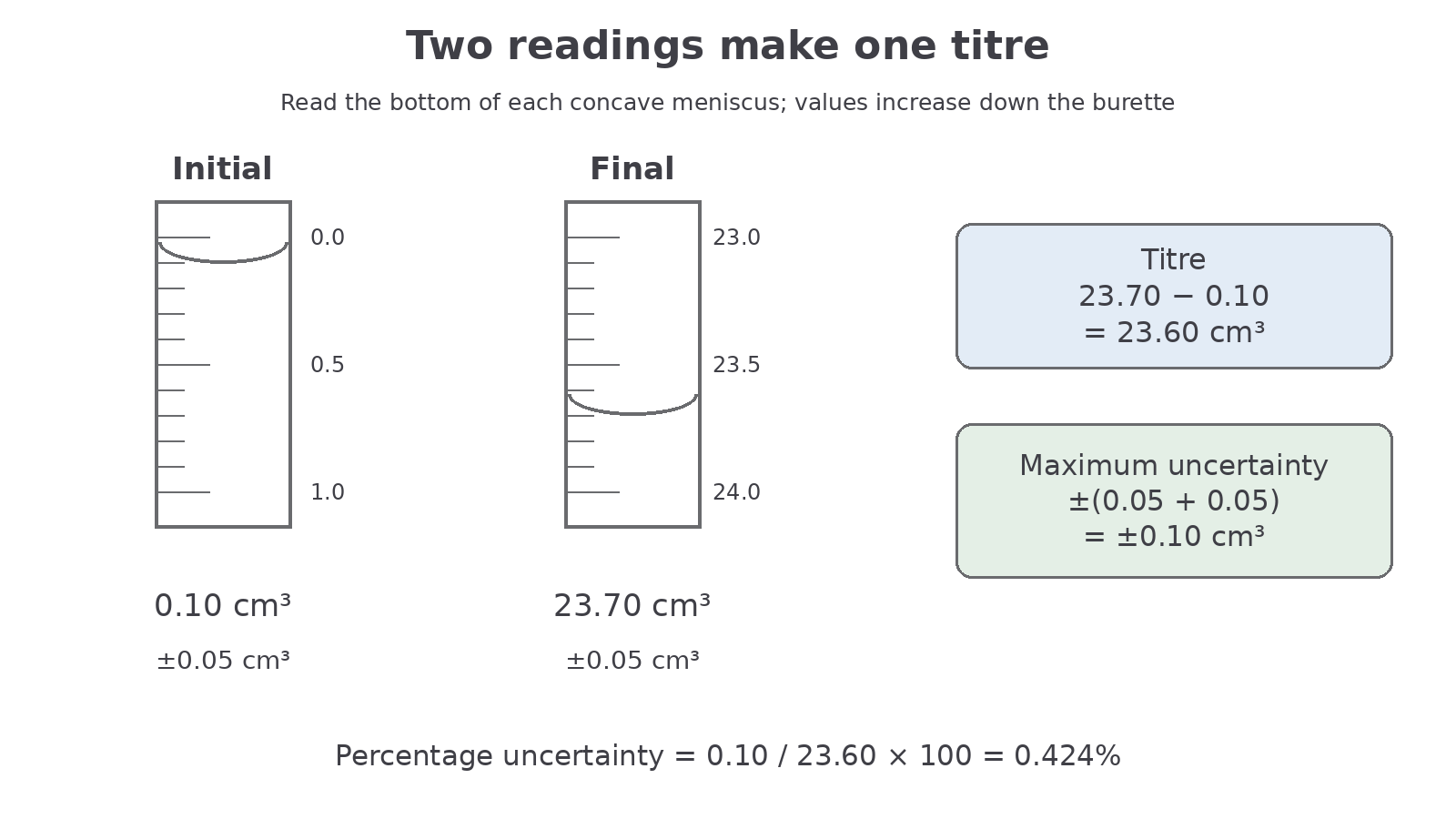
[DIAGRAM: asset_name: Edexcel A Level Chemistry L027 Burette Titre Uncertainty; asset_slug: edexcel_a_level_chemistry_l027_burette_titre_uncertainty; recommended_method: deterministic_code; description: Initial 0.10 and final 23.70 cm3 readings give a 23.60 cm3 titre with maximum uncertainty ±0.10 cm3. Pale 1600 by 900 diagram rendered with Pillow; technical geometry and Unicode chemical labels inspected.]
Core rules
For a single measured value, use the percentage-uncertainty formula above. For a value found by subtraction, add the absolute uncertainties. This is why a burette titre has two reading uncertainties: one from the initial reading and one from the final reading.
Uncertainty of a value found by difference
The same rule applies to a mass found by difference from two balance readings.
These are maximum-uncertainty estimates for this course. A fixed balance zero offset can cancel in a mass difference, whereas independent reading uncertainties still contribute. Use the stated uncertainty model rather than automatically doubling every quoted instrument uncertainty.
For products and quotients, add percentage uncertainties. This is useful when a calculated result depends on several measured quantities, such as concentration from a measured volume and amount.
For repeated direct readings of the same quantity, a question may ask you to use the spread of values. A simple estimate of random uncertainty is often:
Use this only when the data and wording make it appropriate. In many titration contexts, the intended calculation is the apparatus uncertainty in the titre from the two burette readings.
Worked example: burette uncertainty
A titre is found from a burette with readings that each have an uncertainty of .
Initial reading ; final reading ; titre .
The titre uses two readings, so the absolute uncertainty is:
The percentage uncertainty in the titre is:
To a sensible number of significant figures, this is .
Chemical interpretation: the absolute uncertainty is small, but it is not zero. A titre near gives a much smaller percentage uncertainty than a very small titre because the same uncertainty is divided by a larger measured volume.
Worked example: combining measured volumes
A concentration calculation uses:
- a pipette with an uncertainty of
- a titre with an uncertainty of
The percentage uncertainties are:
Pipette:
Titre:
If the final concentration is calculated by multiplying or dividing by these measured volumes, the approximate combined percentage uncertainty from these two measurements is:
Chemical interpretation: the titre contributes more uncertainty than the pipetted volume. If you wanted to improve this method, the evidence points first toward getting a larger, reliable titre or reducing burette reading uncertainty.
Guided practice
The result should not be reported with excessive precision just because the calculator shows many digits. A sensible statement is , with a percentage uncertainty of about .
Commenting On Sources Of Error
A source of error is not just "something went wrong". A strong chemistry comment says what caused the error, whether it is random or systematic, how it affects the measured result, and how the method could be improved.
| Source | Type of effect | Likely consequence | Stronger comment |
|---|---|---|---|
| Judging a meniscus from slightly different eye positions | Random reading error | Titres scatter around the best value | Read at eye level and use concordant repeats |
| Air bubble in the burette jet at the start, then expelled during titration | Systematic effect on that titre | Apparent titre is too high because some delivered volume fills the jet | Remove bubbles before taking the initial reading |
| Burette not rinsed with the solution it contains | Systematic error | Solution in the burette is diluted, changing the titre needed | Rinse the burette with the titrant before filling |
| Wet conical flask in an acid-base titration | Usually no error in moles in the flask | Added water changes concentration but not amount of substance in the aliquot | Do not claim this changes the titre unless a reaction or dilution step changes moles |
| Gas escapes from a gas collection apparatus | Systematic low gas volume | Calculated molar volume or amount of gas is too low | Check airtight seals before starting |
| Heat lost to surroundings in calorimetry | Systematic low temperature change | Magnitude of enthalpy change is underestimated | Insulate, use a lid, record temperature promptly, or use a correction method |
Continue this lesson.
You’re previewing NovaLearn without an account. Create a free account to read the rest.
Create free account