5.6-5.10 - Equations And Stoichiometry
Turn balanced full and ionic equations into reacting amounts, masses and gas volumes. Core Practical 1 applies these relationships to measure the molar volume of a gas and evaluate collection errors.
Equations As Chemical Evidence
A strip of magnesium added to hydrochloric acid fizzes and gets smaller. The observation is useful, but the equation is the claim that explains what changed and what was conserved.
Full equation with state symbols:
The formulae show the species present; the coefficients show the reacting ratio; the state symbols connect the symbols to the practical situation. Here is a solid metal, and are dissolved substances, and is the gas causing the fizzing.
Balanced equations must conserve atoms. Ionic equations go one step further: they show only the species that actually change. In aqueous hydrochloric acid, the chloride ions are spectator ions in this reaction, so the ionic equation is:
This ionic equation is balanced for atoms and charge. The total charge on the left is ; the total charge on the right is also .
A precipitation reaction makes the difference even clearer:
The sodium and nitrate ions remain in solution. The net ionic equation is:
The state symbol (s) earns its place because a solid precipitate forms. Do not write state symbols as decoration: choose them from the chemical situation.
Worked example: write a full and ionic equation
Calcium carbonate reacts with dilute hydrochloric acid to form calcium chloride solution, carbon dioxide and water.
Full equation:
Ionic equation:
Chemical interpretation: carbonate reacts with acid to produce carbon dioxide gas. Chloride ions are present before and after reaction, so they do not appear in the ionic equation.
The Stoichiometry Route
Stoichiometry is the bridge from equation to quantity. The coefficients in a balanced equation are mole ratios, not mass ratios and not volume ratios unless gases are being compared under the same conditions.
[DIAGRAM: asset_name: Edexcel A Level Chemistry L025 Stoichiometry Route; asset_slug: edexcel_a_level_chemistry_l025_stoichiometry_route; recommended_method: deterministic_code; description: Acid amount 0.00400 mol gives 0.00200 mol hydrogen and 48.0 cm3 at rtp via the 2:1 ratio. Pale 1600 by 900 diagram rendered with Pillow; technical geometry and Unicode chemical labels inspected.]
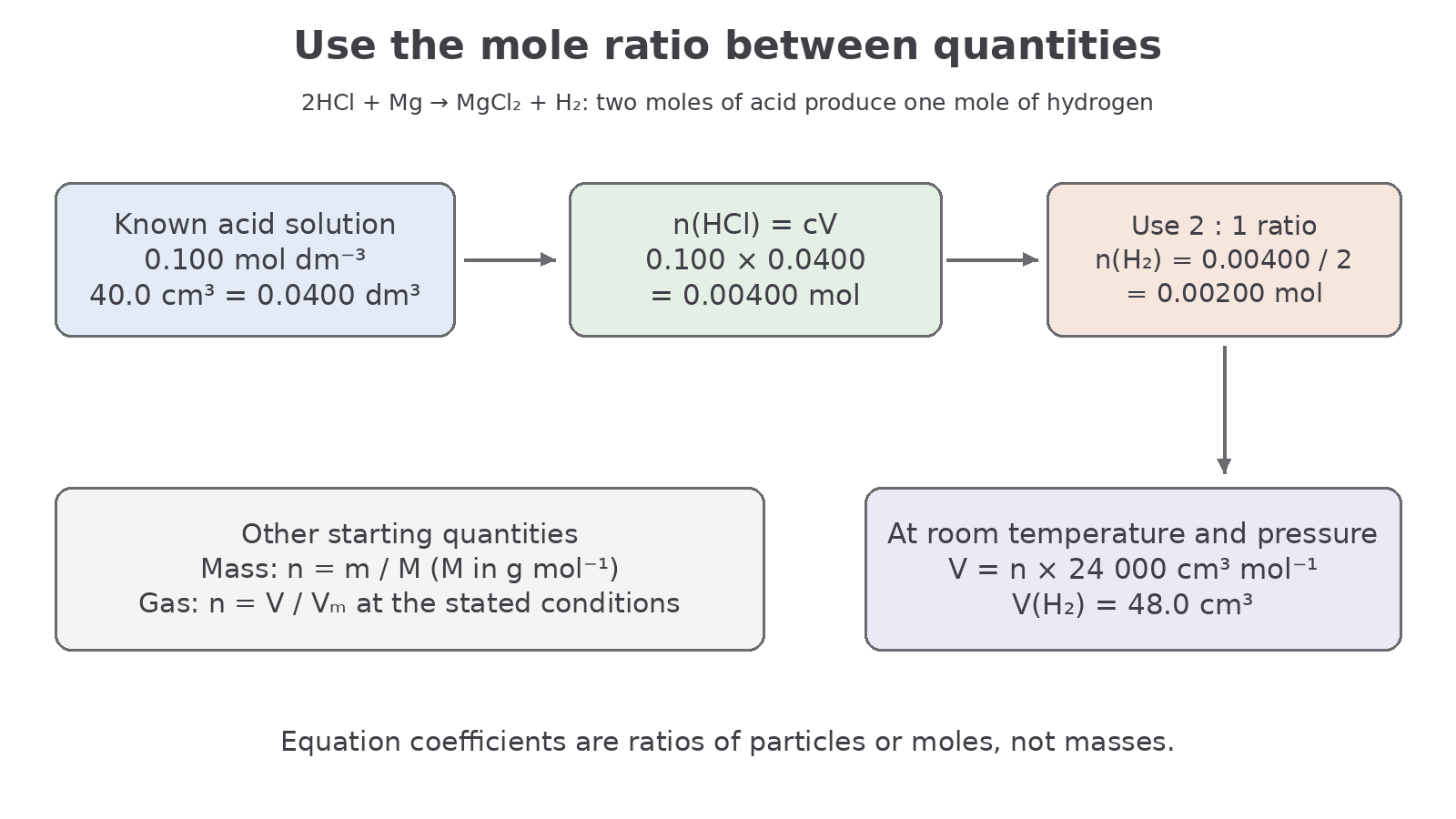
Use the same route every time:
| Stage | Question to ask | Common conversion |
|---|---|---|
| Balanced equation | What is the reacting ratio? | coefficients give mole ratio |
| Known quantity | What data have I been given? | mass, gas volume, solution volume/concentration |
| Convert to moles | How many moles of the known species? | , with in ; at r.t.p.; for solutions |
| Use mole ratio | Which coefficient links known and target species? | multiply or divide by coefficient ratio |
| Target quantity | What unit does the question want? | mol, g, , |
Amount in a solution
= amount in ; = concentration in ; = volume in . Divide a volume in by 1000 first: .
Worked example: solution amount to gas volume
Excess sodium carbonate reacts with of hydrochloric acid:
Calculate the volume of carbon dioxide formed at r.t.p.
Step 1: convert the known solution data to moles of HCl.
Step 2: use the equation ratio.
Step 3: convert moles of gas to volume at r.t.p.
Chemical sense check: the acid amount is small, so a small gas volume is reasonable. The sodium carbonate is in excess, so hydrochloric acid controls the amount of carbon dioxide.
Coefficients link moles, not masses
"The equation has , so I should double the mass of sodium carbonate" is wrong. Coefficients link amounts in moles, so convert the known quantity to moles before using the ratio.
Guided practice
Hydrogen peroxide decomposes:
of hydrogen peroxide decomposes completely. Determine the amount of oxygen formed.
Answer: the ratio gives .
Reacting Masses
Reacting-mass calculations use molar mass to move between grams and moles. The equation ratio still operates in moles, so the route is:
mass of known substance → moles of known substance → moles of target substance → mass of target substance
Worked example: mass of product
Magnesium burns in oxygen:
Calculate the mass of magnesium oxide formed from of magnesium. Use and .
Step 1: find moles of magnesium.
Step 2: use the mole ratio.
The equation ratio is , so the mole ratio is .
Step 3: convert target moles to mass.
Chemical sense check: the product mass is greater than the magnesium mass because oxygen atoms have been added.
Worked example: mass data back to a ratio
If of nitrogen reacts with of hydrogen to form ammonia, calculate the reacting mole ratio of nitrogen to hydrogen.
ratio : = 0.500 : 1.50 = 1 : 3
The ratio supports the equation:
The key point is not "hydrogen has a smaller mass". The key point is that masses must be converted to moles before the reacting ratio can be read.
Common-error contrast
| Tempting error | Why it fails | Correct move |
|---|---|---|
| Use the mass ratio directly | Coefficients compare particles or moles, not grams | convert each mass to moles first |
| Round too early to | Early rounding can move the final answer | keep extra figures until the end |
| Ignore the balanced equation | The target may not be in a ratio | use coefficients after converting to moles |
Reacting Gas Volumes
Gas-volume questions have two related ideas.
First, equal moles of gases occupy equal volumes at the same temperature and pressure. That means gas volumes can be compared directly using equation coefficients, but only when all the gases are measured under the same conditions.
Second, at room temperature and pressure, one mole of any gas occupies (data value).
Gas volume at r.t.p.
= gas volume in at room temperature and pressure; in . For volumes in use .
Worked example: gas-volume ratio at the same conditions
Nitrogen and hydrogen react to form ammonia:
At the same temperature and pressure, calculate the volume of hydrogen needed to react with of nitrogen, and the volume of ammonia formed.
The gas volume ratio is the same as the mole ratio:
: : = 1 : 3 : 2
Therefore:
Chemical sense check: hydrogen is required in the largest volume because its coefficient is largest.
Gas volumes back to an equation
At the same temperature and pressure, of nitrogen monoxide reacts with oxygen to form nitrogen dioxide. Divide by 10.0 to get , then check atoms:
Use volumes actually consumed or formed, not the whole amount of an excess gas. A liquid formed after cooling cannot be included in the same gas-volume ratio.
Continue this lesson.
You’re previewing NovaLearn without an account. Create a free account to read the rest.
Create free account