12.11-12.13 - Kw, pKa And Strong-Base pH
Water links hydrogen and hydroxide ion concentrations through its ionic product. Use that link to calculate strong-base pH, account for hydroxide stoichiometry and interpret pKa and pKw.
Water Sets The pH Scale
A bottle labelled "pure water" is not a bottle with absolutely no ions. A tiny fraction of water molecules form hydrogen ions and hydroxide ions, and at a fixed temperature those ion concentrations are linked by an equilibrium expression.
The simplified reversible change is:
In reality, is a shorthand for hydrated hydrogen ions in water. calculations use the shorthand , so the important expression is:
Ionic product of water, \(K_{\mathrm w}\)
Concentrations in , so is in . Constant at a fixed temperature; at 298 K.
[DIAGRAM: asset_name: Water Ion Product Particles; asset_slug: edexcel_a_level_chemistry_l055_water_ion_product_particles; recommended_method: deterministic_chart; description: Pale-background colour beaker and particle zoom showing many water molecules with rare positive and negative ions to support the ionic product of water model.]
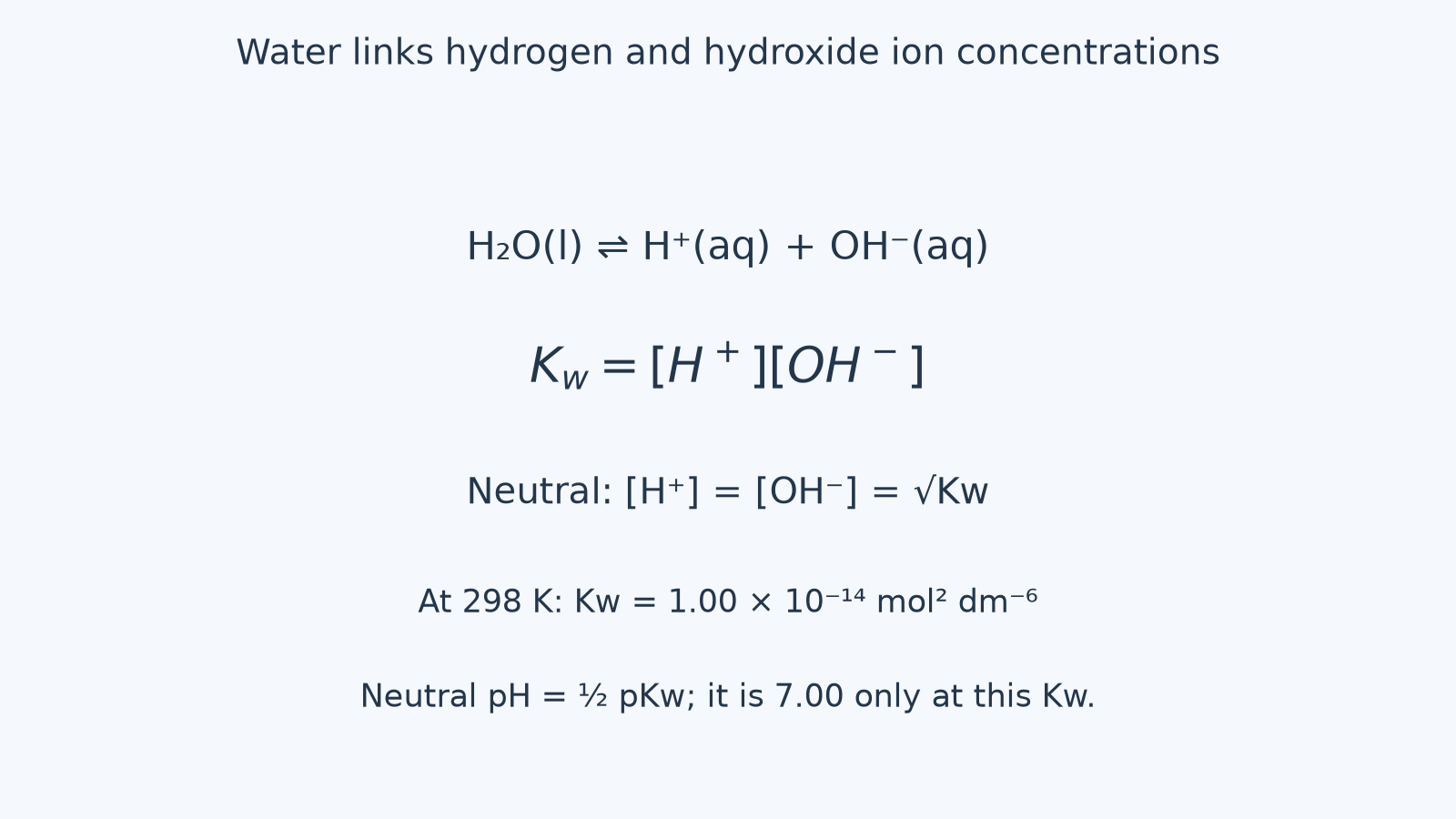
At 25 (298 K), the data value used unless another value is supplied is:
In pure water, the two ions form in equal amounts, so:
That gives:
This is why neutral pure water has 7 under these conditions. Neutral does not mean "no ions"; it means equal hydrogen ion and hydroxide ion concentrations. At another temperature the neutral is /2, so neutral water need not have 7.
Alkaline solutions still contain H⁺
Adding a base does not make zero. Water still has an ionic product: if becomes larger, becomes much smaller so that still equals at that temperature.
From Strong Base Concentration To pH
A strong base is treated as fully dissociated in aqueous solution. For sodium hydroxide:
So, for , the hydroxide ion concentration is also:
The is not found by doing . That would give . To calculate using , first find .
Use this route:
- Find from the strong base concentration and formula.
- Use .
- Rearrange: .
- Calculate .
Worked example: of sodium hydroxide
Calculate the of .
For sodium hydroxide, one formula unit gives one hydroxide ion:
Use :
Now calculate :
Keep the unrounded calculator value until the final logarithm. These strong-base routes assume the hydroxide concentration is large enough for water’s own ionisation to be negligible.
The chemical sense-check is that this is a strongly alkaline solution, so the should be above 7. The is tiny, but it is not zero.
Alternative check using
You may also see the route:
For this example:
That shortcut works here because for . The route is safer because it shows where the relationship comes from.
Get Hydroxide Concentration First
Strong-base questions often hide one decision before the logarithm: the concentration of the base is not always the same as the concentration of hydroxide ions.
For a dissolved Group 1 hydroxide:
gives .
For a dissolved Group 2 hydroxide:
gives .
If a question gives the concentration of a strong base solution, read the formula before using .
Worked example: of barium hydroxide
Calculate the of .
First convert base concentration into hydroxide ion concentration:
Now use :
Then:
The answer is higher than for a one-hydroxide base because the solution contains twice as many hydroxide ions per mole of dissolved base.
Common-error contrast
Weak route:
That answer is acidic, so it fails the chemical sense-check. It also used the base concentration as if it were .
Stronger route: find from the base formula, use to find , then calculate .
Dilution changes hydroxide concentration before any logarithm is taken. For example, 20.0 cm³ of a dissolved hydroxide made up to 100.0 cm³ has one fifth of its initial concentration. First apply , then multiply by the number of hydroxide ions per formula unit.
Continue this lesson.
You’re previewing NovaLearn without an account. Create a free account to read the rest.
Create free account