6D.30-6D.32 - Halogenoalkane Reactions
Replacing a halogen can make an alcohol, a nitrile or an amine; removing it together with a neighbouring hydrogen makes an alkene. Learn to classify the starting molecule and choose the reagent, solvent and attacking species for each route.
Classifying The Carbon Attached To X
A halogenoalkane contains a carbon-halogen bond, written generally as , where is usually , or . The classification does not depend on the whole molecule; it depends on the carbon atom directly bonded to the halogen.
| Classification | Carbon bonded to halogen is also bonded to | Example | Reason |
|---|---|---|---|
| Primary | one other carbon atom | the carbon is at the end of the chain | |
| Secondary | two other carbon atoms | the carbon is in the middle of the chain | |
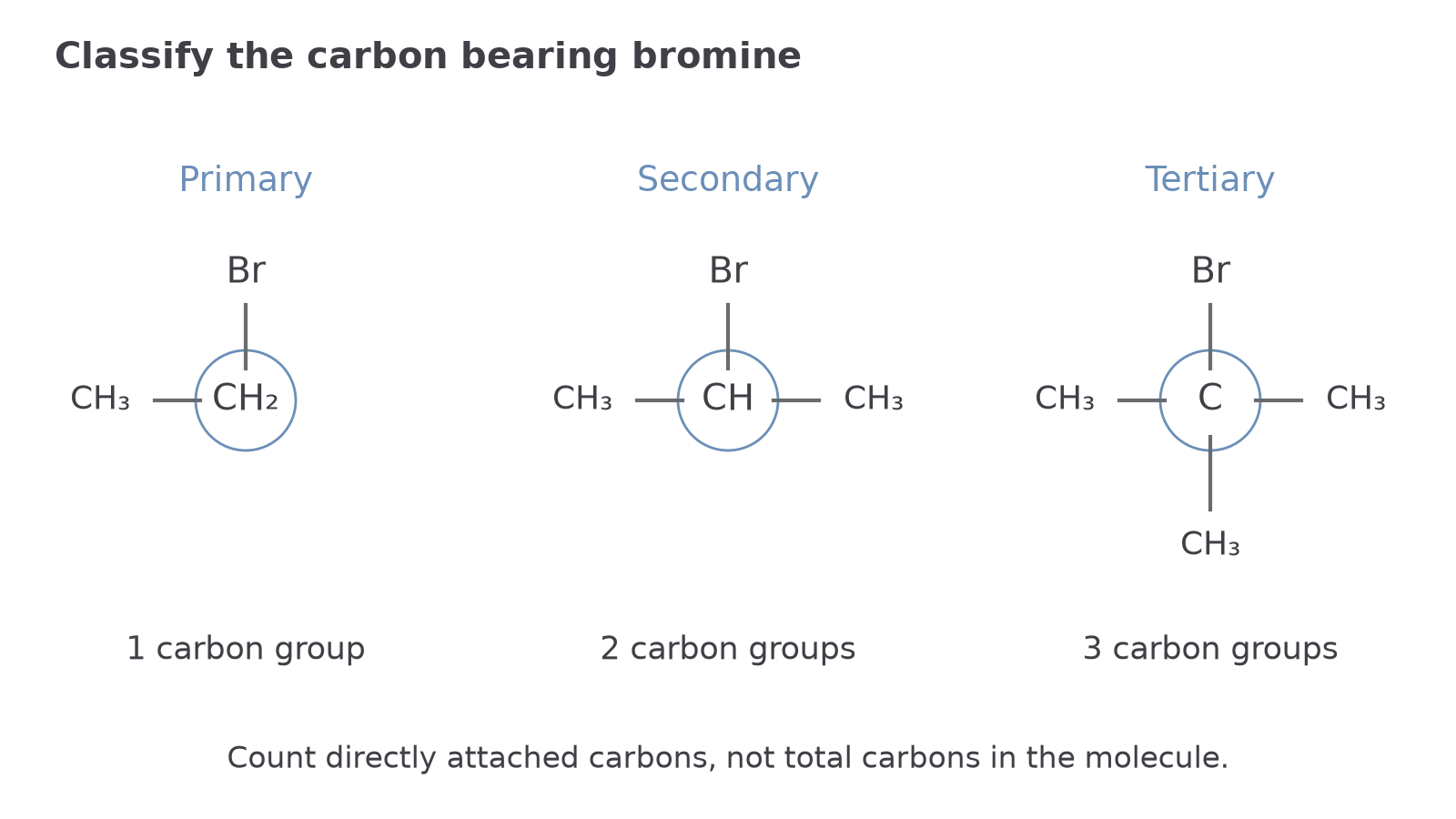
| Tertiary | three other carbon atoms | the carbon is attached to three carbon groups |
The common error is to classify by the halogen itself or by the longest chain. Instead, circle the carbon attached to , then count how many carbon atoms are directly bonded to that carbon.
Worked classification:
is a secondary halogenoalkane. The carbon bearing is bonded to the group on one side and the group on the other side, so it is bonded directly to two carbon atoms.
[DIAGRAM: asset_name: Halogenoalkane Carbon Classes; asset_slug: organic_halogen_classes; recommended_method: deterministic_chart; description: Primary, secondary and tertiary bromoalkanes: count the carbon groups directly attached to the carbon bearing bromine.]
Nucleophiles And The Polar C-X Bond
The carbon–halogen bond creates an electron-deficient carbon that can accept a lone pair from a reagent.
Nucleophile
An electron-pair donor.
A nucleophile is attracted to an electron-deficient atom and uses an available electron pair, usually a lone pair, to form a new covalent bond.
Halogenoalkanes are vulnerable to nucleophiles because the halogen is more electronegative than carbon. The bond is polar: the carbon is and the halogen is . That makes the carbon atom attached to the halogen an electrophilic site, so electron-rich species can attack it.
Useful nucleophiles in this lesson:
| Species | Why it can act as a nucleophile | Reaction in this lesson |
|---|---|---|
| negative ion with lone pairs on oxygen | substitution with aqueous | |
| lone pairs on oxygen, even though the molecule is neutral | reaction with aqueous silver nitrate in ethanol | |
| negative ion with a lone pair; carbon end forms the new bond | substitution with potassium cyanide | |
| lone pair on nitrogen | substitution to make a primary amine |
Nucleophile is a role, not a permanent label. acts as a nucleophile in aqueous potassium hydroxide, but as a base in ethanolic potassium hydroxide. The condition changes the main reaction pathway.
Neutral molecules can be nucleophiles
Ammonia can be a nucleophile even though it has no negative charge: the nitrogen atom in has a lone pair that can be donated to an electron-deficient carbon; negative charge often helps, but it is not required for nucleophilic behaviour.
Substitution To Alcohols
Warm or heat the halogenoalkane with aqueous potassium hydroxide to form an alcohol; reflux allows longer heating without losing volatile reactants. The hydroxide ion acts as a nucleophile and replaces the halide ion.
General ionic equation:
Example with bromoethane:
The condition aqueous matters. In water, hydroxide ions are well placed to donate a lone pair to the carbon and substitute the halogen. In explanations, do not just name the reagent; state the role of and the product functional group.
Common-error contrast:
| Prompt | Strong answer | Tempting but weak answer |
|---|---|---|
| What forms when 1-bromopropane is heated with aqueous ? | propan-1-ol, by substitution of by | "an alkene", which would need ethanolic as the main condition |
| What is the role of here? | nucleophile / electron-pair donor | "catalyst", because is consumed in the substitution equation |
Water As Nucleophile With Silver Nitrate
Aqueous silver nitrate in ethanol gives another hydrolysis route. In this reaction mixture, water acts as the nucleophile and substitutes the halogen to form an alcohol. The released halide ion then reacts with silver ions to form a silver halide precipitate.
The organic change can be represented as:
The observation-forming step is:
For bromoethane:
Ethanol helps the organic halogenoalkane mix with the aqueous reagent. Silver ions remove halide ions as a precipitate, so the appearance of is evidence that has been released.
The silver halide is white for chloride, cream for bromide and yellow for iodide. This observation follows release of the halide; silver nitrate does not replace the halogen in the organic molecule.
New Functional Groups From Cyanide And Ammonia
Potassium cyanide and ammonia both substitute the halogen, but the synthetic consequence is different.
Continue this lesson.
You’re previewing NovaLearn without an account. Create a free account to read the rest.
Create free account