6B.15-6B.17 - Radicals And Alkane Substitution
Light can start a chain reaction in which halogens replace hydrogen atoms in alkanes. Follow the electrons through initiation, propagation and termination, then use the mechanism to explain why a synthesis produces a mixture.
Alkane Bonds And Photochemical Reactivity
Imagine two sealed tubes containing methane and chlorine. One is kept in the dark; the other is exposed to ultraviolet light. The dark tube changes very little, but the UV tube can lose the green colour of chlorine and form hydrogen chloride and chlorinated organic products.
That observation creates the key question of this lesson: why does a saturated alkane react with a halogen only when light starts a different kind of pathway?
Alkanes contain strong and single bonds. These bonds are almost non-polar because carbon and hydrogen have similar electronegativities, so alkanes do not usually attract nucleophiles or electrophiles strongly. Their important reactions in this part of the specification are therefore not ordinary polar mechanisms:
| Alkane reaction | What changes | Main reasoning model |
|---|---|---|
| combustion with oxygen in air | and bonds are replaced by bonds in and | oxidation and energy release |
| substitution with halogens | one or more H atoms are replaced by halogen atoms | radicals formed by homolytic fission |
Substitution means replacement. In the simplest chlorination of methane, one hydrogen atom in methane is replaced by one chlorine atom:
This overall equation is useful, but it hides the real chemistry. The overall equation does not describe a single collision or elementary step. It proceeds through radical particles in a chain reaction.
Reading a photochemical comparison
In a small-scale comparison using the same alkane and a few drops of dilute bromine solution, colour loss under ultraviolet light shows bromine being consumed in substitution. A dark control tests the need for radical initiation. The hydrogen bromide produced gives acidic conditions in moisture and can turn damp blue litmus red. Such observations are handled in a fume cupboard to reduce inhalation of bromine vapour and hydrogen bromide; use appropriate shielding against ultraviolet exposure and follow the practical risk assessment. Do not identify a gas by smelling it.
Common-error contrast
"Alkanes are saturated" means they have no carbon-carbon multiple bonds. It does not mean "alkanes never react." Saturation explains why they do not undergo alkene-style addition, but combustion and radical substitution are still important alkane reactions.
Radicals And Homolytic Fission
A covalent bond contains a pair of shared electrons; splitting the pair equally produces two reactive species.
Radical
A species with an unpaired electron.
In mechanisms for this lesson, the unpaired electron is represented by a single dot, for example for a chlorine radical.
Radicals are formed when a covalent bond breaks by homolytic fission.
Homolytic fission
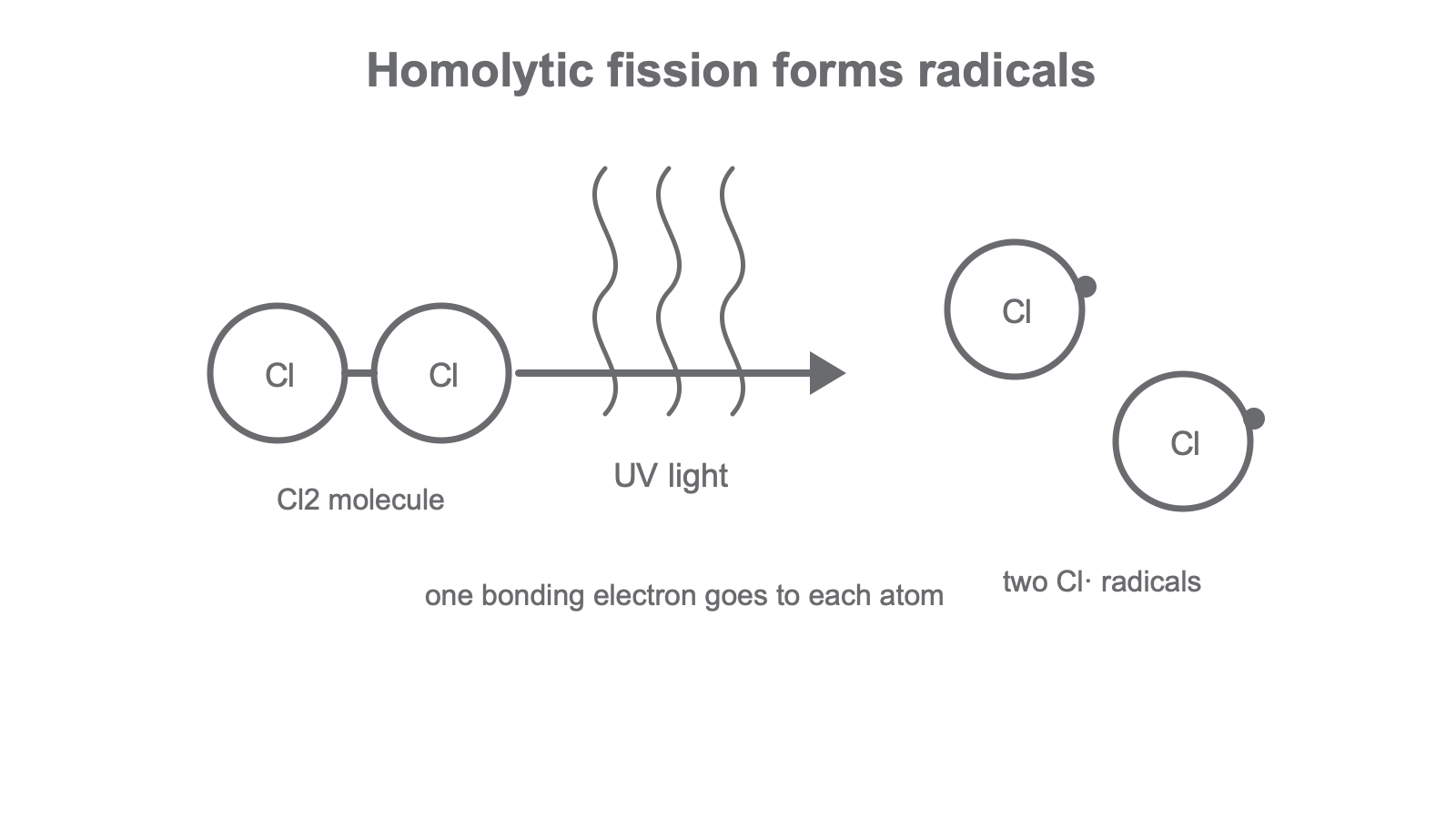
Breaking of a covalent bond in which each bonded atom takes one electron from the shared pair, forming two radicals.
This is different from heterolytic fission, where both bonding electrons go to one atom and ions are formed.
[DIAGRAM: asset_name: Homolytic Fission Radical Pair; asset_slug: edexcel_a_level_chemistry_l031_homolytic_fission_radical_pair; recommended_method: deterministic_chart; description: Monochrome schematic showing ultraviolet light causing a chlorine molecule to split by homolytic fission into two chlorine radicals, each with one unpaired electron dot.]
For chlorine:
For bromine:
The energy needed for this bond breaking is commonly supplied by ultraviolet light. Curly half-arrows are not expected for this mechanism, so the key notation is the radical dot plus correct initiation, propagation and termination equations.
Worked example: recognising homolytic fission
Question: Explain why this equation represents homolytic fission.
The bond is a covalent bond containing two shared electrons. The equation forms two identical bromine radicals, each shown with a single dot. That means each bromine atom has taken one electron from the original bond, so the bond has broken homolytically.
The chemical interpretation is that radicals are not ions. A bromine radical is neutral overall, but it is very reactive because it has an unpaired electron.
Guided practice
Choose the equation that shows homolytic fission, and give the reason.
A
B
C
Answer: B. It shows one covalent molecule forming two radicals, so each atom has taken one electron from the broken covalent bond. A shows heterolytic fission into ions. C is the overall substitution equation, not the bond-breaking initiation step.
A radical is defined by its unpaired electron
"A radical is a charged particle" is the wrong shortcut: it confuses "very reactive" with "ionic". A radical has an unpaired electron; it may be neutral, like , or charged in other contexts, but charge is not what defines it.
Combustion With Oxygen In Air
The first alkane reaction here is combustion with oxygen in air. The oxygen is the reacting gas; nitrogen in air is mostly a spectator for the simple combustion equation, although high-temperature pollutant chemistry was treated in the previous lesson.
In complete combustion, an alkane reacts with excess oxygen to form carbon dioxide and water:
alkane + oxygen → carbon dioxide + water
For methane:
Use a reliable balancing route:
- Balance carbon atoms by making the correct number of molecules.
- Balance hydrogen atoms by making the correct number of molecules.
- Count oxygen atoms on the product side.
- Put the required number of molecules on the reactant side.
- If a fraction appears, multiply the whole equation to remove it.
Worked example: complete combustion of pentane
Write the balanced equation for complete combustion of pentane, .
Start with the unbalanced skeleton:
Balance carbon:
Balance hydrogen. Twelve H atoms need six water molecules:
Now count oxygen atoms on the right:
contains 10 O atoms and contains 6 O atoms, so the products contain 16 O atoms in total.
So eight oxygen molecules are needed:
The chemical sense check is that all carbon atoms are fully oxidised to and all hydrogen atoms end up in water.
If oxygen is limited, incomplete combustion can form carbon monoxide or carbon particulates as well as water. For example:
The previous lesson covers pollutant consequences in detail. Here the essential point is that changing the oxygen supply changes the carbon-containing products.
Continue this lesson.
You’re previewing NovaLearn without an account. Create a free account to read the rest.
Create free account