15B.20-15B.23 - Vanadium And Chromium Redox
Follow vanadium and chromium through oxidation states using colour, balanced half-equations and electrode potentials. Distinguish redox changes from the chromate–dichromate acid–base equilibrium.
Colour As Redox Evidence
A useful transition-metal demonstration begins with an acidified yellow vanadium(V) solution. Add a reducing agent such as zinc, and the solution can pass through blue, green and violet stages. The colours are not decoration: each colour is evidence that electrons have changed the oxidation state of vanadium.
The vanadium colours to recall are:
| Oxidation state of vanadium | Common aqueous species in this topic | Colour to know |
|---|---|---|
| +5 | yellow | |
| +4 | blue | |
| +3 | green | |
| +2 | violet |
The formulas also show why oxidation state bookkeeping is needed. In , the two oxide ligands contribute overall and the ion charge is , so vanadium must be . In , oxygen contributes and the ion charge is , so vanadium is .
This lesson will also use typical chromium observations: dichromate(VI), , is orange; chromate(VI), , is yellow; solutions are commonly green; and solutions are commonly blue and easily oxidised by air. Those chromium colours help interpret the chemistry, but the specification's direct colour-recall demand is the vanadium sequence above.
Common-error contrast. A colour change in a transition-metal solution may come from a change in oxidation state, ligand or coordination number. In this lesson the vanadium yellow-blue-green-violet sequence is tied to oxidation state changes; the ligand-exchange and precipitate tests are the next lesson's job.
During vanadium reduction, a temporary green appearance can also be a mixture of yellow V(V) and blue V(IV). Use the sequence, reducing conditions and electrode-potential evidence together; colour alone does not prove a pure V(III) solution.
Using Standard Electrode Potentials
Standard electrode potentials are written as reductions. A more positive value means the oxidised species on the left of the reduction half-equation has a greater tendency to accept electrons under standard conditions.
For a redox reaction made from two half-equations:
Equivalently, add the reduction potential for the species being reduced to the oxidation potential for the species being oxidised. If is positive, the reaction is thermodynamically feasible under standard conditions. It may still be slow, or affected by concentration and , so predicts feasibility rather than guaranteed rapid reaction.
Do not multiply values when balancing electrons. Electrode potentials are not enthalpy changes; use the tabulated value for the half-cell, even if the half-equation has been scaled to cancel electrons.
The relevant Data Booklet reductions are:
| Reduction half-equation | |
|---|---|
Notice the acid terms in several half-equations. For example, reducing to consumes , and reducing dichromate(VI) consumes a large amount of . That is why "acidic conditions" is not a spare word in these reactions; it fixes which species and potentials are relevant.
Worked example: can zinc reduce to ?
Keep the vanadium half-equation as a reduction:
—
Zinc must be oxidised, so compare it with its reduction potential:
—
Now calculate:
The positive value predicts that zinc can reduce to under standard conditions. Chemically, zinc atoms lose electrons to form ; vanadium(III) ions gain those electrons to form vanadium(II).
A negative E° does not mean "cannot react"
The listed zinc value is for the reduction . In these reactions zinc metal is oxidised, so that half-equation is reversed. Pairing zinc oxidation with a more positive reduction half-equation can give a positive .
The Vanadium Redox Ladder
The vanadium sequence is easiest to learn as a ladder. Reduction moves down the oxidation states from +5 to +2; oxidation moves back up the ladder. The electrons and acid terms show the chemistry behind the colour sequence.
[DIAGRAM: asset_name: Acidic vanadium reduction colour ladder with distinct oxovanadium formulas; asset_slug: edexcel_a_level_chemistry_l072_vanadium_ladder; recommended_method: deterministic_chart; description: Acidic vanadium reduction colour ladder with distinct oxovanadium formulas.]
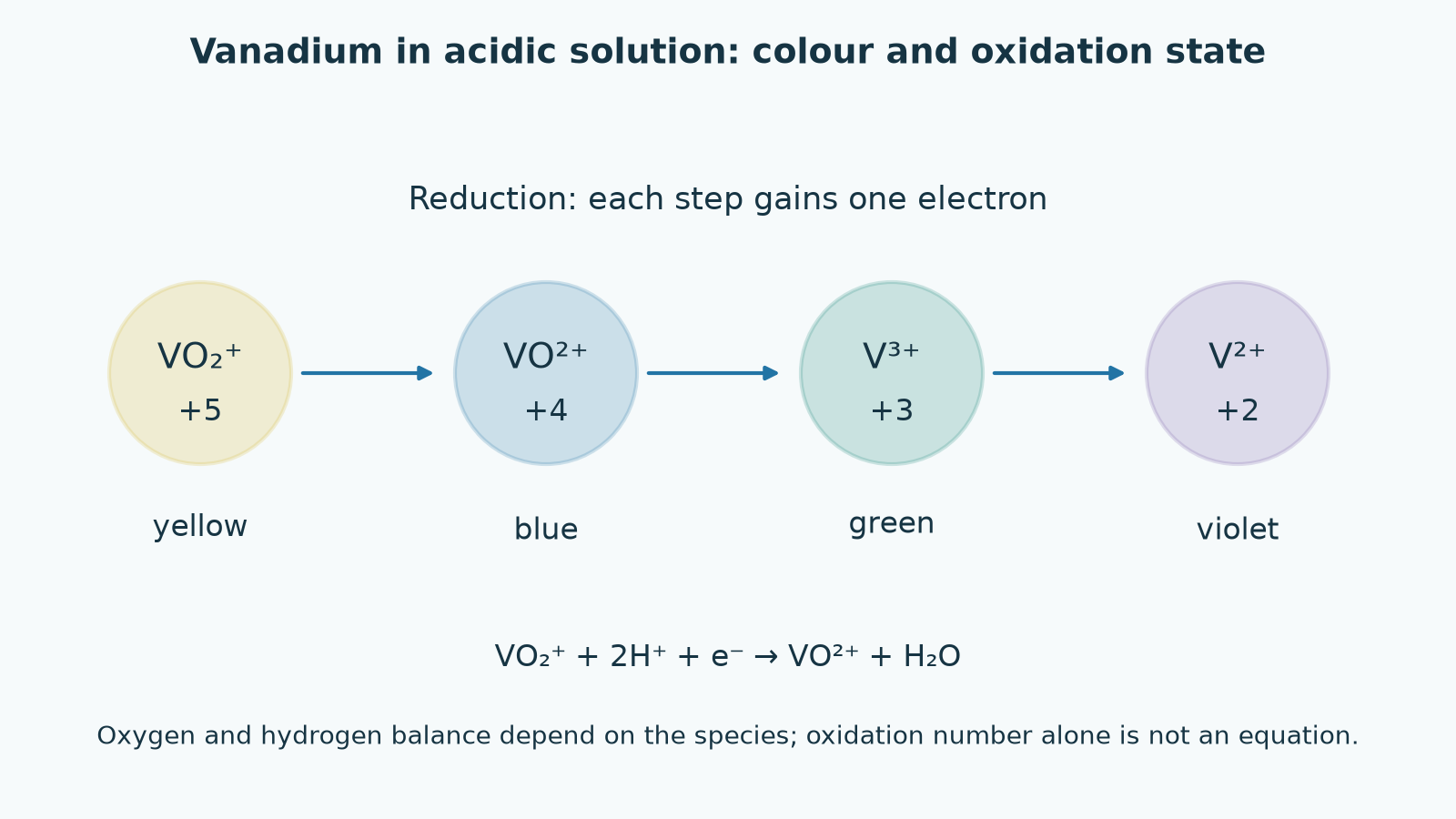
| Oxidation state | Species | Colour |
|---|---|---|
| V(V) | yellow | |
| ↓ | ||
| V(IV) | blue | |
| ↓ | ||
| V(III) | green | |
| ↓ | ||
| V(II) | violet |
The stepwise reductions are:
yellow — blue
blue — green
green — violet
With zinc as the reducing agent, all three steps are predicted to be feasible:
| Vanadium reduction step | with |
|---|---|
| to | |
| to | |
| to |
For the blue-to-green stage with zinc, combining two vanadium reductions with one zinc oxidation gives . Both atoms and total charge balance, and no electrons remain in the overall equation.
This explains why an acidified vanadium(V) solution can be reduced step by step. The observed colour is a quick check on which region of the ladder the mixture has reached.
Continue this lesson.
You’re previewing NovaLearn without an account. Create a free account to read the rest.
Create free account