6C.25-6C.29 - Alkene Tests And Polymers
An alkene double bond provides both a chemical test and a route to addition polymers. Learn to translate monomers into repeat units, then compare recycling, cracking, incineration and biodegradable materials using evidence across a product’s life cycle.
Testing For A C=C Double Bond
Two clear liquid hydrocarbons look similar. One is an alkane and one is an alkene. If a few drops of orange bromine water are shaken with each sample away from ultraviolet light, one mixture rapidly loses the orange colour while the other stays orange.
The decolourised sample contains a C=C double bond. Bromine or bromine water is the qualitative test required here: an alkene decolourises orange/brown bromine solution because bromine adds across the double bond. An alkane does not rapidly decolourise bromine water under these test conditions.
What the test proves
The alkene has a sigma bond and a pi bond between the two carbon atoms. The pi bond has electron density exposed above and below the axis, so it can react with bromine. In a simple symbolic addition reaction, the C=C bond becomes a single bond and one bromine atom attaches to each of the two carbon atoms:
(ethene + bromine → 1,2-dibromoethane)
For the qualitative test, the key evidence is the observation and conclusion:
- observation: orange/brown bromine water is decolourised
- conclusion: a C=C double bond is present
Do not overclaim from the test. It is evidence for a carbon-carbon double bond in the context of alkene chemistry; it does not identify the full structure or the position of the double bond by itself.
Practical reasoning
Use small quantities and follow the risk assessment for bromine or bromine water. Bromine is hazardous and volatile, so eye protection, controlled volumes and avoiding inhalation matter. The test should be read from the change in the bromine colour, not from the colour of the organic liquid before mixing.
Worked example: identifying the alkene
Question: A student adds bromine water separately to hexane and hex-1-ene. One sample changes from orange to colourless. Deduce which sample is hex-1-ene and give the reason.
Model answer: the sample that decolourises bromine water is hex-1-ene. Hex-1-ene contains a C=C double bond, so bromine adds across the double bond and the orange colour disappears. Hexane is saturated and does not rapidly decolourise bromine water under these conditions.
Chemical interpretation: the observation is not just "a colour change happened"; it is a test result linked to the presence of a reactive double bond.
How Alkenes Make Addition Polymers
The two carbons of each alkene double bond can join neighbouring monomers to build a long backbone.
Addition polymerisation
The joining of many alkene monomer molecules by opening their C=C bonds, forming a single polymer product with no other product.
Each alkene monomer opens its C=C double bond and forms new single bonds to neighbouring monomers. The polymer chain contains the atoms from the monomers; no small molecule is eliminated.
For ethene:
Monomer
The small molecule that joins repeatedly to form a polymer.
Repeat unit
A structural unit whose repetition represents the polymer chain. For an addition polymer from a simple alkene, show both carbons from the original C=C bond and all their side groups.
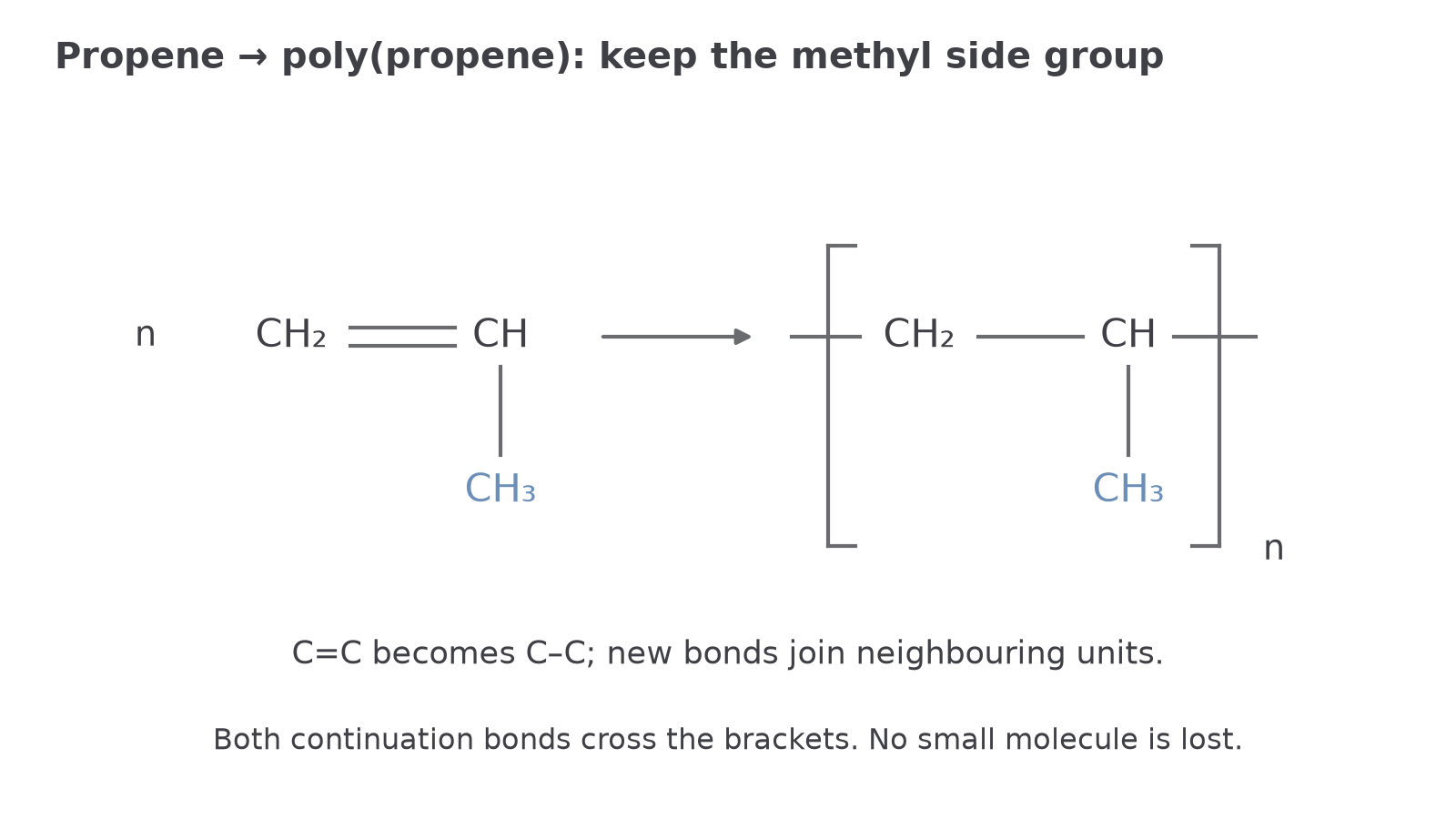
In a drawn repeat unit, brackets show the repeating section, bonds pass through both brackets to show the chain continues, and shows that the unit is repeated many times.
Addition polymerisation keeps the same atoms from the monomers in the polymer chain. The double bond is used to make new single bonds between monomer units:
alkene double bonds used up → saturated polymer backbone
This is different from a condensation process, where a small molecule such as water or hydrogen chloride is lost. Condensation polymers are taught later in the course; for this lesson, the key point is that alkenes form polymers by addition.
Worked example: propene to poly(propene)
Propene is . The two double-bond carbons become neighbouring carbon atoms in the polymer backbone, and the group stays attached to the same carbon:
The repeat unit is .
Chemical interpretation: the methyl side group is not lost and it does not become part of the main chain unless the displayed structure shows it as one of the double-bond carbons. The C=C bond is the reactive feature; the side group is carried along into every repeat unit.
Common-error contrast
Do not copy the C=C double bond into the polymer repeat unit. The monomer contains ; the addition polymer backbone contains single bonds. If the repeat unit still shows a double bond between the two original alkene carbons, the bond-opening step has not been represented.
[DIAGRAM: asset_name: Propene And Its Repeat Unit; asset_slug: organic_propene_polymer; recommended_method: deterministic_chart; description: Propene forms poly(propene): two alkene carbons become the backbone, methyl remains a side group, and continuation bonds cross the brackets.]
Converting Between Monomer And Repeat Unit
Questions often give either the monomer or the polymer repeat unit and ask for the other. The safest method is to track the two carbon atoms that were originally in the C=C bond.
Use this route:
- Find the C=C bond in the monomer.
- Replace the C=C with a single bond.
- Keep every atom or group attached to each double-bond carbon.
- Put the two backbone carbons inside brackets.
- Show continuation bonds through the brackets and add .
Example with chloroethene:
Monomer ; repeat unit .
The polymer is poly(chloroethene), also commonly called PVC.
From repeat unit to monomer
Use the reverse route:
- Identify the two carbon atoms in the polymer backbone inside one repeat unit.
- Remove the continuation bonds at the ends of the repeat unit.
- Put a C=C double bond between those two carbon atoms.
- Keep the side groups on the same carbon atoms.
Example:
Repeat unit ; monomer .
The monomer is propene.
Worked example: tetrafluoroethene
Question: Tetrafluoroethene has structure . Draw or write the repeat unit of its addition polymer.
Model answer:
The polymer is poly(tetrafluoroethene), often abbreviated to PTFE.
Chemical interpretation: each carbon in the repeat unit still has two fluorine atoms attached. The only change needed for the repeat unit is that the C=C bond becomes a single bond and the chain continues at both ends.
Separating Waste Polymers For Different Routes
Waste polymers are not all treated in the same way. Separating waste into specific polymer types makes recycling, energy recovery and cracking easier to control.
Sorting matters because different polymers have different softening temperatures, additives, densities, decomposition products and uses after processing. A mixed plastic stream can give a weak recycled material, contaminate a cracking feedstock, or produce a mixture of waste gases during incineration.
Continue this lesson.
You’re previewing NovaLearn without an account. Create a free account to read the rest.
Create free account