5.14-5.16 - Yield, Atom Economy And Practical Evidence
Compare percentage yield with atom economy, using balanced equations and experimental masses. Link test-tube observations to full and ionic equations, then choose precautions that address the risks of the actual procedure.
Comparing Yield And Atom Economy
A reaction can disappoint a chemist in two different ways. It might make less of the desired product than the balanced equation predicts, or it might make the desired product while also sending many atoms into unwanted products.
[DIAGRAM: asset_name: Edexcel A Level Chemistry L028 Yield Vs Atom Economy; asset_slug: edexcel_a_level_chemistry_l028_yield_vs_atom_economy; recommended_method: deterministic_code; description: Actual and theoretical calcium oxide masses give yield; coefficient-weighted equation masses give atom economy. Pale 1600 by 900 diagram rendered with Pillow; technical geometry and Unicode chemical labels inspected.]
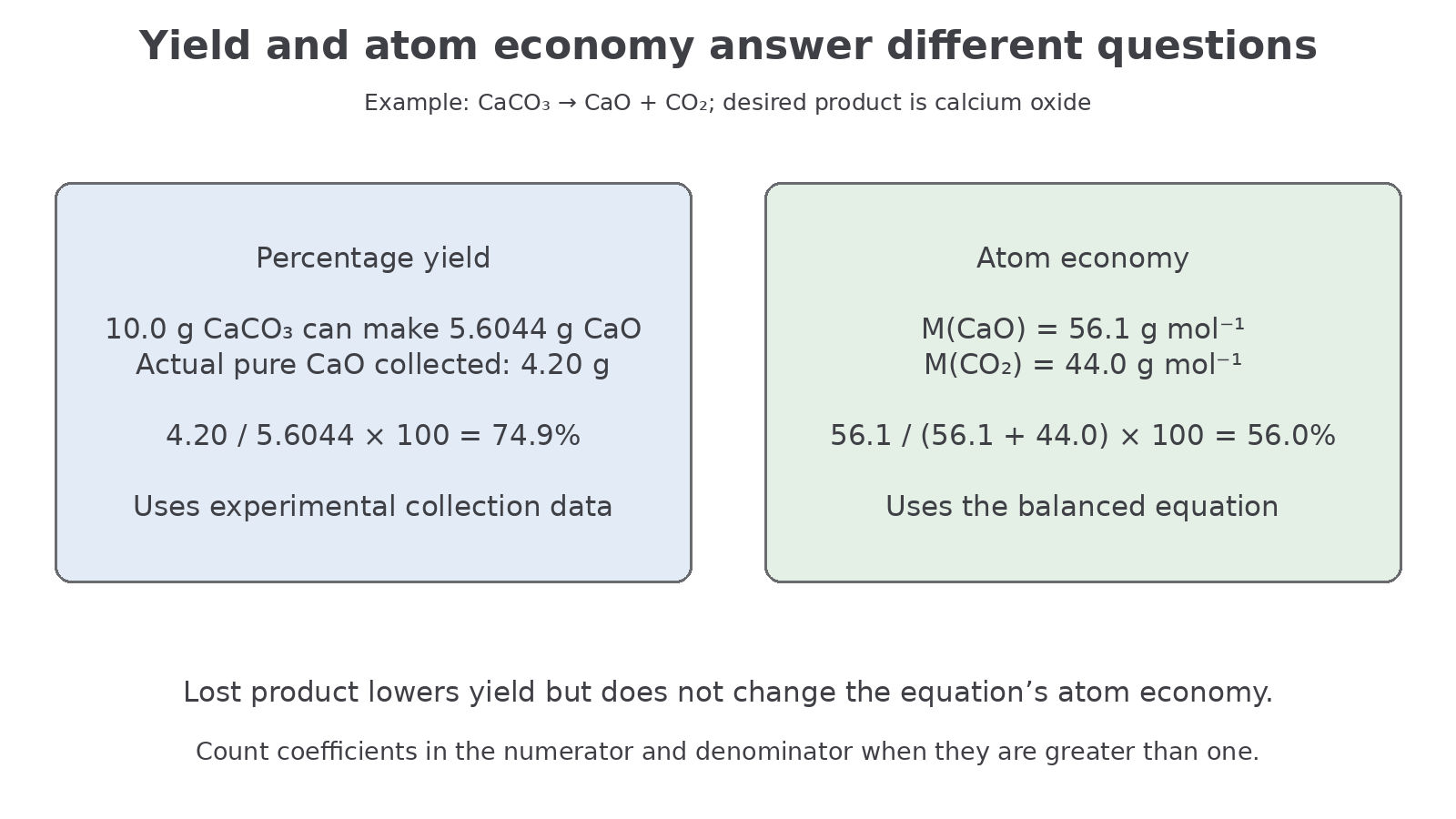
Percentage yield and atom economy answer different questions.
| Quantity | Question it answers | Evidence used | Formula |
|---|---|---|---|
| Percentage yield | How much desired product was actually obtained compared with the theoretical maximum? | experimental result plus stoichiometric calculation | |
| Percentage atom economy | What percentage of the stoichiometric product mass is the desired product? | balanced equation and molar masses |
Percentage yield is practical. It changes if the reaction is incomplete, the product is lost during transfer, the product is impure, or the product is not fully dry.
Atom economy is theoretical for a stated equation. It does not depend on whether the student collected the product neatly. It depends on the balanced equation and which product is considered the desired product.
The two quantities can disagree. A reaction can have excellent atom economy but poor percentage yield if the practical method is inefficient. A reaction can have high percentage yield but poor atom economy if it reliably makes a lot of unwanted by-product.
Common-error contrast
| Tempting idea | Why it fails | Correct idea |
|---|---|---|
| Use actual product mass in atom economy | Atom economy is about the balanced equation, not the student's collection skill | use molar masses from the balanced equation |
| Use the mass of reactants in percentage yield | Yield compares actual product with theoretical product | calculate the theoretical mass of product first |
| Treat a yield above as "very good" | More than the theoretical maximum usually means impurity, wet product or a calculation error | question the experimental result or method |
| Ignore coefficients in atom economy | The equation may make more than one mole of a product | include coefficients when summing product molar masses |
Atom economy is not percentage yield
Percentage yield compares the actual product collected with the theoretical product from a calculation, while atom economy compares the desired product's molar mass with the total molar mass of all products in the balanced equation. Yield is about what happened in the lab; atom economy is about where the atoms are designed to go.
Percentage Yield From Experimental Results
Percentage yield begins with the normal amount-of-substance route. The balanced equation predicts a theoretical yield; the experiment gives an actual yield.
Use this route:
balanced equation → moles of known substance → mole ratio to desired product → theoretical mass of desired product → percentage yield
Percentage yield
Both yields in the same unit (usually g or mol); the theoretical yield comes from the limiting reagent and the balanced equation.
If the question says a reactant is in excess, the other reactant controls the theoretical yield. If no excess is stated and there is more than one reactant amount, decide which reactant is limiting before calculating the theoretical product.
Worked example: calculate percentage yield
Calcium carbonate decomposes on heating:
A student heats of calcium carbonate and obtains of calcium oxide. Calculate the percentage yield of calcium oxide. Use and .
Step 1: convert the known mass to moles.
Step 2: use the equation ratio.
1 mol : 1 mol , so theoretical
Step 3: convert theoretical moles of product to mass.
theoretical mass of
Step 4: compare the actual yield with the theoretical yield.
(using the unrounded theoretical mass)
Chemical interpretation: the balanced equation predicts up to about of calcium oxide from of calcium carbonate. The student collected less than this, so possible explanations for a low mass of isolated pure oxide include loss during transfer or product left in the apparatus. Incomplete decomposition reduces the amount of oxide made, but unreacted carbonate remaining in the weighed residue contaminates it and can increase its apparent mass. Do not identify the mass of a mixed residue as pure oxide yield.
Guided practice
Magnesium burns in oxygen:
A student burns of magnesium and obtains of magnesium oxide. Use and to calculate the percentage yield.
Route:
2 mol : 2 mol , so theoretical
theoretical mass of
The result is below , so it is chemically plausible. A lower yield could come from some magnesium oxide escaping as smoke or not all magnesium reacting.
Atom Economy From Equations
Atom economy asks how efficiently atoms are incorporated into the desired product. It does not ask whether the product was collected successfully.
Atom economy
Uses only the balanced equation and molar masses, never an experimental mass.
The denominator is built from the products in the balanced equation. If a product has a coefficient, multiply its molar mass by that coefficient. Atom economy is a percentage and has no unit.
Worked example: atom economy for thermal decomposition
Calcium carbonate decomposes:
If calcium oxide is the desired product:
and
Chemical interpretation: only about of the product mass is in the desired calcium oxide. The rest is carbon dioxide, which is not the desired product in this calculation.
If carbon dioxide were the desired product instead:
The balanced equation has not changed. The "desired product" chosen by the chemical process has changed.
Worked example: coefficient care
Hydrogen reacts with nitrogen to form ammonia:
If ammonia is the desired product, there are no by-products in this equation.
The coefficient appears in both numerator and denominator because the equation produces of ammonia. The atom economy is still because every product atom is in the desired product.
Common-error contrast
For:
if sodium carbonate is desired, the numerator is , and the denominator is:
The usual specification formula builds the denominator from coefficient-weighted products. An equivalent denominator is also chemically valid: mass conservation gives the same total for coefficient-weighted reactants and products in a balanced equation. Do not reject a correct equivalent route merely because it uses the reactant total.
High atom economy does not guarantee high yield
High atom economy means most or all of the coefficient-weighted product mass in the balanced equation belongs to the desired product. The percentage yield can still be low if the reaction is incomplete, side reactions occur, product is lost during transfer or purification. Impurity or retained solvent/water can instead inflate the apparent collected mass and apparent yield; that is unreliable evidence of pure-product yield.
Observations To Full And Ionic Equations
A simple test-tube reaction gives observations first: colour change, fizzing, warming, a solid disappearing, a metal coating, or a precipitate forming. The equation is the chemical claim that explains the observation.
Continue this lesson.
You’re previewing NovaLearn without an account. Create a free account to read the rest.
Create free account