5.11 - Concentrations And Titrations
Calculate solution concentrations and use titration data to find an unknown concentration. Prepare a standard acid for Core Practical 2, determine hydrochloric acid concentration in Core Practical 3, and connect indicator and apparatus choices to reliable results.
What Concentration Measures
Problem opener. A bottle is labelled . That does not mean there is in the bottle. It means that every of that solution would contain of dissolved sodium hydroxide, if the solution is mixed evenly.
Concentration is an amount per volume:
Amount concentration
in ; in ; in , not . Since : and .
There is also a mass concentration, and the two are connected by molar mass:
Mass concentration
Mass concentration in ; = mass of solute in ; in ; = molar mass in . Divide a mass concentration by to get in .
Worked example: changing between concentration units.
A glucose solution contains of glucose, . Calculate its concentration in .
Molar mass of glucose:
Now convert mass per into moles per :
The chemical interpretation is that each of solution contains of glucose particles. The unit is not optional: by itself does not say whether the answer is an amount, a mass concentration or an amount concentration.
Common-error contrast. The ratio route starts with the volume of solution, not the total volume of the container. If of solution is used, the concentration calculation uses ; it does not use as though the unit were already .
Making A Standard Solution
Accurately known mass and final volume let you prepare a solution with a known concentration.
Standard solution
A solution whose concentration is known accurately.
Core Practical 2 uses this idea: prepare a standard solution from a solid acid, then use it to find the concentration of sodium hydroxide solution.
[DIAGRAM: asset_name: Edexcel A Level Chemistry L026 Cp2 Standard Solution Preparation; asset_slug: edexcel_a_level_chemistry_l026_cp2_standard_solution_preparation; recommended_method: deterministic_code; description: Accurate weighing, complete dissolution, rinsed quantitative transfer and calibration-line filling before mixing. Pale 1600 by 900 diagram rendered with Pillow; technical geometry and Unicode chemical labels inspected.]
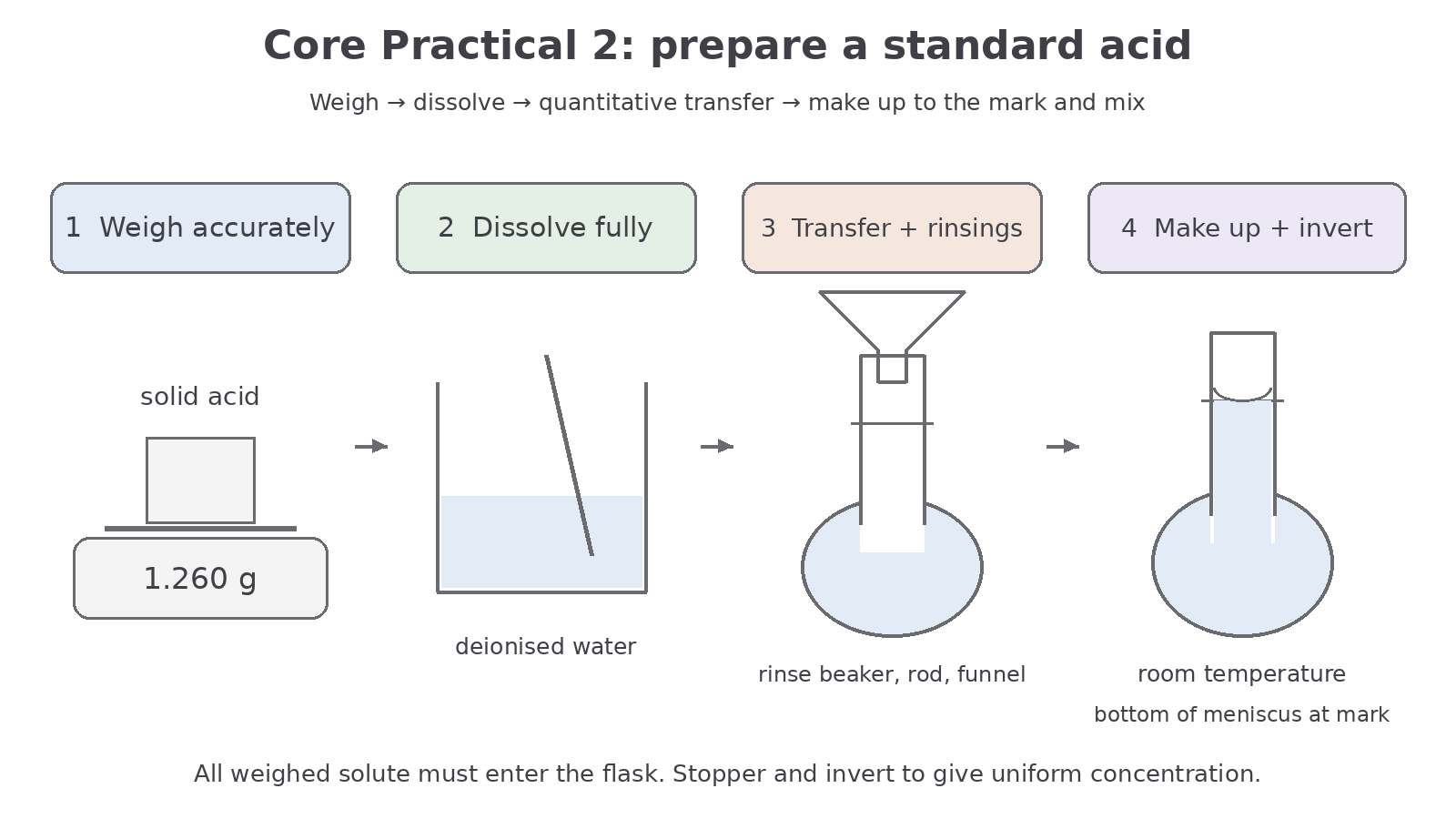
The method is a calculation route made physical:
- Weigh an accurate mass of a pure solid acid using a balance.
- Dissolve it in a small volume of deionised water in a beaker.
- Transfer the solution into a volumetric flask using a funnel.
- Rinse the beaker, stirring rod and funnel into the flask so all dissolved acid reaches the flask.
- Allow the solution to reach room temperature before making up to volume. Add deionised water to near the mark, then use a dropping pipette to make the bottom of the meniscus sit on the calibration line.
- Stopper and invert the flask several times so the concentration is uniform.
The volumetric flask matters because the final volume is known accurately. The rinsing matters because the known amount of acid is the amount weighed out; if some remains in the beaker or funnel, the actual concentration in the flask is lower than the calculated concentration.
Worked example: concentration of a standard acid.
of hydrated ethanedioic acid, , is dissolved and made up to in a volumetric flask. Calculate the concentration of the acid in .
First find the molar mass:
Then find the amount of acid:
Convert the final volume:
Now calculate concentration:
The answer is sensible because the acid was made up to a quarter of a cubic decimetre, so the concentration is four times the number of moles weighed out.
Dilution changes concentration, not amount
The moles of acid come from the mass weighed out, so adding water does not create or destroy acid particles. During dilution it spreads the same amount through a larger volume, so is unchanged but V increases and decreases. Once preparations are made up to the same final calibration mark, their final volumes are equal: using more water initially does not change that final concentration, provided no solute is lost.
For a dilution, use conservation of solute amount: , with volumes in consistent units. To prepare of acid from stock, . Measure that stock volume, add it to some water in the volumetric flask, and then make up to the final mark. The final volume is the volume of solution, not the volume of added water.
Using A Titre To Find Concentration
A titration uses a measured volume of one solution to find the concentration of another. The indicator endpoint estimates the equivalence point; a suitable indicator changes colour close to the exact ratio in the balanced equation.
[DIAGRAM: asset_name: Edexcel A Level Chemistry L026 Cp3 Titration Setup; asset_slug: edexcel_a_level_chemistry_l026_cp3_titration_setup; recommended_method: deterministic_code; description: Clamped burette containing HCl above carbonate and methyl orange; white tile, filled jet and reading technique shown. Pale 1600 by 900 diagram rendered with Pillow; technical geometry and Unicode chemical labels inspected.]
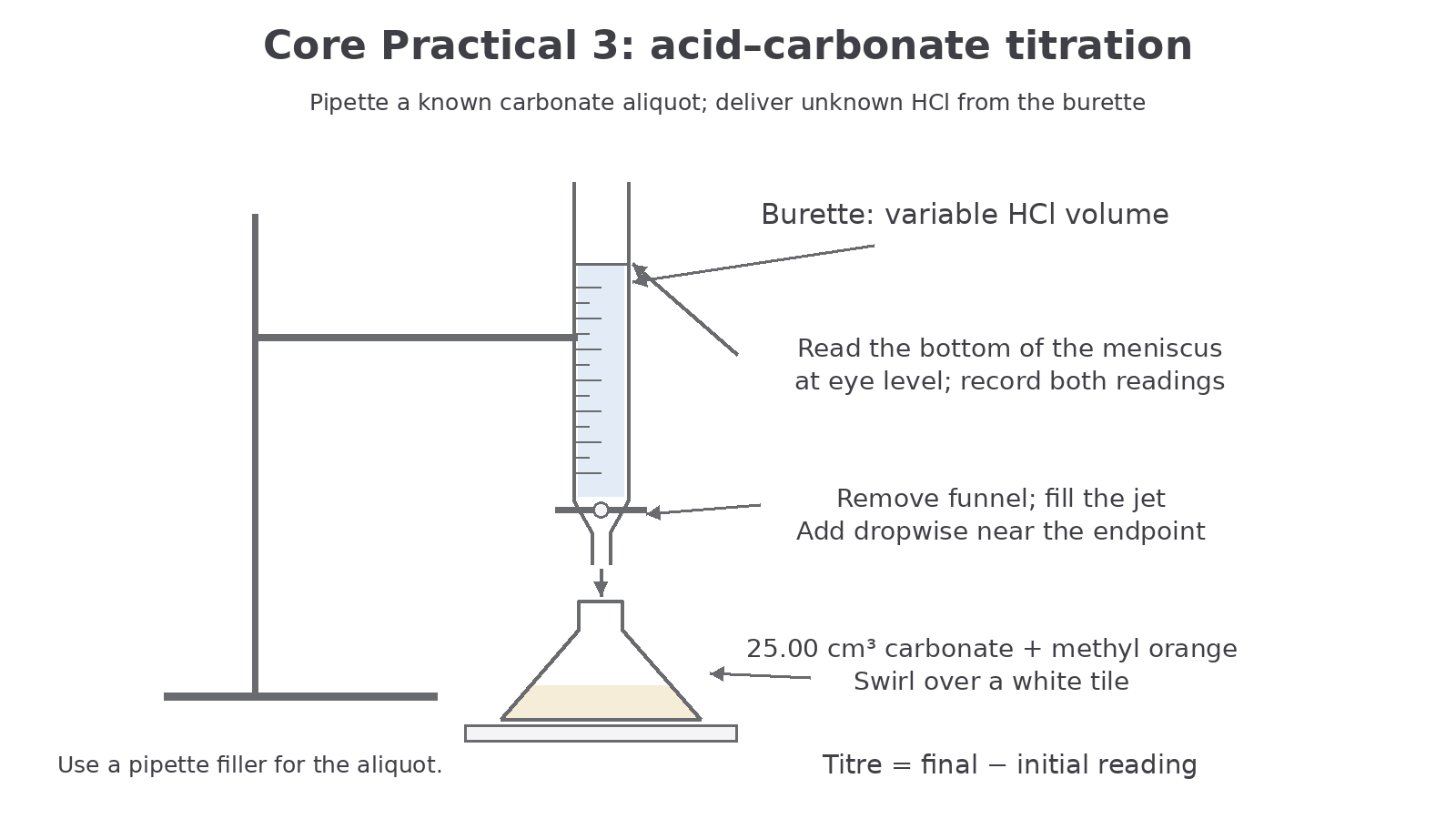
For a simple acid-base titration, use this route every time:
- Write the balanced equation.
- Identify the known concentration and volume.
- Convert to .
- Calculate moles of the known solution.
- Use the equation ratio to find moles of the unknown.
- Divide by the volume of the unknown solution in .
- Give units and sensible significant figures.
Worked example: Core Practical 2 style.
An acid standard solution contains . A portion of sodium hydroxide solution is placed in a conical flask. The mean titre of acid from the burette is . Calculate the concentration of the sodium hydroxide solution.
Balanced equation:
The known solution is the acid in the burette:
The equation ratio is:
Continue this lesson.
You’re previewing NovaLearn without an account. Create a free account to read the rest.
Create free account