2B.24-2B.25 - Simple Molecular Structures And Carbon Allotropes
Identify the units in a covalent solid: separate molecules or a continuous network. Compare iodine and ice with diamond, graphite and graphene, then read diagram keys to distinguish covalent bonds from intermolecular attractions.
Particles, Bonds And Structure
A student sees the word "covalent" and writes "simple molecular" for every covalently bonded substance. That answer works for iodine and ice, but it fails badly for diamond and graphite. The useful question is not just "is there covalent bonding?" but "what particles or atoms are joined into one unit?"
Separate these three ideas:
- Bonding type: the attraction holding atoms together, such as covalent bonding.
- Structure: the overall arrangement of particles or atoms, such as simple molecular or giant covalent.
- Forces between units: the attractions between molecules or layers, where relevant.
Simple molecular structure
A structure made of discrete molecules: covalent bonds act within each molecule, and only intermolecular forces act between neighbouring molecules.
Giant covalent structure
A continuous network of atoms joined by covalent bonds throughout the solid, with no separate molecules.
| Tempting answer | Why it is tempting | Better reasoning |
|---|---|---|
| Ice is giant covalent because the molecules form a crystal | The diagram may look like a network | The covalent bonds are inside molecules; the forces between molecules are hydrogen bonds |
| Iodine is atomic because iodine is an element | The substance contains only iodine atoms | Solid iodine contains molecules, so its structure is simple molecular |
| Graphite and graphene are the same structure | Both contain hexagonal carbon sheets | Graphene is one sheet; graphite is a stack of sheets |
| Diamond is simple molecular because it is covalent | Covalent often reminds students of molecules | Diamond has a continuous three-dimensional covalent network, not separate molecules |
The key move is to name the particles first. If the particles are molecules, you can then discuss intermolecular forces. If the structure is a continuous network of atoms, there are no separate molecules to pull apart.
Simple Molecular Solids
Iodine and ice contain discrete molecules even in the solid state. The attractions between those molecules create the crystal without turning it into one covalently bonded network.
[DIAGRAM: asset_name: Simple Molecular Solids; asset_slug: edexcel_a_level_chemistry_l015_simple_molecular_solids; recommended_method: matplotlib; description: Pale-colour schematic comparing solid iodine as separate I2 molecules and ice as separate H2O molecules, with dotted lines between molecules and solid covalent bonds within molecules.]
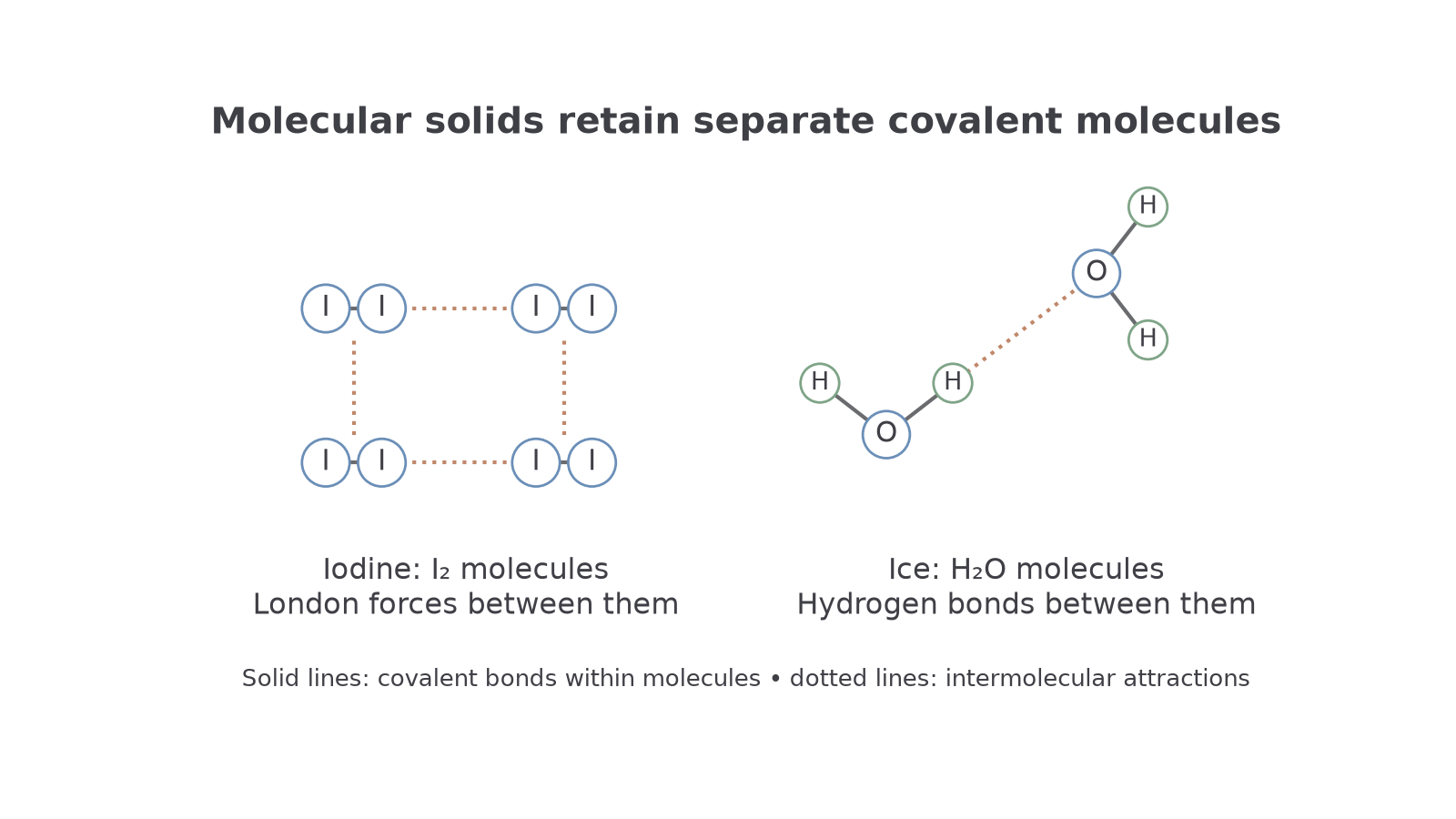
Iodine and ice are both examples of covalently bonded substances with simple molecular structures. The phrase sounds slightly odd for ice because the molecules form an ordered crystal, but the important unit is still the molecule.
In solid iodine, each molecule contains a covalent bond between two iodine atoms. The separate molecules are attracted to one another by London forces, not by covalent bonds between molecules. When the physical state changes, the covalent bond inside each molecule is not the bond being broken.
In ice, each molecule contains two O-H covalent bonds. The molecules are held to neighbouring molecules by hydrogen bonds, which are intermolecular forces. Hydrogen bonds are strong intermolecular attractions, but they are still different from a covalent bond joining all the oxygen and hydrogen atoms into one giant covalent lattice.
The common error is to see many dashed or drawn connections in a diagram of ice and call it a giant covalent structure. That loses the particle-level idea: the covalent units are still individual molecules.
Why ice is still simple molecular
Ice is made of molecules, and each molecule has covalent O-H bonds inside it. The attractions between different molecules are hydrogen bonds, which are intermolecular forces, so the structure is simple molecular rather than a giant covalent network.
Carbon Allotropes
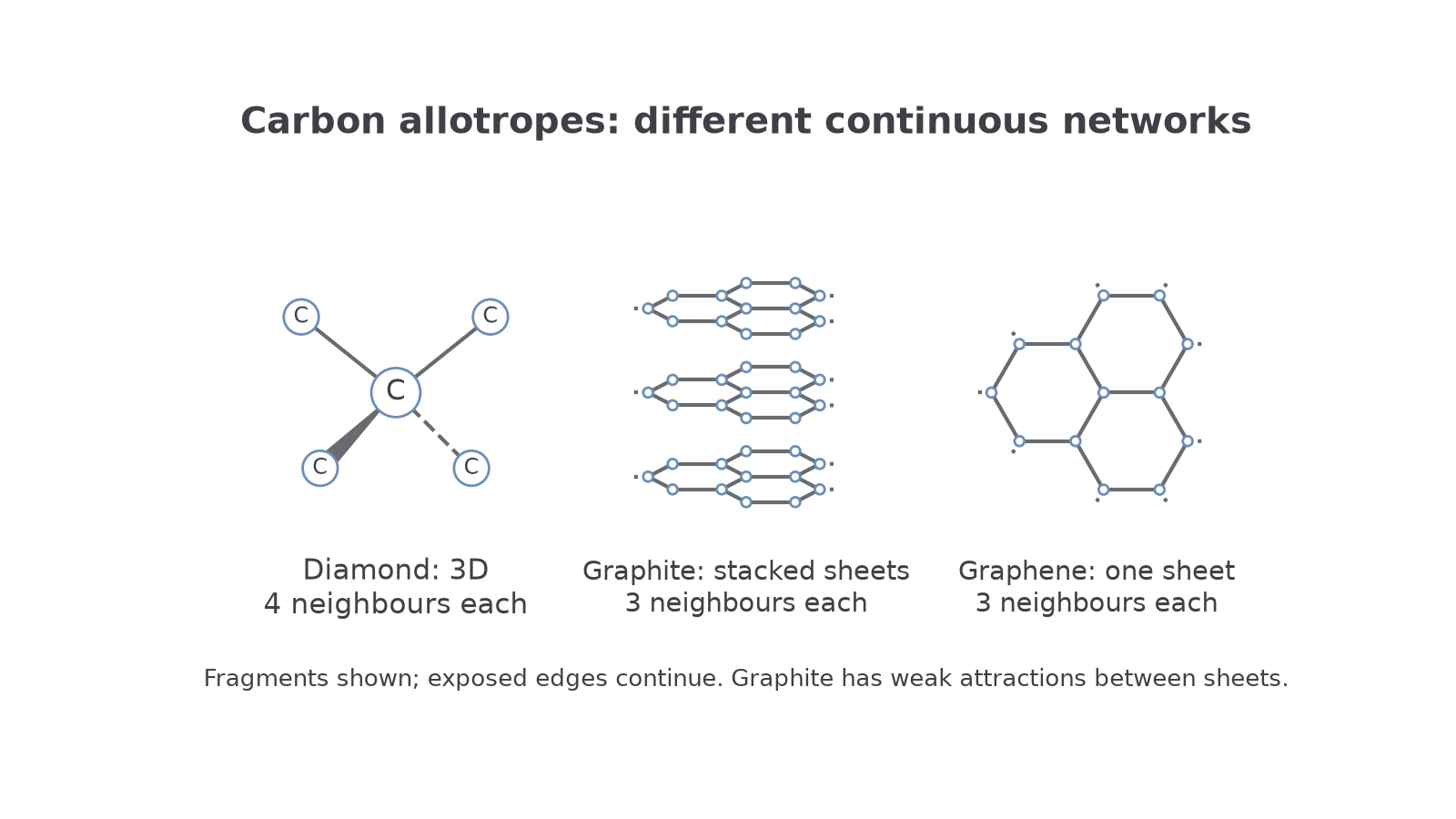
Carbon atoms can make different continuous networks. Count the neighbours around each atom and follow how the bonds extend in three dimensions or within a sheet.
[DIAGRAM: asset_name: Carbon Allotropes; asset_slug: edexcel_a_level_chemistry_l015_carbon_allotropes; recommended_method: matplotlib; description: Pale-colour schematic showing diamond as a three-dimensional carbon network, graphite as stacked hexagonal carbon layers, and graphene as a single hexagonal carbon sheet.]
Allotropes
Different structural forms of the same element in the same physical state.
Carbon atoms can form different structures because each carbon atom can make several covalent bonds to other carbon atoms. The structures in this lesson are all made from carbon atoms, but the atoms are connected in different ways.
Diamond
Diamond is a giant covalent structure. Each carbon atom is covalently bonded to four other carbon atoms in a three-dimensional tetrahedral network. There are no separate carbon molecules in diamond; the covalent network extends through the crystal.
Graphite
Graphite is also a giant covalent structure, but the arrangement is layered. Each carbon atom is covalently bonded to three other carbon atoms in flat hexagonal sheets. The sheets are stacked on top of one another, with much weaker attractions between layers than the covalent bonds within a layer.
Graphene
Graphene is a single layer of carbon atoms arranged in a hexagonal sheet. It is easiest to think of graphene as one layer from graphite, not as a stack of layers. Each carbon atom is bonded to three other carbon atoms within the sheet, and the sheet is one atom thick.
Notice the careful distinction: diamond, graphite and graphene are not different because the atoms are different. They are different because the same carbon atoms are arranged and bonded in different structures.
Reading Bond And Force Diagrams
A diagram key tells you what a drawn line represents. In the key used here, a solid line joins atoms by a covalent bond, while a dotted line joins separate molecules through an intermolecular attraction. This is an explicit key, not a universal rule: wedge/dash bonds in a three-dimensional molecular drawing can still represent covalent bonds.
For iodine, identify pairs of iodine atoms joined by one covalent bond. Each pair is a separate molecule. Dotted attractions between different pairs represent London forces. For ice, each oxygen has two covalently bonded hydrogens, making molecules. Hydrogen bonds join a donor O-H hydrogen to the oxygen of another molecule; they do not create an extra O-H covalent bond.
For carbon networks, count bonds to neighbouring carbon atoms rather than counting visible polygons alone. Diamond has four carbon neighbours around every carbon in a tetrahedral three-dimensional network. Graphite and graphene have three neighbours per carbon within each hexagonal sheet. A cropped drawing may omit bonds beyond its boundary; the interior atom's coordination and the layer count establish the structural model.
Quick Recap
Iodine and ice contain separate molecules. Diamond is a three-dimensional carbon network with four neighbours per carbon; graphite has stacked three-coordinated hexagonal sheets, and graphene is one sheet. Distinguish covalent bonds from the intermolecular attractions specified in the diagram key.