15A.1-15A.3 - d-Block Configurations And Transition Metals
Deduce period-4 d-block atom and ion configurations, including chromium and copper. Use stable-ion configurations to identify transition metals and explain their variable oxidation numbers.
d-Block And Transition Metals
Iron can form and , copper can form and , but zinc is usually not treated as a transition metal in this course even though it sits in the d-block. The difference is not the position of the neutral atom alone. It is the electron configuration of stable ions.
The period-4 d-block is the series:
Sc, Ti, V, Cr, Mn, Fe, Co, Ni, Cu, Zn
These elements involve the subshell, even though the subshell is filled before in the simple filling order. The useful shorthand is the argon core:
So instead of rewriting 18 core electrons every time, you can focus on the electrons after . For example:
Fe atom:
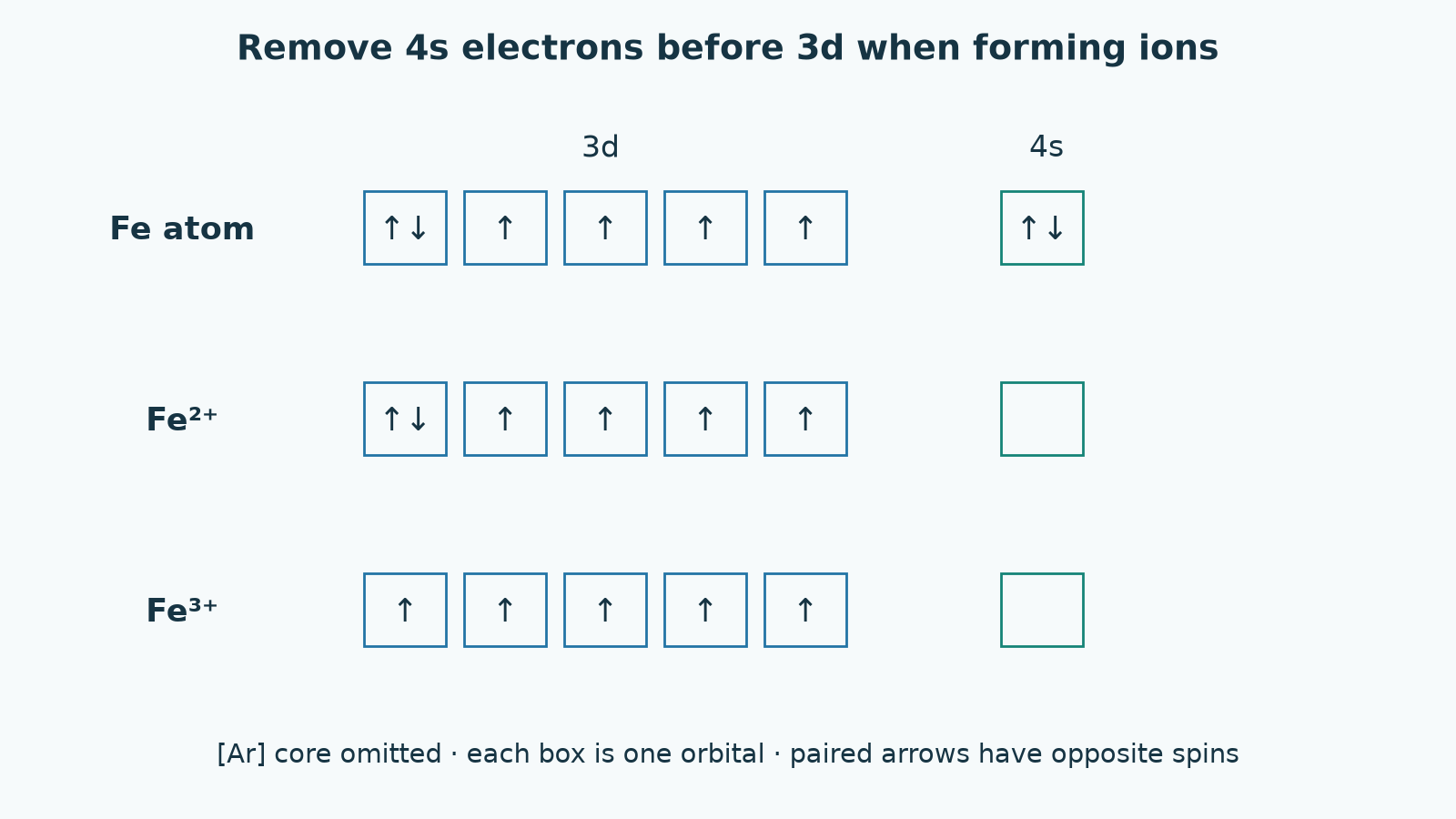
The catch is that forming period-4 d-block cations is not just "take electrons away from the last symbol written". When these atoms form positive ions, the electrons are removed before the electrons. That one rule prevents most wrong ion configurations in this topic.
Common-error contrast
| Tempting shortcut | Why it fails | Better habit |
|---|---|---|
| "The d-block element is automatically a transition metal." | Sc and Zn are d-block but fail the stable incomplete-d-ion test used here. | Apply the ion criterion. |
| "Remove from first because it is written after ." | Period-4 d-block cations lose electrons before electrons. | Start with the neutral atom, then remove before . |
| "Incomplete d orbital means any d electron is enough." | A full subshell is not incomplete, and an empty subshell is not incomplete. | Look for to in a stable ion. |
Deducing Period-4 d-Block Atom Configurations
For neutral atoms, begin from and then add the and electrons. The simple pattern is , then add one more electron as you move across the series.
Two atoms need special attention:
Cr:
Cu:
These are associated with especially stable half-filled or full subshells. Do not write chromium as or copper as when giving their ground-state atom configurations.
| Element | Atomic number | Neutral atom configuration |
|---|---|---|
| Sc | 21 | |
| Ti | 22 | |
| V | 23 | |
| Cr | 24 | |
| Mn | 25 | |
| Fe | 26 | |
| Co | 27 | |
| Ni | 28 | |
| Cu | 29 | |
| Zn | 30 |
Worked example: deduce the configuration of cobalt
Cobalt has atomic number 27, so a neutral cobalt atom has 27 electrons. The argon core accounts for 18 electrons, leaving:
27 - 18 = 9 electrons after
Cobalt is not one of the chromium/copper exceptions. Fill , then put the remaining 7 electrons in :
Co:
The chemical interpretation is that cobalt is a period-4 d-block element because the configuration involves the subshell.
Guided practice
Deduce the atom configurations for titanium, manganese and copper.
| Element | Cue | Configuration |
|---|---|---|
| Ti | two electrons after begins the series | |
| Mn | after chromium, return to the usual pattern | |
| Cu | copper exception |
Why copper is 4s¹3d¹⁰
Copper is written as , not , not "because copper is in Group 11" but because a full subshell is especially stable, so the observed ground state has one fewer electron than the simple filling prediction. This is not an excited atom produced by absorbing energy.
Deducing Ion Configurations
For d-block ions, do not refill the ion from scratch using the neutral-atom filling order. Use this route:
[DIAGRAM: asset_name: Iron atom and ion orbital occupancy removing 4s first; asset_slug: edexcel_a_level_chemistry_l069_d_orbital_boxes; recommended_method: deterministic_chart; description: Iron atom and ion orbital occupancy removing 4s first.]
- Write the neutral atom configuration.
- Use the positive charge to decide how many electrons have been lost.
- Remove electrons first.
- If more electrons must be removed, remove them from .
- Check the final electron count.
Worked example 1:
Vanadium has atomic number 23:
V atom:
has lost 3 electrons. Remove the two electrons first, then one electron:
:
Electron-count check: has 18 electrons and adds 2, so has 20 electrons. A ion from vanadium should have electrons, so the configuration is consistent.
Worked example 2:
Chromium is an exception as an atom:
Cr atom:
has lost 2 electrons. Remove the one electron first, then one electron:
:
The common wrong answer is or . Both keep electrons in a period-4 d-block cation, which is the key error.
Worked example 3:
Copper is also an exception as an atom:
Cu atom:
has lost 2 electrons. Remove the one electron first, then one electron:
:
This is why copper can satisfy the transition-metal criterion even though the neutral copper atom has a full subshell: has an incomplete subshell.
Useful ion configurations
| Ion | Route from neutral atom | Ion configuration |
|---|---|---|
| remove , then | ||
| remove , then one electron | ||
| remove | ||
| remove , then one electron | ||
| remove , then one electron | ||
| remove | ||
| remove | ||
| remove , then one electron | ||
| remove | ||
| remove , then one electron | ||
| remove |
You do not need to write . Once the electrons have been removed, the configuration is normally written with the remaining occupied subshells.
Continue this lesson.
You’re previewing NovaLearn without an account. Create a free account to read the rest.
Create free account