12.1-12.6 - Acids, Bases And pH
Follow proton transfer to identify acids, bases and conjugate pairs. Use the logarithmic pH scale to calculate hydrogen ion concentrations and compare solutions quantitatively.
Acids And Bases As Proton Transfers
Ammonia gas reacts with hydrogen chloride gas to form a white smoke of ammonium chloride:
At GCSE this may look like "acid plus base gives salt". At A level, the useful question is: which particle moved? The answer is a proton, .
The Bronsted-Lowry model
Bronsted-Lowry acid
A proton () donor.
Bronsted-Lowry base
A proton () acceptor.
So an acid-base reaction is a proton-transfer reaction. In a simple symbolic form:
donates , so is the acid. accepts , so is the base. The proton is not an electron; acid-base chemistry here is different from redox chemistry.
[DIAGRAM: asset_name: Proton Transfer Conjugate Pairs; asset_slug: edexcel_a_level_chemistry_l053_proton_transfer_conjugate_pairs; recommended_method: deterministic_chart; description: Generic monochrome proton-transfer schematic: one particle donates a small proton to another particle, then the resulting particles form the conjugate base and conjugate acid.]
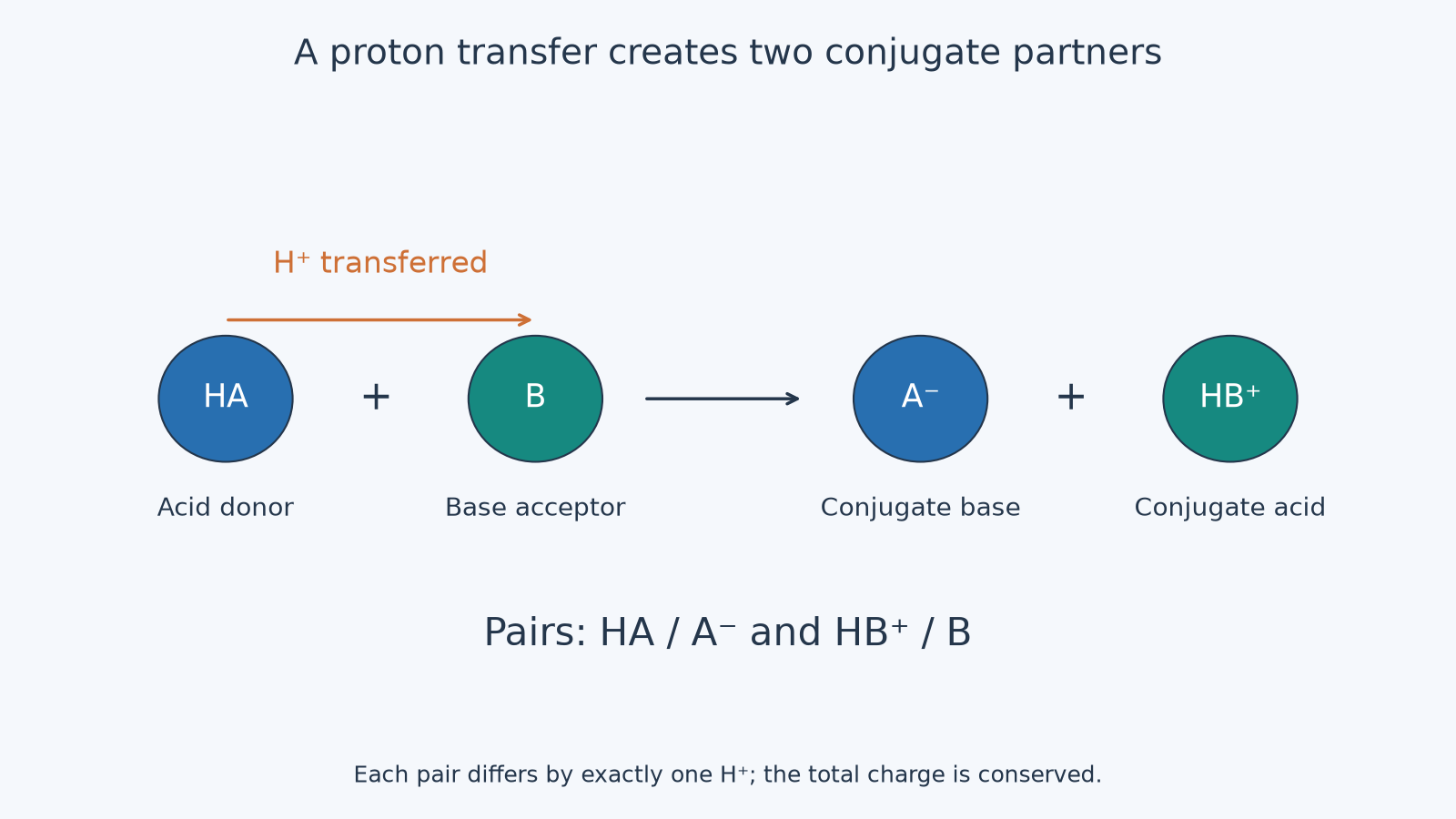
In water, chemists often write as a shorthand. A bare proton does not float around independently for long; it is associated with water molecules, commonly represented as . calculations in this topic use the shorthand concentration .
Worked example: hydrogen chloride and ammonia
Question: Identify the acid and base in this reaction.
Route:
- Look for the species that loses .
- becomes , so has donated a proton.
- Look for the species that gains .
- becomes , so has accepted a proton.
Answer: is the Bronsted-Lowry acid and is the Bronsted-Lowry base.
Chemical interpretation: the bond to hydrogen in is broken in a way that transfers to the lone pair on nitrogen in ammonia. The chloride ion and ammonium ion are the products after transfer.
Donor versus acceptor
"A base is a proton donor" is wrong. In Bronsted-Lowry language, the acid donates ; the base accepts . Some bases also produce alkaline solutions in water, but the defining A-level action here is accepting a proton.
Conjugate Acid-Base Pairs
After proton transfer, the products still carry a memory of the reaction. The acid has lost a proton and becomes its conjugate base. The base has gained a proton and becomes its conjugate acid.
Conjugate acid-base pair
Two species that differ by exactly one proton, , such as and .
General pattern
acid + base → conjugate base + conjugate acid, for example .
The acid and its conjugate base are one pair:
The base and its conjugate acid are the other pair:
Charges often change because has a charge. Do not choose pairs only by looking for similar charges; choose pairs by asking whether one species has exactly one more than the other.
Worked example: ethanoic acid and ammonia
Ethanoic acid can transfer a proton to ammonia:
Identify the proton transfer.
loses and becomes , so is the acid and is its conjugate base.
gains and becomes , so is the base and is its conjugate acid.
Conjugate pairs:
It is equally valid to write the second pair as if you clearly identify which member is the base and which is the conjugate acid. Questions often care more about the correct pairing than the order, unless the wording asks for "acid/conjugate base" specifically.
Common-error contrast
Weak answer: " and are a pair because they are on the same side of the equation."
Stronger answer: " and are a conjugate pair because they differ by one . and are the other pair because has accepted one ."
Reactants that collide are not automatically conjugate partners. Conjugate partners are linked by gaining or losing one proton.
In the second equation, is acting as an acid because it donates a proton. Water is acting as a base because it accepts that proton. The fact that water can act differently in other reactions is useful later, but the role is always decided by this particular proton transfer.
What pH Means
Acid-base reactions tell you where a proton moves. tells you how much hydrogen ion is present in solution, but on a compressed scale.
pH
in ; has no unit. A change of 1 pH unit is a tenfold change in .
means the concentration of hydrogen ions in . itself has no unit.
The minus sign matters. Most aqueous hydrogen ion concentrations are less than , so their base-10 logarithms are negative. The minus sign turns those into familiar positive values.
What the logarithm does
is not a linear scale. A decrease of 1 unit means has increased by a factor of 10.
| Solution comparison | Hydrogen ion concentration relationship |
|---|---|
| 2 compared with 3 | 2 has 10 times the of 3 |
| 2 compared with 4 | 2 has 100 times the of 4 |
| 1 compared with 4 | 1 has 1000 times the of 4 |
Lower means higher . Higher means lower .
Mini-check: interpreting pH without calculating
Two solutions have values 2.30 and 4.30. Which has the larger hydrogen ion concentration, and by what factor?
Expected answer: the 2.30 solution has the larger . The values differ by 2.00 units, so its is times larger.
Continue this lesson.
You’re previewing NovaLearn without an account. Create a free account to read the rest.
Create free account