18B.8-18B.13 - Amines, Amides And Amino Acids
The nitrogen lone pair explains why amines can accept protons, attack carbon and bind metal ions. Use that idea to compare basicity, identify amine and amide groups and choose practical routes to primary amines.
Spotting Amines, Amides And Amino Acids
Amines, amides and amino acids can all contain nitrogen, so the first task is not just to spot . The key question is what the nitrogen is bonded to.
| Family | Functional-group pattern | How to recognise it | Example |
|---|---|---|---|
| Amine | , or | nitrogen bonded to carbon groups, with no carbonyl directly attached to nitrogen | |
| Amide | , or | carbonyl carbon directly bonded to nitrogen | |
| Amino acid | molecule containing both an amino group and a carboxylic acid group | look for or substituted amino group and in the same molecule |
The most common confusion is between an amine and an amide. In an amide, the nitrogen is attached to a carbonyl group, so the local pattern is . In an amine, there is no carbonyl carbon directly bonded to nitrogen.
Worked identification:
- : primary amine
- : amide
- : amino acid
is an amino acid because the same molecule contains an amino group and a carboxylic acid group. Its zwitterion behaviour is important, but that belongs to the next lesson.
Butylamine As A Base
A primary aliphatic amine has the pattern , where is an alkyl group. Butylamine is:
The nitrogen atom has a lone pair. That lone pair can accept a proton, so butylamine acts as a Bronsted-Lowry base.
In water, butylamine partially accepts a proton from water:
The formation of makes the solution alkaline. The equilibrium lies only partly to the right, so this is not the same as adding a strong alkali such as sodium hydroxide; the important point is that the amine produces hydroxide ions by proton transfer.
With acids, butylamine forms salts. For example:
The organic species is a butylammonium ion. In a displayed or structural answer, the nitrogen should now have three bonds and one bond, with the positive charge on nitrogen or on the ammonium ion as a whole.
Where the hydroxide comes from
Butylamine does not contain hydroxide: the nitrogen lone pair accepts from water; water is converted into , and those hydroxide ions give the alkaline solution.
Why Some Amines Are More Basic Than Others
Basicity depends on how available the nitrogen lone pair is to accept a proton. Questions may give data, so the skill is to connect the numbers to the structure.
Reading basicity data
A lower means a stronger base. If data are given for the conjugate acid as , a higher conjugate-acid means a stronger base. Settle the data direction before explaining.
The structural pattern is:
| Base | Lone-pair availability | Relative basicity idea |
|---|---|---|
| Ammonia, | nitrogen lone pair available, no alkyl electron donation | reference point |
| Primary aliphatic amine, | alkyl group donates electron density towards nitrogen | usually more basic than ammonia |
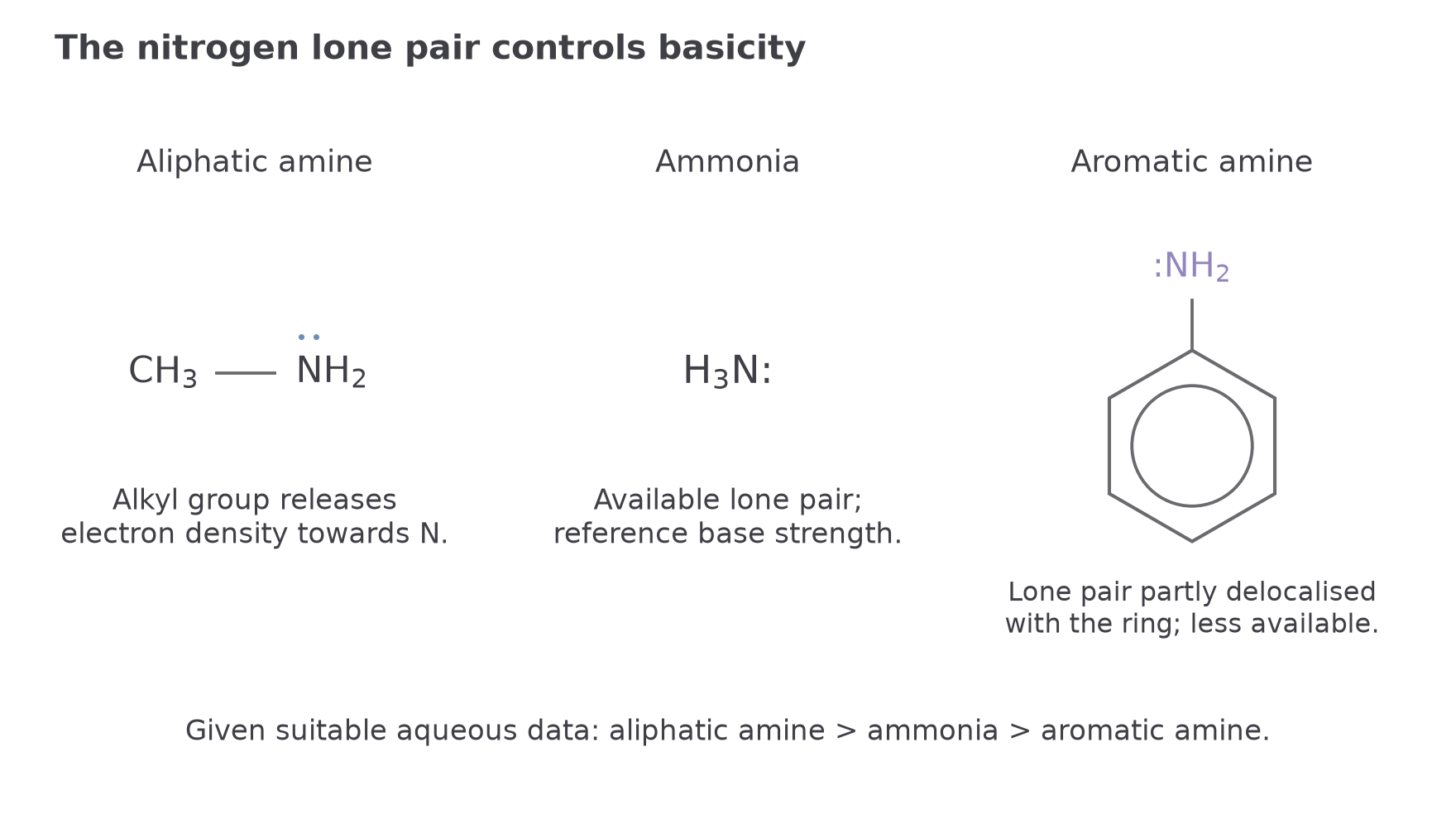
| Primary aromatic amine, | nitrogen lone pair is partly delocalised into the benzene ring | usually less basic than ammonia |
An alkyl group has a positive inductive effect. It pushes electron density towards nitrogen, making the lone pair more available and making proton acceptance more favourable:
In phenylamine, , the nitrogen lone pair overlaps with the delocalised electron system of the benzene ring. The lone pair is less available to bond to , so phenylamine is less basic than ammonia and less basic than a primary aliphatic amine.
Worked example with data:
| Substance | Type | |
|---|---|---|
| A | ammonia | 4.75 |
| B | primary aliphatic amine | 3.35 |
| C | primary aromatic amine | 9.30 |
Question: use the data and structures to explain the order of basicity.
Route:
- Lower means stronger base.
- So the order is B > A > C.
- B is strongest because the alkyl group donates electron density towards nitrogen, increasing lone-pair availability.
- C is weakest because the lone pair on nitrogen is partly delocalised into the aromatic ring, so it is less available to accept .
Common-error contrast:
| Weak answer | Why it falls short | Stronger answer |
|---|---|---|
| "Phenylamine has a benzene ring, so it is stable." | does not link stability to proton acceptance | "The nitrogen lone pair is partly delocalised into the benzene ring, so it is less available to accept a proton." |
| "Aliphatic amines have more hydrogen bonds." | confuses intermolecular forces with base strength | "The alkyl group donates electron density towards nitrogen, increasing lone-pair availability." |
[DIAGRAM: asset_name: Available nitrogen lone pair in aliphatic amine and ammonia compared with partial delocalisation in phenylamine; asset_slug: edexcel_9ch0_amine_basicity; recommended_method: deterministic_chart; description: Available nitrogen lone pair in aliphatic amine and ammonia compared with partial delocalisation in phenylamine]
Butylamine As Nucleophile And Ligand
The same nitrogen lone pair that makes butylamine basic also lets it attack electron-deficient carbon atoms and donate to metal ions. The role changes with the reaction partner.
With ethanoyl chloride, butylamine forms an amide. The acyl chloride carbonyl carbon is electron deficient, and the amine nitrogen uses its lone pair to form a new bond:
The product is a substituted amide, N-butylethanamide. In practice, another amine molecule can react with the formed to give an ammonium chloride salt, but the functional-group conversion is acyl chloride to amide.
With a halogenoalkane, butylamine can act as a nucleophile in substitution. For example, with bromoethane:
Continue this lesson.
You’re previewing NovaLearn without an account. Create a free account to read the rest.
Create free account