12.7-12.10 - Weak Acids, Ka And pH
Distinguish acid strength from concentration, then choose a calculation route for strong or weak monobasic acids. Check the assumptions behind the square-root approximation before trusting its result.
Strength Is Degree Of Dissociation
Two acids can have the same concentration but different values. That is not because one bottle contains more acid formula units than the other. It is because the acids can release different proportions of their acidic protons into the solution at any instant.
Strong acid
An acid that is completely dissociated in aqueous solution.
For a monoprotic strong acid, the model is:
Weak acid
An acid that is only partially dissociated in aqueous solution; its dissociation is an equilibrium.
For a weak acid:
The word strong describes the position of this dissociation equilibrium. It does not mean concentrated. A dilute strong acid can have a low acid concentration but the acid particles present are still essentially fully dissociated. A concentrated weak acid can contain many acid molecules, but only a small fraction may be dissociated at any instant.
[DIAGRAM: asset_name: Strong Weak Dissociation Model; asset_slug: edexcel_a_level_chemistry_l054_strong_weak_dissociation_model; recommended_method: deterministic_chart; description: Particle model comparing a strong monoprotic acid solution with mostly separated hydrogen ions and conjugate base ions against a weak monoprotic acid solution with mostly undissociated acid molecules and a few ions linked by reversible arrows.]
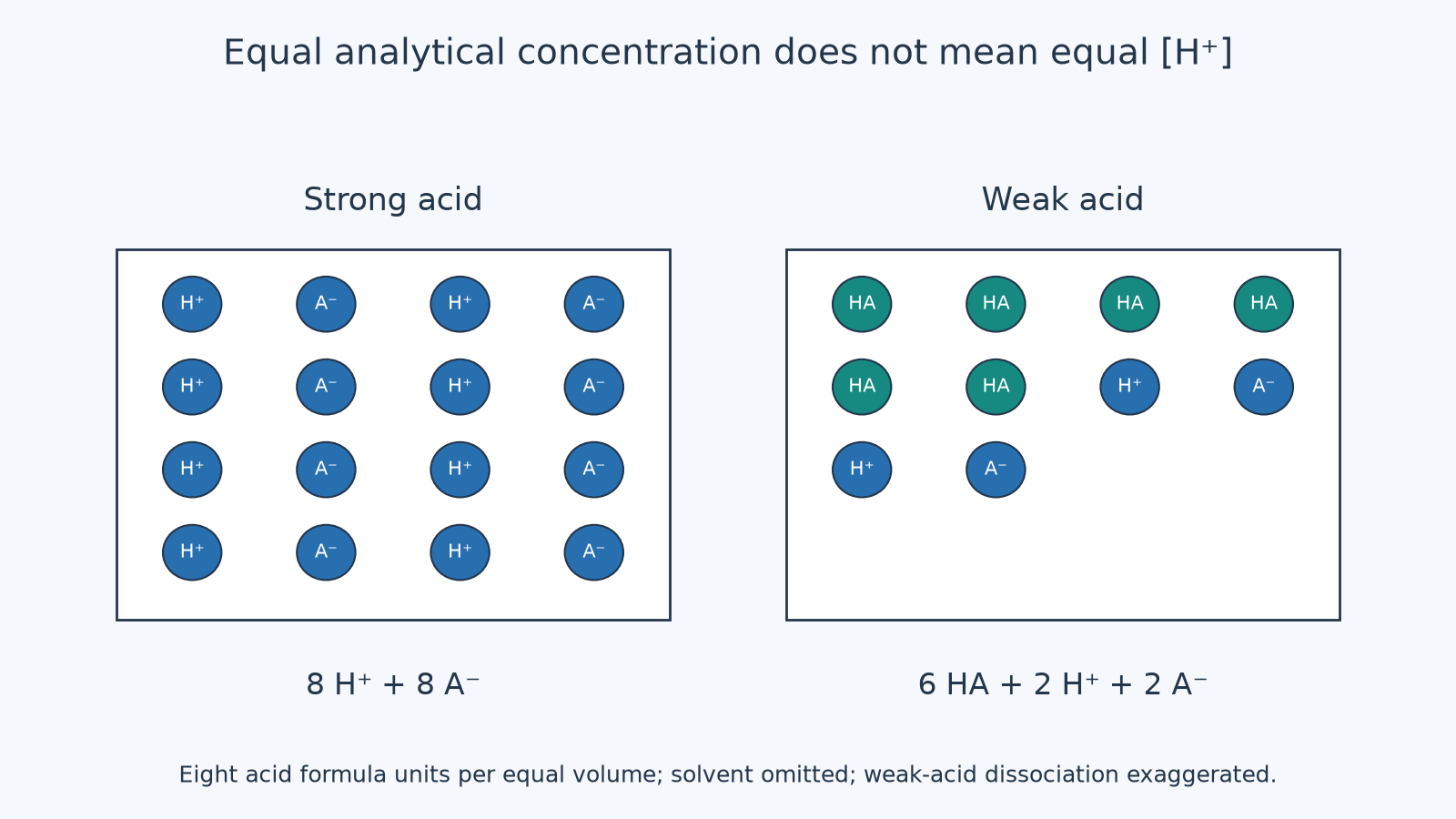
For a weak acid, the equilibrium matters. When ions are removed in a reaction, more molecules can dissociate to replace some of them. That is why weak acid does not mean "has no protons available"; it means "only a small fraction is dissociated at once".
Common-error contrast.
- Strong versus weak is about degree of dissociation.
- Concentrated versus dilute is about amount of acid per volume.
- Low usually means high , but it does not by itself prove that the acid is concentrated or strong.
Same concentration, different pH
and do not have the same . The weak acid does not have fewer acid molecules; it has fewer free ions because most acid molecules remain as at equilibrium.
Calculating pH Of A Strong Acid
For a strong monoprotic acid, complete dissociation gives a direct concentration link:
Then use the relationship from the previous lesson:
The logarithm turns powers of ten into units. If is divided by 10, increases by 1. If is multiplied by 10, decreases by 1.
Worked example: monoprotic strong acid.
Calculate the of .
Model decision:
is a strong monoprotic acid, so .
Calculation:
The chemical sense check is that the acid is less concentrated than , which has 1.00, so a higher than 1 is sensible.
Guided practice.
Caution. Do not automatically double the concentration for every acid formula that contains two hydrogen atoms. The simple strong-acid route above is for monoprotic strong acids, or for cases where the question gives enough information to justify the link between acid concentration and .
The Ka Expression For A Weak Acid
The equality applies here to an acid-only solution with no added conjugate-base salt and with water's own hydrogen ions negligible. Buffers later in Topic 12 do not generally satisfy that equality. Strong-acid likewise assumes the acid contribution dominates water's ionisation; it should not be extended to extremely dilute acid without checking that boundary.
A weak acid has a dissociation equilibrium, so its strength is described by an equilibrium constant. For the general weak acid :
Acid dissociation constant
Equilibrium concentrations in ; in . Larger means a stronger (more dissociated) weak acid. Water is not included.
Water is not included in the expression because its concentration is effectively constant in dilute aqueous solution. Square brackets mean equilibrium concentrations, usually in .
Larger means the equilibrium lies further to the products side, so a larger fraction of acid molecules is dissociated. Smaller means the equilibrium lies further to the undissociated acid side. For this lesson, use directly; is deliberately left to the next lesson.
Worked example: deducing and using .
A weak monoprotic acid has concentration and 2.70. Calculate .
First convert into hydrogen ion concentration:
For each mole of that dissociates, one mole of and one mole of form:
The equilibrium concentration of undissociated acid is the initial concentration minus the amount dissociated:
Now substitute into the expression:
The interpretation is that this is a small value on the concentration scale used here, so most acid remains as ; this fits the weak-acid model.
Continue this lesson.
You’re previewing NovaLearn without an account. Create a free account to read the rest.
Create free account