18A.1-18A.3 - Benzene Models And Evidence
Benzene’s equal bond lengths and unexpectedly small heat release on hydrogenation challenge a literal alternating-bond model. Use orbital overlap and measured data to explain delocalisation, extra stability and resistance to bromine addition.
Kekule And Delocalised Benzene Models
Benzene has molecular formula . A tempting first drawing is a six-carbon ring with alternating and bonds: the Kekule representation. It is useful as a drawing convention, but if it were a literal bonding model it would make two predictions:
- there would be three ordinary bonds and three ordinary bonds
- the carbon-carbon bond lengths would alternate around the ring
Those predictions are testable. Chemists do not choose the delocalised model because it looks neater; they choose it because thermochemical and structural data do not behave like a ring containing three separate alkene double bonds.
[DIAGRAM: asset_name: Kekule And Delocalised Benzene Models; asset_slug: edexcel_a_level_chemistry_l085_benzene_models; recommended_method: deterministic_chart; description: Compares the alternating Kekule representation with a delocalised ring and p-orbital overlap model]
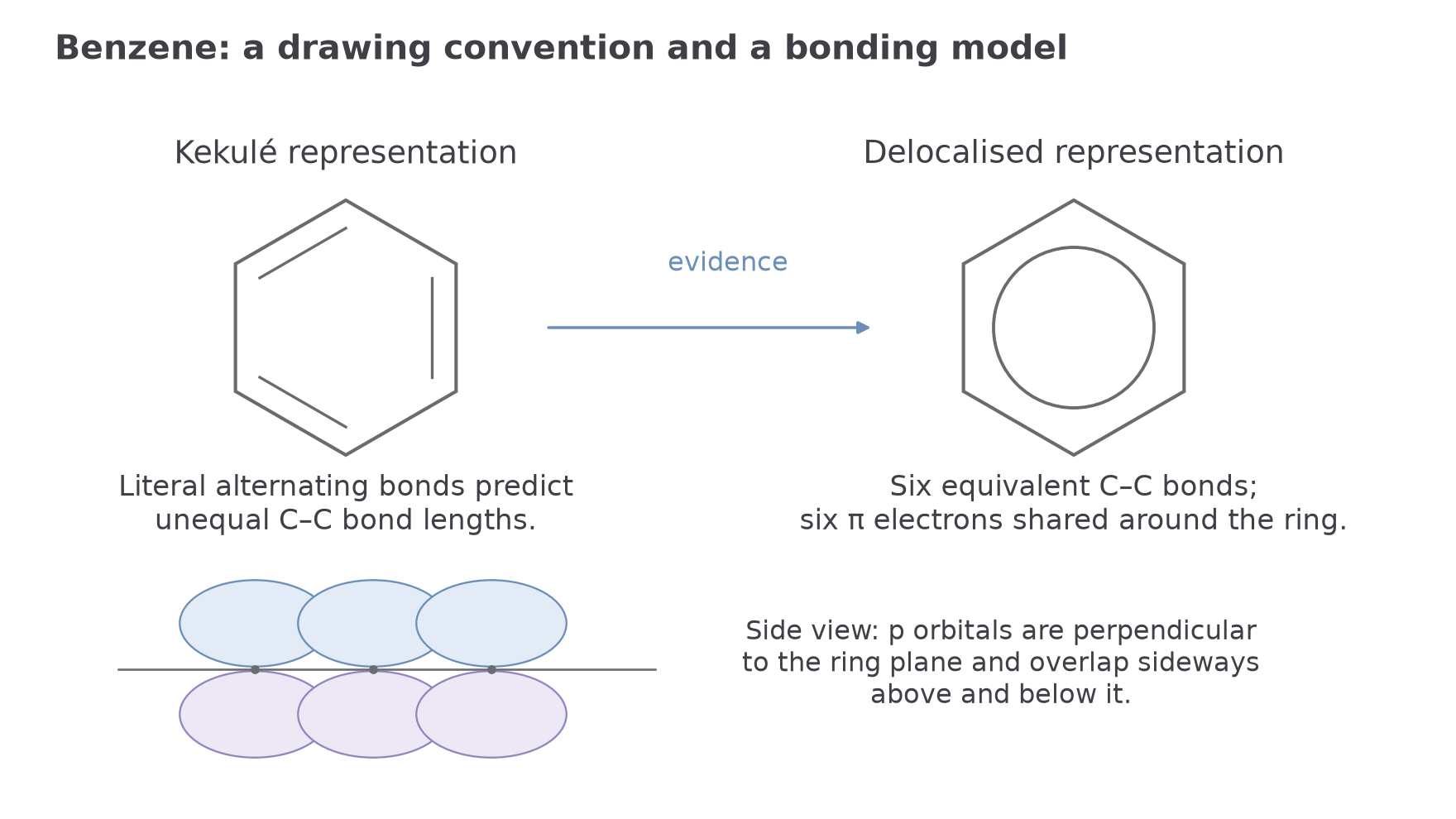
The delocalised model keeps the six carbon atoms in a planar hexagonal ring. Each carbon forms sigma bonds to two neighbouring carbon atoms and one hydrogen atom. The remaining p orbital on each carbon overlaps with p orbitals on both neighbouring carbons, so the six pi electrons are spread over the whole ring rather than locked into three separate bonds.
This means the circle-in-a-hexagon drawing is a shorthand for delocalised pi electron density. It is not meant to show an extra bond or a seventh atom. In equations and mechanisms, either benzene representation may be used, but the chemical model underneath should be the delocalised one.
A literal fixed alternating-bond model also predicts two different adjacent (1,2-) disubstituted arrangements: the substituted carbons could share a single or a double bond. Only one 1,2-dibromobenzene is found. The delocalised model makes every adjacent C–C position equivalent, fitting this observation.
How The Delocalised Pi System Forms
Each carbon atom in benzene is bonded to three atoms: two carbons and one hydrogen. The sigma-bond framework is planar and gives approximately angles around each carbon. The p orbital on each carbon is perpendicular to this plane.
For a localised alkene bond, two neighbouring p orbitals overlap sideways to make one pi bond between two carbon atoms. In benzene, each p orbital can overlap sideways with p orbitals on both sides. The result is a continuous pi system above and below the ring.
"Delocalised electrons" alone is not a full description:
Delocalised pi system in benzene
The p orbitals on all six carbon atoms overlap sideways, forming a continuous pi system above and below the plane of the ring in which the six pi electrons are shared by all six carbons.
That model explains why all carbon-carbon bonds in benzene are equivalent. It also explains why benzene is energetically more stable than a hypothetical cyclohexatriene with three isolated bonds.
The C–C sigma bonds form by head-on overlap of orbitals along the line joining adjacent nuclei. The π system forms by sideways overlap of the perpendicular p orbitals. These are different overlaps: the delocalised π system sits above and below an already bonded planar sigma framework.
Evidence From Hydrogenation Enthalpy
Hydrogenation adds hydrogen across a carbon-carbon double bond. For an ordinary cycloalkene, one bond is hydrogenated to a bond:
cyclohexene + → cyclohexane
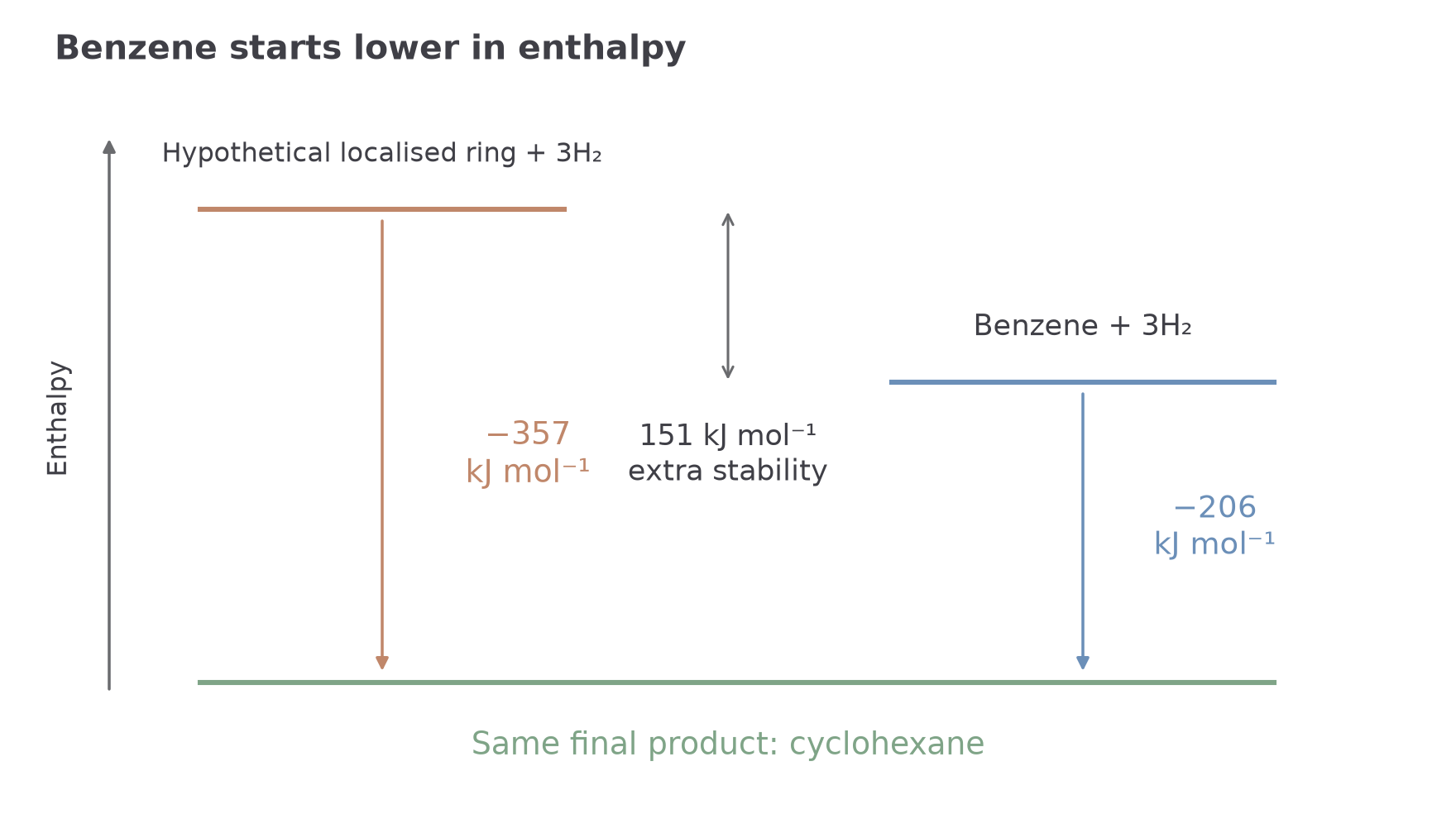
Using a typical gas-phase data set, the enthalpy change for this reaction is about . If benzene really behaved like a ring with three isolated bonds, a simple prediction would be about three times this value:
The measured hydrogenation enthalpy for benzene to cyclohexane is much less exothermic, about :
benzene + → cyclohexane
[DIAGRAM: asset_name: Hydrogenation Enthalpy Evidence For Benzene Stability; asset_slug: edexcel_a_level_chemistry_l085_hydrogenation_enthalpy_evidence; recommended_method: deterministic_chart; description: Shows predicted hydrogenation enthalpy for three isolated C=C bonds versus actual benzene hydrogenation]
Worked example: calculate the extra stability
Use these values: hydrogenation of cyclohexene ; hydrogenation of benzene .
If benzene contained three ordinary isolated bonds, the predicted value would be . The actual value is .
Extra stability of benzene
the hydrogenation enthalpy of one isolated (cyclohexene).
Continue this lesson.
You’re previewing NovaLearn without an account. Create a free account to read the rest.
Create free account