5.1-5.5 - Moles, Formulae And Gas Data
Connect particle counts, amount of substance and molar mass. Use composition, mass-change and gas measurements to calculate empirical and molecular formulae, with careful unit conversions and whole-number ratios.
Particles And The Mole
Imagine trying to compare a bottle of carbon dioxide with a few grams of magnesium. Their masses, volumes and particles are all different, but chemistry needs one quantity that lets us count reacting particles. That quantity is amount of substance, measured in moles, symbol .
Mole
The SI unit of amount of substance. One mole contains exactly specified entities. For course calculations use the supplied rounded Avogadro constant, .
Particles and amount
= number of specified particles; = amount in ; (data-booklet value).
The word "particles" must match the substance named in the question. For sodium atoms it means atoms. For chlorine gas it means molecules. For magnesium oxide it means formula units, unless the question asks for ions.
Worked example: using Avogadro's constant
A sample contains of water molecules. Calculate the number of water molecules, and then the total number of atoms in the sample.
Each water molecule contains 3 atoms, so:
The chemical sense-check is that the atom count is three times larger than the molecule count because each particle contains two H atoms and one O atom.
A mole is a count, not a mass
"One mole weighs " is wrong: a mole is a count of particles, and the mass of one mole depends on what the particles are.
Standard form and ordinary decimal form represent the same amount: . Both retain two significant figures; the leading zeros locate the decimal point, while the final zero records precision. Enter powers of ten with the calculator's exponent key and bracket the whole denominator in a division.
Keep extra figures through a multi-step calculation, then report the final result to the precision justified by the least precise measured input. Exact counting factors, such as three atoms per carbon dioxide molecule, do not limit significant figures. For example, molecules is reported as to three significant figures.
Molar Mass
The mole links microscopic particles to measurable laboratory mass.
Molar mass, M
The mass per mole of a substance, in .
For elements, molar mass uses the relative atomic mass, . For compounds, molar mass uses the relative formula mass or relative molecular mass, , found by adding the values in the formula.
Amount from mass
= amount in ; = mass in ; = molar mass in .
The number for and the number for molar mass are often the same, but their meanings are not identical. has no unit. Molar mass has unit .
Worked example: mass to moles
Calculate the amount of substance in of sodium carbonate, .
First find the molar mass:
Then convert mass to amount:
The sense-check is useful: is much less than , so the amount must be much less than one mole.
A dot in a hydrate formula includes water of crystallisation in its mass. For , add seven complete water molecules: . Thus has mass . The dot is part of the formula, not a decimal point.
Common-error contrast
Do not multiply by just because a question mentions moles. Use Avogadro's constant when the target is particles. Use molar mass when the target is mass or amount.
Guided practice
Calculate the amount of substance in of magnesium oxide, .
Route: , so to three significant figures.
Empirical Formulae
Composition data become a chemical formula only after masses have been converted into relative numbers of atoms.
Empirical formula
The simplest whole-number ratio of atoms of each element in a substance.
It does not always show the actual molecule. For example, glucose has molecular formula , but its empirical formula is .
[DIAGRAM: asset_name: Edexcel A Level Chemistry L024 Empirical To Molecular Formula; asset_slug: edexcel_a_level_chemistry_l024_empirical_to_molecular_formula; recommended_method: deterministic_code; description: Worked composition route gives CH2O and molecular multiplier six gives C6H12O6. Pale 1600 by 900 diagram rendered with Pillow; technical geometry and Unicode chemical labels inspected.]
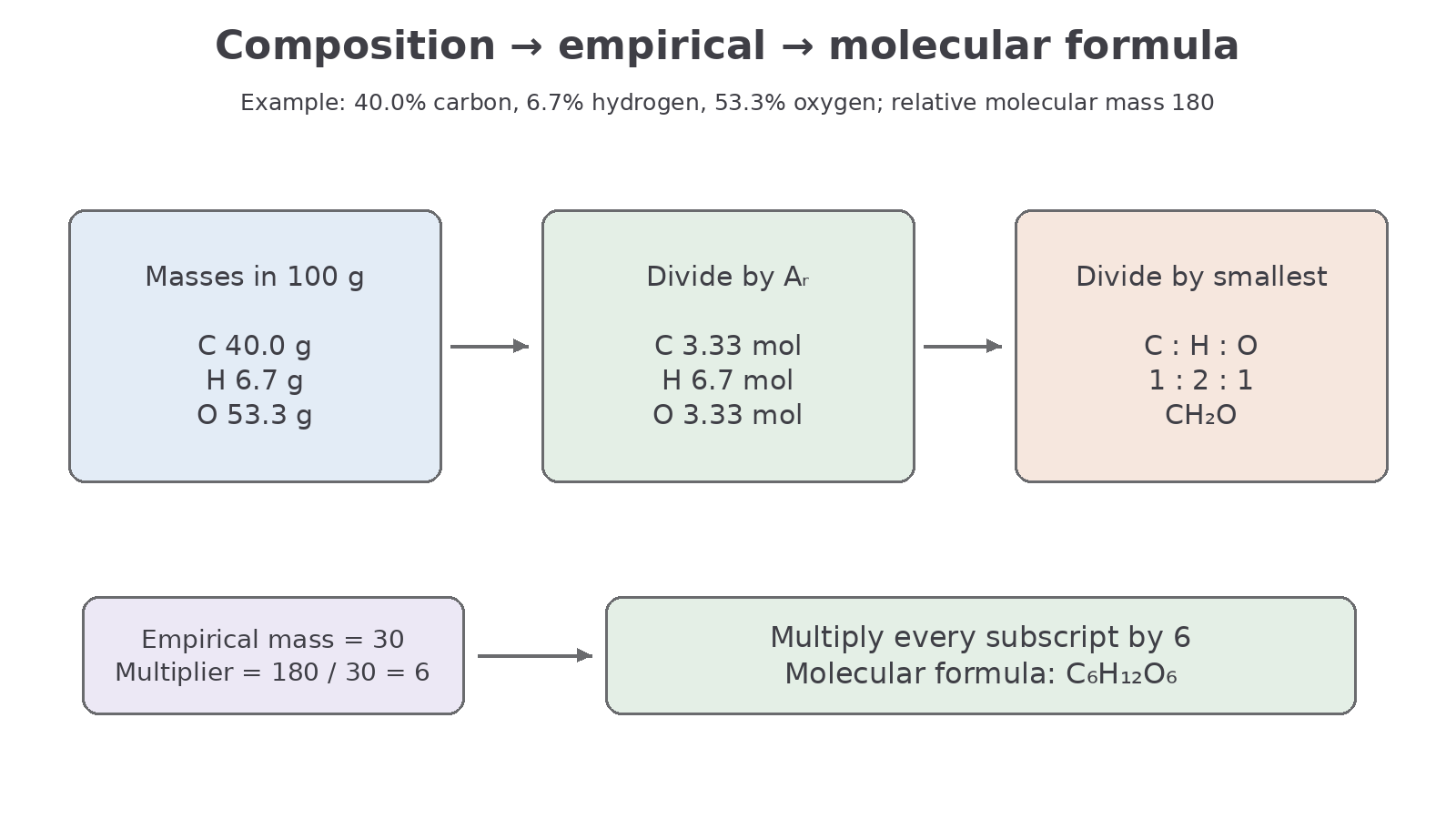
The route from composition data is always a mole-ratio route:
- If data are percentages, assume .
- Convert each element's mass to moles using .
- Divide every mole amount by the smallest mole amount.
- If the ratio is close to halves, thirds or quarters, multiply all ratios by the same integer.
- Write the empirical formula using the simplest whole-number ratio.
Worked example: percentage composition
A compound contains , and by mass. Determine its empirical formula.
Assume of compound:
| Element | Mass / g | Moles | |
|---|---|---|---|
| C | 52.2 | 12.0 | |
| H | 13.0 | 1.0 | |
| O | 34.8 | 16.0 |
Now divide by the smallest mole amount, :
The is close enough to because the data are given to three significant figures. The empirical formula is .
Do not round a ratio of to . Multiplying both values by 2 gives . For example, N and O give , hence . Values near one third or two thirds need multiplication by 3.
Mass ratio is not atom ratio
Percentages are not placed straight into a formula as subscripts. Formulae count atoms, so the masses must first be converted to amounts in moles.
Continue this lesson.
You’re previewing NovaLearn without an account. Create a free account to read the rest.
Create free account