10.1-10.2 - Dynamic Equilibrium And Shifts
At dynamic equilibrium, both reactions continue while concentrations remain constant. Predict how changing concentration, gas volume or temperature changes the mixture, and distinguish an immediate physical effect from the later chemical response.
Dynamic Does Not Mean Static
A reversible reaction is not simply a reaction that "goes backwards" after it has finished. It is a reaction where reactants form products and products can form reactants under the same conditions.
For a simple homogeneous gaseous example:
all reacting species are in the same phase, so the system is homogeneous. A dynamic equilibrium can be reached if the system is closed, so substances cannot escape and the conditions can settle.
Dynamic equilibrium
The state of a reversible reaction in a closed system in which the forward and backward reactions continue at equal rates, so the concentrations of reactants and products remain constant.
The word "constant" is doing careful work. It does not mean the concentrations of reactants and products are equal. It means each concentration is no longer changing with time because the two rates are balanced.
Common-error contrast
| Tempting statement | Why it fails | Better A level statement |
|---|---|---|
| The reaction has stopped | The particles are still reacting in both directions | The forward and backward rates are equal |
| Reactants and products have equal concentrations | Equal rates do not require equal concentrations | The concentrations remain constant |
| Equilibrium always means half reactants and half products | Some equilibria strongly favour one side | The position of equilibrium depends on the reaction and conditions |
| An open flask can always reach equilibrium | Products may escape, so the reverse reaction cannot balance the forward one | A closed system is needed for a stable dynamic equilibrium |
What A Shift Really Means
When a system at equilibrium is disturbed, the two rates are no longer balanced for a while. The system then has a net reaction in one direction until a new dynamic equilibrium is reached.
[DIAGRAM: asset_name: Equilibrium Response Sequence; asset_slug: edexcel_a_level_chemistry_l049_equilibrium_response_sequence; recommended_method: deterministic_chart; description: Three-panel monochrome schematic showing a homogeneous gaseous equilibrium before a concentration change, during a temporary net forward reaction, and at a new equilibrium where forward and reverse rates are equal again.]
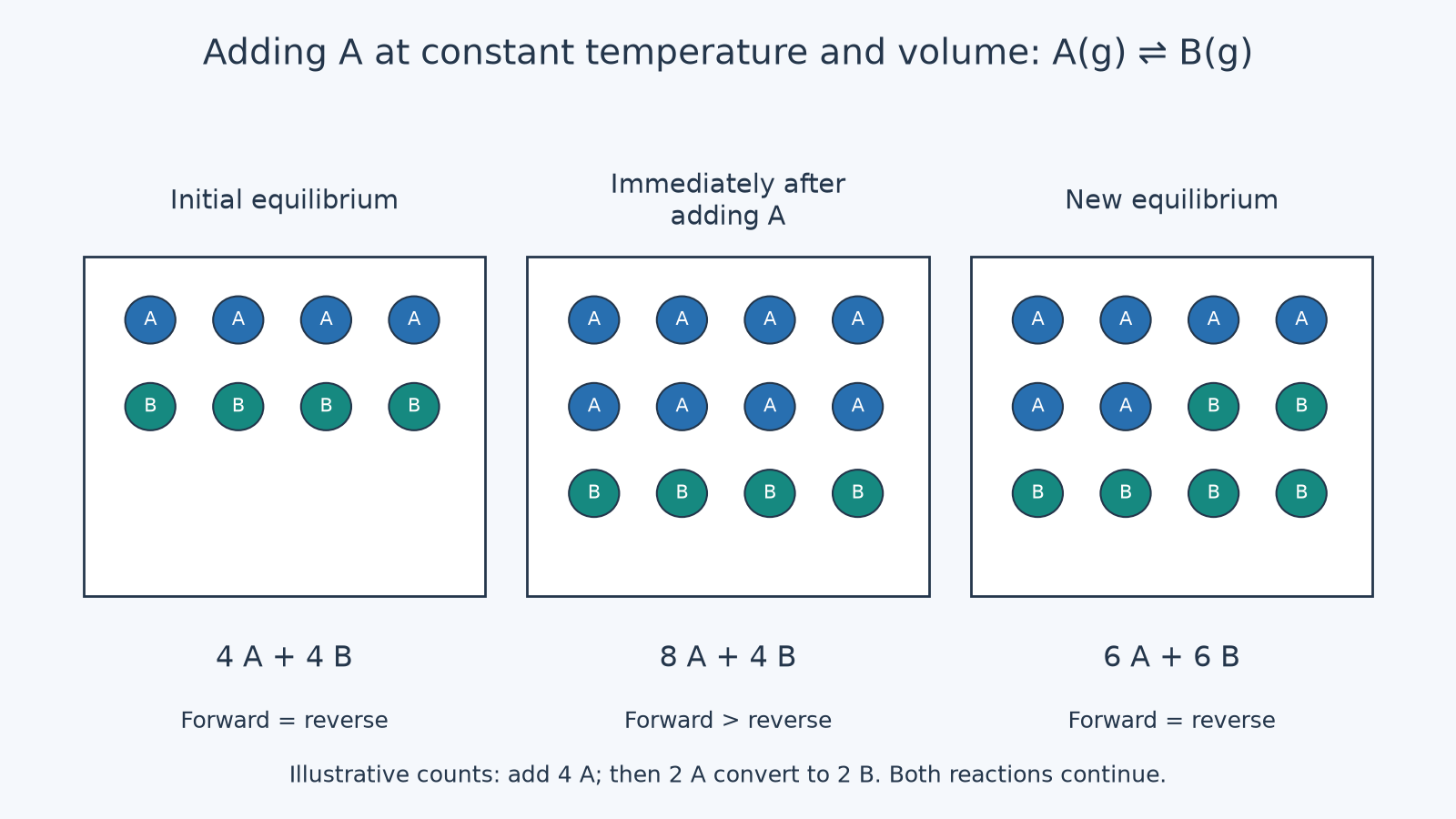
This is what chemists often call a shift in equilibrium position. A shift does not mean the reaction has become one-way. It means that, for a period, more reaction occurs in one direction than the other, changing the equilibrium mixture.
Use this reasoning sequence:
change applied → one rate is affected more than the other → net forward or net backward reaction occurs → concentrations change → forward and backward rates become equal again → new dynamic equilibrium
The system's response is often summarised as opposing the change. That phrase is useful, but it is not a magic sentence. In an answer, say which direction is favoured and why that direction reduces the effect of the change.
Worked example: describing the response
A homogeneous equilibrium mixture contains , and :
Extra is added at constant temperature and volume. Immediately, there are more collisions involving and , so the forward reaction rate increases more than the backward reaction rate. The system has a net forward reaction, using some of the added and producing more , until the forward and backward rates are equal again.
Chemical interpretation: the new equilibrium still contains all three species. The mixture has changed composition; it has not gone to completion.
Changing Concentration
Changing concentration changes how often reacting particles meet. In a homogeneous equilibrium, the qualitative prediction follows the species whose concentration was changed.
For:
use these patterns:
| Change | Net direction favoured | Why |
|---|---|---|
| Add | forward | uses up some added by forming more |
| Add | backward | uses up some added by forming more and |
| Remove | backward | replaces some by decomposing |
| Remove | forward | replaces some by reacting with |
The justification should name the species and the direction. "It shifts right" may be too thin if the question asks you to justify. "The equilibrium shifts forward because added is used up as more forms" is much more secure.
When adding a dissolved species, assume the added volume is negligible unless dilution data are supplied. A large volume of dilute reagent changes several concentrations, so consider dilution as well as the added amount.
Guided practice
For the equilibrium:
predict the effect of adding more .
Route:
- is a reactant.
- The system responds by using up some added .
- The net reaction is forward.
- The equilibrium mixture contains more .
Changing Pressure In Gaseous Equilibria
Pressure changes matter most for homogeneous gaseous equilibria. If pressure is increased by decreasing volume, the system responds in the direction that reduces the number of gas particles. If pressure is decreased by increasing volume, the system responds in the direction that increases the number of gas particles.
Only count gaseous species in the balanced equation. For this qualitative lesson, compare the total number of moles of gas on each side.
Worked example: pressure and gas particles
Consider:
Continue this lesson.
You’re previewing NovaLearn without an account. Create a free account to read the rest.
Create free account