6E.37-6E.38 - Alcohol Classification And Reactions
The carbon bearing the OH group determines an alcohol’s class and its oxidation products. Learn how reagents select combustion, substitution, oxidation or dehydration, and use structural formulae to predict and balance each change.
One Functional Group, Several Routes
A bottle labelled "propanol" is not enough information for a chemist. Propan-1-ol and propan-2-ol have the same molecular formula, but they do not give the same oxidation products, because the OH group sits in a different carbon environment. Alcohol chemistry therefore begins with a structural question: what is the carbon attached to the OH group bonded to?
[DIAGRAM: asset_name: Alcohol Reaction Map; asset_slug: edexcel_a_level_chemistry_l038_alcohol_reaction_map; recommended_method: deterministic_chart; description: Four alcohol reaction families with the correct reagents and product families, separating oxidation from substitution and dehydration.]
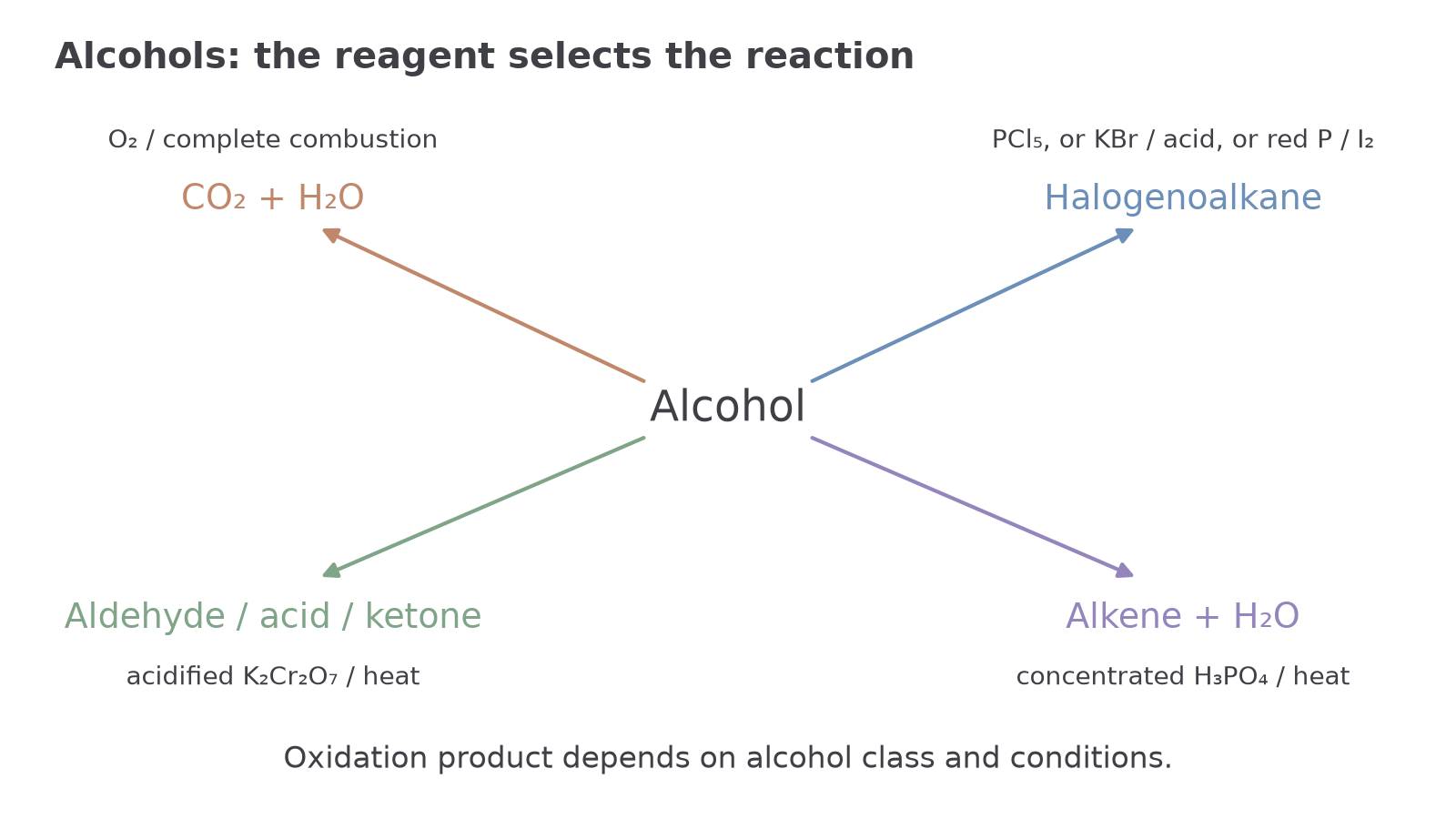
The pattern is not "alcohols do lots of reactions"; it is "the OH group can be used as a handle for predictable functional-group conversions". The same starting alcohol can be:
| Reaction family | What changes | Typical product family |
|---|---|---|
| Combustion | The molecule is fully oxidised by oxygen in air | Carbon dioxide and water |
| Halogenation | OH is replaced by Cl, Br or I | A halogenoalkane |
| Oxidation | The carbon attached to OH loses hydrogen and gains oxygen character | Aldehyde, carboxylic acid or ketone |
| Elimination | OH and H are removed from neighbouring carbons | An alkene and water |
The reaction name alone is not enough. Questions usually expect the reagent, condition and product to match each other: for example, is an oxidation condition, while concentrated is an elimination condition.
Classifying The OH Carbon
Alcohols are classified by looking only at the carbon atom directly bonded to the OH group. Do not classify from the longest carbon chain, the total number of carbons, or the position number in the name unless that position tells you the environment of the OH carbon.
| Class | What the OH carbon is bonded to | General pattern | Example |
|---|---|---|---|
| Primary alcohol | No more than one other carbon atom | , ethanol | |
| Secondary alcohol | Two other carbon atoms | , propan-2-ol | |
| Tertiary alcohol | Three other carbon atoms | , 2-methylpropan-2-ol |
Methanol, , has no carbon group attached to the OH carbon, but it behaves with the primary-alcohol pattern in this topic because the OH carbon still has C-H bonds that can be oxidised. For larger alcohols, read the class directly from the displayed or condensed structural formula.
Common-error contrast
and both contain three carbon atoms, but only one is primary. In , the OH carbon is at the end and is bonded to one other carbon; in , the OH carbon is in the middle and is bonded to two other carbons. The class follows the OH carbon, not the molecular formula.
Classify from the OH carbon only
A tertiary alcohol is not tertiary because it has three methyl groups somewhere in the molecule: the OH-bearing carbon itself must be bonded to three carbon atoms. Counting carbons elsewhere in the chain fails on branched structures.
Combustion And Halogenation
In complete combustion, an alcohol reacts with oxygen in air to form carbon dioxide and water. For a saturated monohydric alcohol with formula , the balanced pattern is:
Complete combustion of an alcohol
For a saturated monohydric alcohol with carbon atoms; double all coefficients if is odd.
For ethanol:
The chemical reasoning is atom accounting. All carbon atoms in the alcohol become , all hydrogen atoms become , and the coefficient of is then chosen to balance oxygen. If a question simply says "combustion in oxygen in air", assume complete combustion unless the stem gives evidence of limited oxygen, carbon monoxide or soot.
For a gas-volume calculation, first use the balanced equation to convert alcohol amount to oxygen amount, then use with the supplied molar gas volume. For example, 0.100 mol ethanol needs oxygen. At a supplied room-temperature molar gas volume of , this is . The final unit is a volume, and the equation coefficient supplies the ratio.
Halogenation converts an alcohol into a halogenoalkane by replacing OH with a halogen atom. Three reagent routes replace the OH group:
| Product wanted | Reagent/condition | Product pattern | Useful equation pattern |
|---|---|---|---|
| Chloroalkane | |||
| Bromoalkane | 50% concentrated sulfuric acid and potassium bromide | ||
| Iodoalkane | Red phosphorus and iodine |
For the iodoalkane route, red phosphorus and iodine generate phosphorus(III) iodide in the reaction mixture, so you may see used as the reacting halogenating agent. The starting reagents are red phosphorus and iodine; the phosphorus(III) iodide is formed in situ.
Worked example
Write an equation for the reaction of propan-1-ol with phosphorus(V) chloride, and name the organic product.
Start from the functional group conversion: becomes . Propan-1-ol is , so the organic product is .
The product is 1-chloropropane. The equation also shows why this reaction can give steamy acidic fumes: hydrogen chloride is a by-product. Hydrogen chloride forms acidic fumes in moist air, so this reaction needs suitable ventilation and eye protection.
Guided practice
Complete the product for each conversion.
| Starting alcohol | Reagent condition | Organic product |
|---|---|---|
| 50% concentrated and | ||
| Red phosphorus and iodine |
The mechanism is not required here. The assessed decision is the functional-group replacement and the correct reagent-product pairing.
Oxidation Depends On Class
Oxidation of alcohols in this lesson uses potassium dichromate(VI) in dilute sulfuric acid. In equations, the oxidising agent may be represented as [O], which keeps the focus on the organic product rather than the full ionic redox equation. The usual observation is that acidified dichromate(VI) changes from orange to green when it is reduced while the alcohol is oxidised.
Continue this lesson.
You’re previewing NovaLearn without an account. Create a free account to read the rest.
Create free account