4C.15 - Inorganic Ion Tests
Identify carbonate, hydrogencarbonate, sulfate and ammonium ions using reagents, observations and balanced ionic equations. Plan fresh-portion tests and recognise what positive and negative results can establish.
Positive And Negative Tests
A bottle labelled "unknown salt" is not identified by a single chemistry word. It is identified by a chain:
| Step | What the chemist does | What counts as evidence |
|---|---|---|
| Reagent choice | Add a reagent that reacts with one target ion family | The reagent is specific enough for the question context |
| Observation | Look for gas, precipitate or indicator change | The observation is described, not guessed |
| Particle model | Decide which ions must have reacted | Charges and reacting species are correct |
| Equation | Write the ionic equation where useful | Spectator ions are removed and charge is balanced |
| Conclusion | Name the ion present | The conclusion follows from the observation |
For this lesson, the useful observations are fizzing from a gas, a white precipitate, and alkaline ammonia gas. The equations are not decoration: they explain why a positive test is positive.
Observation opener
Three colourless solutions are tested.
| Sample | Test performed | Observation |
|---|---|---|
| A | Add dilute acid | Effervescence; gas turns limewater milky |
| B | Add acidified barium chloride solution | White precipitate |
| C | Add sodium hydroxide solution and warm | Damp red litmus paper held at the tube mouth turns blue |
Before naming the ions, ask what each observation proves. A gas that turns limewater milky is carbon dioxide; a white precipitate with barium ions in acidified solution is barium sulfate; an alkaline gas formed on warming with hydroxide ions is ammonia.
Negative results and controls
A negative result means the target was not detected under the conditions used. It does not prove absolute absence: a small amount, an unsuitable condition or a failed reagent may give a false negative. Compare with a known positive sample using the same reagent and procedure, and a blank where appropriate. A positive control shows the method can detect the target; a blank can reveal contamination.
Common-error contrast
"A white precipitate formed" is not a full identification by itself. The reagent and conditions matter. A white precipitate after acidified barium chloride has a different meaning from a white precipitate in a halide test with silver nitrate, which belongs outside this lesson.
Carbonate And Hydrogencarbonate
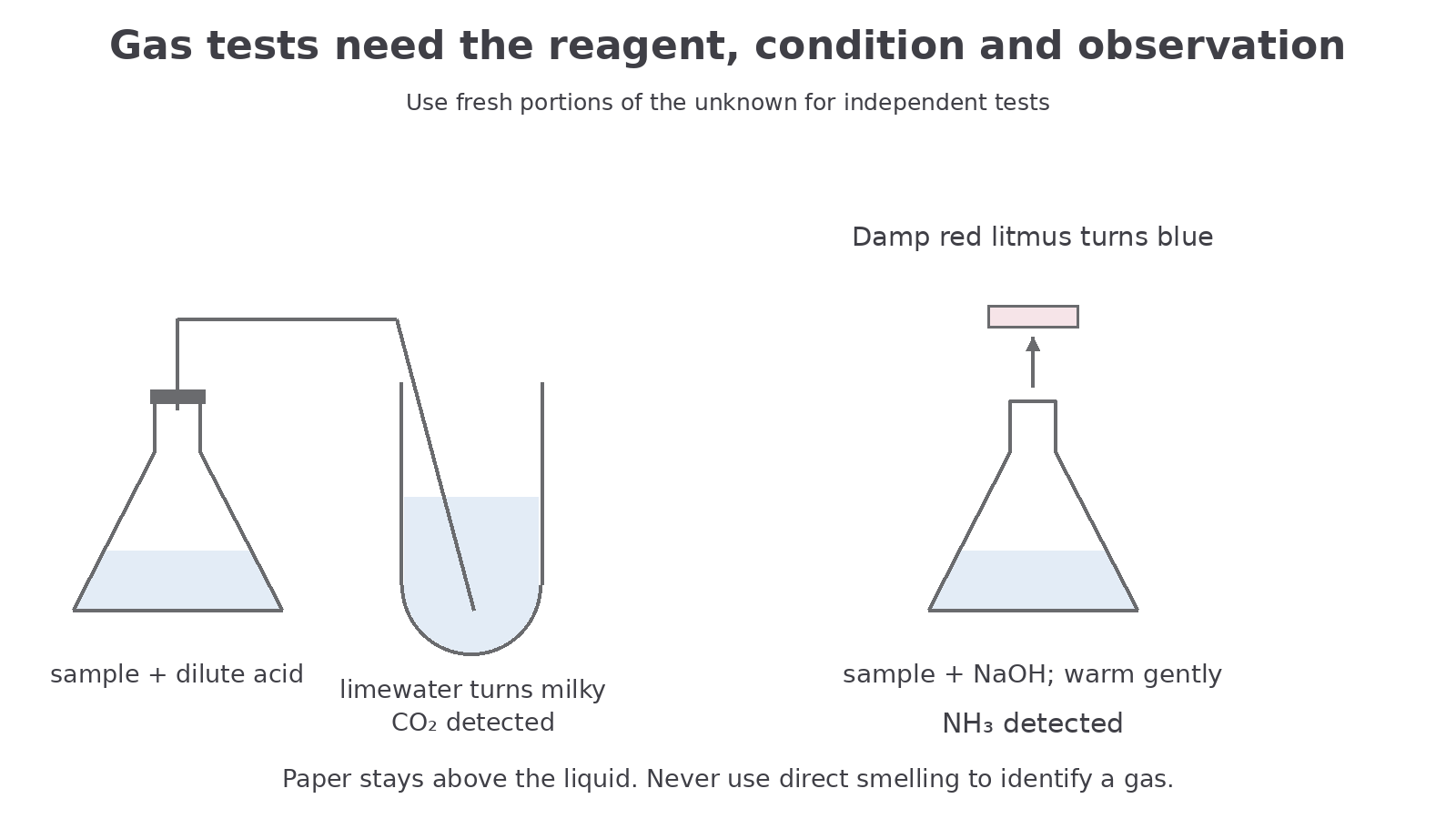
Carbonate ions, , and hydrogencarbonate ions, , both react with aqueous acid to produce carbon dioxide. The visible sign is effervescence; the confirmatory gas test is that carbon dioxide turns limewater milky.
The ionic equations show the difference in proton demand:
Carbonate needs two protons because its charge is ; hydrogencarbonate already has one proton attached, so it needs one more proton to form carbonic acid, which breaks down to carbon dioxide and water. In a qualitative test, both ions can give the same carbon dioxide observation, so the equation is where the distinction becomes clear.
The limewater confirmation can be represented as:
The milkiness is a suspension of calcium carbonate.
Worked example
A student adds dilute hydrochloric acid to an aqueous sample. The mixture effervesces, and the gas turns limewater milky.
- Deduce the gas produced.
- Write an ionic equation if the ion in the sample is carbonate.
- Write an ionic equation if the ion in the sample is hydrogencarbonate.
Route
The limewater result identifies the gas as carbon dioxide. For carbonate:
For hydrogencarbonate:
Chemical interpretation
Within the stated carbonate/hydrogencarbonate candidate set, the observation supports an acid-reactive carbonate-type ion. It does not, by observation alone, distinguish carbonate from hydrogencarbonate; the question must give enough context, or ask for both possible equations.
Sulfate Tests
Sulfate ions, , are identified using acidified barium chloride solution. A positive result is a white precipitate of barium sulfate.
The acidified condition matters. Carbonate ions can also form an insoluble white barium salt if barium ions are added directly, so acid is used to remove carbonate or hydrogencarbonate interference by converting it to carbon dioxide and water. Do not acidify a sulfate test with sulfuric acid, because that would add sulfate ions and could create the very precipitate being tested for.
Practical reasoning
Use a clean portion of the sample solution. If the sample is a solid, dissolve a small amount in deionised water first, then acidify with dilute hydrochloric acid, allow carbonate effervescence to finish, then add barium chloride solution. The conclusion should name both the observation and the ion: a white precipitate with acidified barium chloride indicates sulfate ions.
Name the acid in a complete procedure: dilute hydrochloric acid or dilute nitric acid is suitable. “Acidified” describes a condition but does not identify which reagent was used. If a solid does not dissolve in water, do not infer absence of the target ion from an unsuccessful solution test; obtain an appropriate preparation method for that sample.
What the acid does in the sulfate test
Barium ions form an insoluble white solid with sulfate ions. The acid is added first so that carbonate ions are destroyed as carbon dioxide instead of forming their own white barium precipitate. The acid does not "make the sulfate": the sulfate ion is already in the sample if the test is positive.
Ammonium Tests
Ammonium ions, , are identified by adding sodium hydroxide solution and warming. Hydroxide ions remove a proton from ammonium ions, producing ammonia gas.
Ammonia is an alkaline gas. The usual positive observation is that damp red litmus paper held near the mouth of the warm test tube turns blue. The paper must be damp because ammonia needs to dissolve in water on the paper before it can show alkaline behaviour.
Method logic
Use a small amount of sample in a test tube, add sodium hydroxide solution, and warm gently. Hold damp red litmus paper at the mouth of the tube without touching the liquid. Keep the mouth of the tube pointed away from people, and do not rely on direct smelling as the main test.
Worked example
An unknown salt is warmed with aqueous sodium hydroxide. A gas is produced that turns damp red litmus paper blue.
- Deduce the gas.
- Deduce the ion in the original salt.
- Write the ionic equation.
Route
Damp red litmus turning blue shows an alkaline gas. In this test, the alkaline gas is ammonia, . Ammonia formed only after adding hydroxide ions and warming, so the original sample contained ammonium ions, .
Common-error contrast
Sodium hydroxide does not "contain ammonia". It supplies ions. The ammonium ion in the sample supplies the nitrogen and most of the hydrogen atoms in the ammonia molecule.
Combining Inorganic Ion Tests
Qualitative analysis is strongest when each test is done on a fresh small portion of the unknown. That avoids one reagent contaminating the next test and producing a misleading observation. For example, excess sodium hydroxide left after an ammonium test consumes added acid; if the mixture is not made acidic, carbonate interference may remain in a later barium test.
[DIAGRAM: asset_name: Edexcel 9Ch0 Inorganic Gas Tests; asset_slug: edexcel_9ch0_inorganic_gas_tests; recommended_method: deterministic_code; description: Acid generates carbon dioxide confirmed with limewater; warmed ammonium and hydroxide release ammonia to damp indicator above the liquid. Pale 1600 by 900 diagram rendered with Pillow; technical geometry and Unicode chemical labels inspected.]
| Target ion | Reagent and condition | Positive observation | Ionic equation |
|---|---|---|---|
| Aqueous acid, then test gas | Effervescence; turns limewater milky | ||
| Aqueous acid, then test gas | Effervescence; turns limewater milky | ||
| Acidified barium chloride solution | White precipitate | ||
| Sodium hydroxide solution and warming | Ammonia turns damp red litmus blue |
State symbols are often worth including when the question asks for an equation from a practical observation:
Recap
Do not stop at naming the ion. Link reagent, condition, observation and ionic equation: acid plus carbonate-type ions gives ; acidified barium chloride plus sulfate gives ; warm sodium hydroxide plus ammonium gives . That chain is what turns a remembered test into a justified chemical conclusion.