15B.24-15B.28 - Transition Metal Reactions And Complexes
Use reagent amount and colour changes to identify transition-metal ions. Write the equations for precipitation, amphoteric dissolving and ligand exchange, then explain chelate stability through entropy.
Reading The Test Tube
A colour change is not automatically a ligand exchange reaction. In this lesson, a colour change may come from a precipitate forming, a precipitate dissolving, a different ligand attaching to the metal ion, a different coordination number, or slow oxidation by air. Good answers give the observation and the chemical interpretation.
The ions in water are best treated as complex ions with water ligands, such as . In ordinary observations, exam questions may still write the ions as or . The table below gives the practical observations to recognise.
| Ion in solution | Typical solution colour | With a little | With excess | With a little | With excess |
|---|---|---|---|---|---|
| often green in test-tube solutions; pure is violet | green or grey-green precipitate | precipitate dissolves to a green solution | green or grey-green precipitate | precipitate dissolves slowly, or after sufficient excess/concentrated ammonia, to a purple solution | |
| pale green | green precipitate | no dissolving; precipitate may turn brown on standing | green precipitate | no dissolving; precipitate may turn brown on standing | |
| yellow to orange-brown | brown precipitate | no change | brown precipitate | no change | |
| pink | blue or blue-pink precipitate | no change | blue or blue-pink precipitate | precipitate dissolves to a straw/yellow solution, which can darken in air | |
| blue | blue precipitate | no change | blue precipitate | precipitate dissolves to a deep blue solution |
Two details are worth holding onto.
First, hydroxide is easily oxidised by oxygen in air, especially in alkaline solution, so a green precipitate turning brown is not ligand exchange. Second, cobalt(II) in excess ammonia can be oxidised by air after the ligand exchange; the initial dissolving in excess ammonia is the ligand substitution step, while later browning is a redox change.
Use fresh, separately labelled small samples for sodium hydroxide and ammonia. Add reagent dropwise first, record the precipitate colour, then add enough excess to test whether it dissolves; record the final solution colour and any change on standing. Record observations separately from the inferred ion identity. Use clean droppers to prevent contamination and a white background to distinguish pale colours. Wear eye protection, handle concentrated ammonia with ventilation, and collect metal-containing waste as directed. Chromium(III) ligand substitution can be slow, so record time and reagent concentration rather than assuming an immediate final colour.
Worked example: interpreting one unknown
An unknown transition-metal solution is blue. With a few drops of it forms a blue precipitate that does not dissolve in excess sodium hydroxide. With excess , a blue precipitate first forms and then dissolves to give a deep blue solution.
The ion is . The blue precipitate is copper(II) hydroxide, often written as or more fully as . The deep blue solution in excess ammonia contains , so this part is ligand exchange.
Chemical interpretation: sodium hydroxide only removes protons from coordinated water and gives a precipitate. Excess ammonia supplies ligands as well as behaving as a base, so it can dissolve the precipitate by forming a stable soluble ammine complex.
Writing Precipitation Equations
Metal aqua ions are acidic because the positive metal ion withdraws electron density from the bonds in the coordinated water ligands. A base can remove from those water ligands. Once enough protons have been removed to make a neutral complex, the product is insoluble and appears as a precipitate.
For a hexaaqua ion, the full complex-ion equation with hydroxide ions is:
For a hexaaqua ion:
The shortcut ionic equations are often enough when the question is about qualitative testing:
| Ion | Equation with | Observation |
|---|---|---|
| green/grey-green precipitate | ||
| green precipitate | ||
| brown precipitate | ||
| blue or blue-pink precipitate | ||
| blue precipitate |
Ammonia as a base
A small amount of aqueous ammonia gives the same hydroxide precipitates because ammonia acts as a Bronsted-Lowry base. It accepts protons removed from coordinated water and forms ammonium ions.
For a ion:
For a ion:
For example, with iron(III):
The state symbols matter because the visible observation is the solid precipitate. The ammonium ion is aqueous and usually colourless, so it is not the observation.
Worked example: sodium hydroxide versus ammonia
Write suitable ionic equations for the formation of a green iron(II) precipitate using and using .
With sodium hydroxide:
With ammonia:
Chemical interpretation: both equations produce the same insoluble hydroxide. The difference is the base: sodium hydroxide supplies directly, while ammonia removes protons and becomes .
Ammonia as a base first
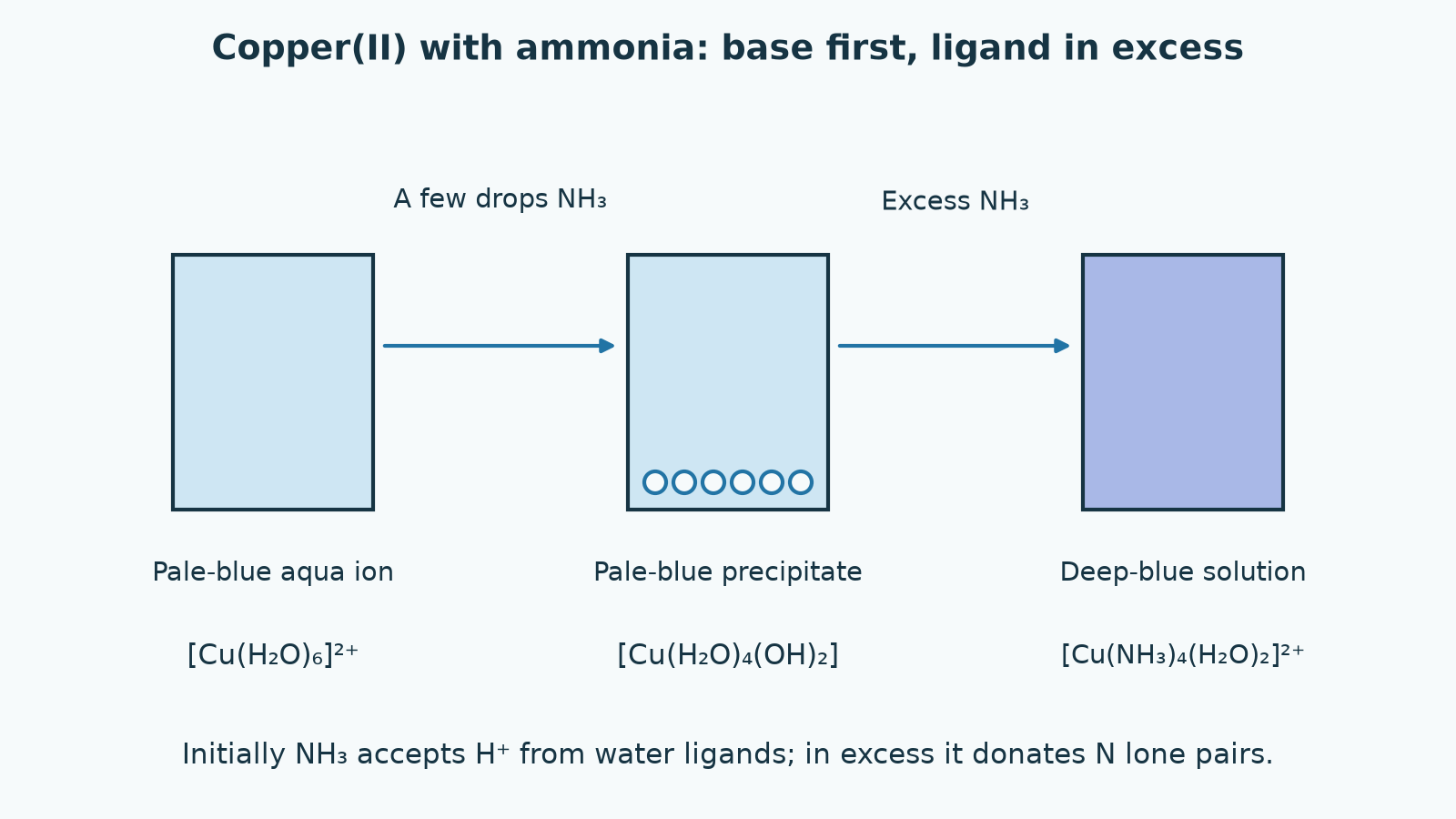
A precipitate forming with ammonia is not automatically ligand exchange. In the first drops, ammonia is acting as a base: it removes from coordinated water and forms a metal hydroxide precipitate. Ligand exchange is only the later substitution of ligands around the metal ion, seen clearly when some precipitates dissolve in excess ammonia.
Excess Reagent: Amphoteric Or Ligand Exchange
Among the five ions in this lesson, the important hydroxide precipitate that dissolves in excess is chromium(III) hydroxide.
[DIAGRAM: asset_name: Copper ammonia precipitation followed by excess ammonia ligand substitution; asset_slug: edexcel_a_level_chemistry_l073_copper_ammonia_sequence; recommended_method: deterministic_chart; description: Copper ammonia precipitation followed by excess ammonia ligand substitution.]
Amphoteric
Able to react with both acids and bases; chromium(III) hydroxide dissolves in acid and in excess hydroxide.
Using the full complex form:
Using the simplified hydroxide formula:
This is amphoteric behaviour, not ligand exchange in the usual sense. The precipitate is reacting further with hydroxide ions and forms a soluble hydroxo complex. The central chromium remains in oxidation state .
The other hydroxide precipitates in this set do not dissolve significantly in excess sodium hydroxide under the usual test conditions:
: no further reaction with excess
: no further reaction with excess
: no further reaction with excess
: no further reaction with excess
Excess ammonia: ligand exchange
In excess ammonia, some precipitates dissolve because ammonia molecules replace water or hydroxo ligands around the metal ion and form soluble ammine complexes. The nitrogen lone pair forms a dative covalent bond to the central metal ion.
Key equations for this lesson are:
The copper reaction gives the very strong deep blue colour. Cobalt(II) gives a straw/yellow solution, but it may darken because the amminecobalt(II) complex is oxidised by oxygen in air. Chromium(III) exchange with ammonia can be slower and less complete in a simple test tube than copper's, so observation wording may include "with sufficient excess ammonia" or "on standing".
Continue this lesson.
You’re previewing NovaLearn without an account. Create a free account to read the rest.
Create free account