8.7-8.8 - Hess's Law
Hess’s law connects measurable reactions to an enthalpy change that is difficult to measure directly. Build cycles from chemical equations, preserve signs and amounts, and apply the method to Core Practical 8 calorimetry.
Why Hess's Law Works
Some enthalpy changes are difficult to measure directly. In Core Practical 8, for example, the target reaction is the thermal decomposition of potassium hydrogencarbonate:
Heating must be supplied to make this decomposition happen, so a simple temperature-change experiment would not isolate the enthalpy change of decomposition. The temperature change would include heat transferred by the heater as well as heat absorbed or released by the reaction.
Hess's law gives a way around that problem.
Hess's law
The total enthalpy change for a reaction is independent of the route taken, provided the initial and final conditions (chemical states) are the same.
This works because enthalpy is a state function. The enthalpy change depends on the starting substances and the final substances, under the stated conditions, not on the number of steps used between them.
The useful consequence is practical: if the direct route is hard to measure, you can use one or more measurable routes that start and finish at the same chemical states. The sum of the enthalpy changes around the alternative route must match the enthalpy change for the direct route.
Keep three sign rules close to the chemistry:
| Operation | What happens to | Why |
|---|---|---|
| Reverse an equation | change the sign | the energy flow is reversed |
| Multiply an equation by a number | multiply by the same number | twice as many reacting particles transfer twice as much energy |
| Add equations together | add their values | the intermediate chemical steps cancel to give the overall route |
The route trap
A longer route does not have a bigger enthalpy change. The enthalpy change compares the same initial and final states; the alternative route may have more steps, but their signed enthalpy changes add up to the same overall change.
Building Hess Cycles
A Hess cycle is not a picture to memorise. It is a bookkeeping diagram that makes the starting state, final state and alternative route visible.
[DIAGRAM: asset_name: Hess Cycle Formation; asset_slug: edexcel_a_level_chemistry_l044_hess_cycle_formation; recommended_method: deterministic_chart; description: Pale-background colour Hess cycle with reactants and products at the top, elements in standard states at the bottom, a target enthalpy arrow across the top, formation enthalpy arrows from the elements to each top state, and a reminder that reversing an arrow changes the sign.]
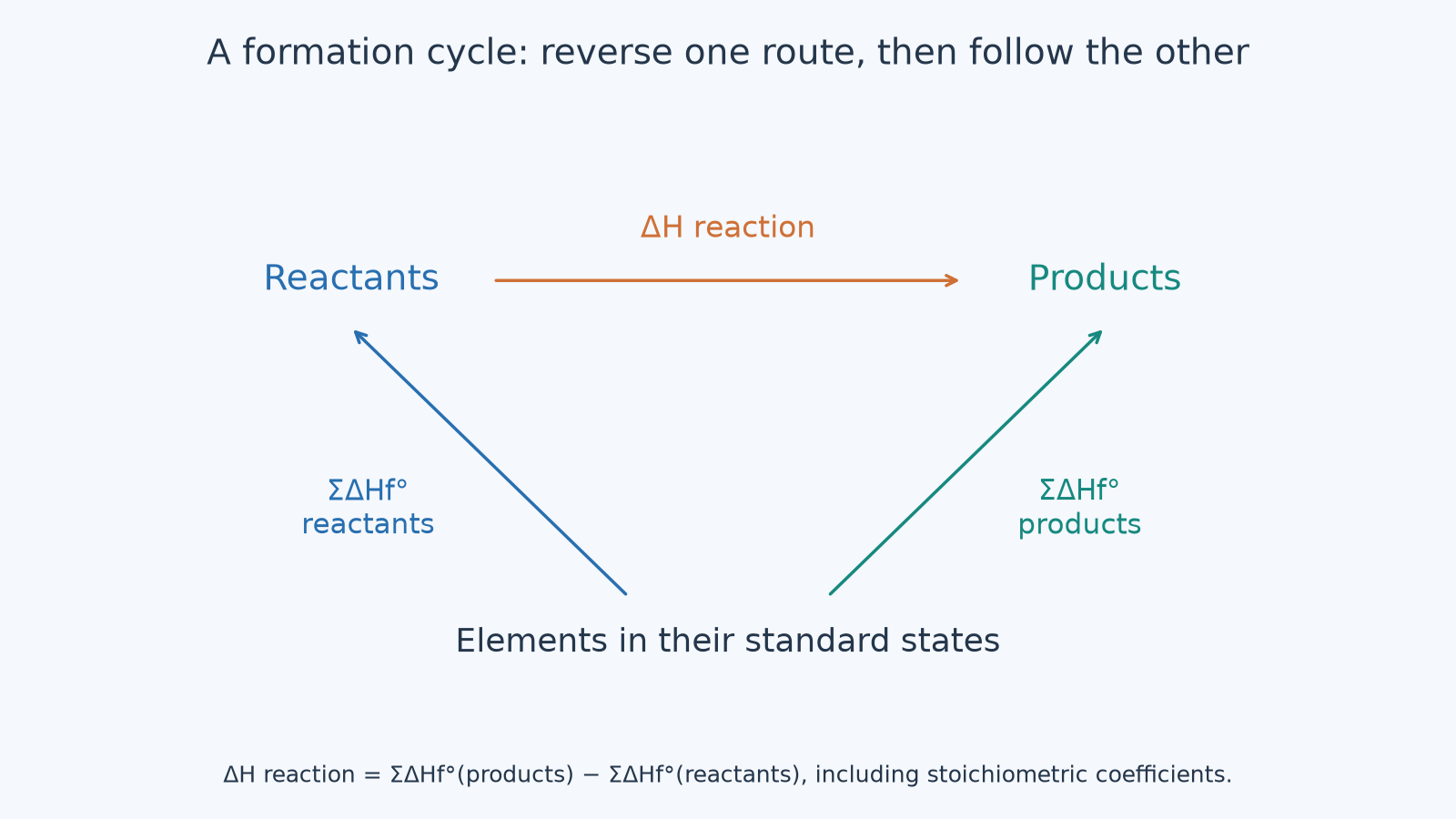
Start by placing the target reaction across the top: reactants → products.
Then choose the common lower state that both sides can be connected to using the data supplied. Two common patterns appear in A level Hess questions.
| Data supplied | Common state in the cycle | Useful relationship |
|---|---|---|
| Standard enthalpies of formation, | elements in their standard states | |
| Standard enthalpies of combustion, | complete combustion products, usually and |
Those relationships are not magic formulae. They come from following the arrows in the cycle.
For a formation cycle, the data usually forms substances from elements. If your route goes from reactants down to elements, you are moving against the formation arrows, so the reactant formation values are subtracted. Then you move from elements up to products, so the product formation values are added.
For a combustion cycle, both reactants and products burn to the same final combustion products. If you go from reactants to combustion products and then reverse the products' combustion route, the reactants' combustion enthalpies are added and the products' combustion enthalpies are subtracted.
Common-error contrast
Weak route: "Products minus reactants always works."
Stronger route: "For formation data, products minus reactants works because formation arrows point from elements to substances. For combustion data, reactants minus products works because combustion arrows point from substances down to the same combustion products."
Guided practice
The reaction is:
The supplied data are standard enthalpies of combustion. Which common state should go at the bottom of the cycle?
Answer: complete combustion products, and . Both ethene plus hydrogen and ethane can be connected to the same final combustion products, so combustion data can be used.
Calculating From Data
A Hess calculation has two jobs. First, build the correct route. Then do the arithmetic with signs, stoichiometric multiples and units.
Worked example: using formation enthalpies
Use the following standard enthalpies of formation to calculate the enthalpy change for the combustion of methane:
| Substance | |
|---|---|
Oxygen has a formation enthalpy of zero because is oxygen in its standard state. The cycle uses elements in their standard states at the bottom, so:
Substitute with the coefficients from the balanced equation:
Chemical interpretation: the reaction is strongly exothermic. The negative sign means the reacting system releases energy to the surroundings when one mole of methane reacts as written.
Worked example: using combustion enthalpies
Use the combustion data to calculate the enthalpy change for hydrogenation of ethene:
| Substance | |
|---|---|
The cycle goes from both top states down to the same combustion products. For combustion data:
Substitute:
Chemical interpretation: hydrogenation of ethene is exothermic. The calculation is not a bond enthalpy calculation; it uses complete combustion routes to the same products.
Continue this lesson.
You’re previewing NovaLearn without an account. Create a free account to read the rest.
Create free account