15B.33-15B.35 - Homogeneous Catalysis And Complex Preparation
Track catalysts and intermediates through aqueous redox cycles, including autocatalysis. Prepare and purify a copper complex, and use its stoichiometry to calculate and evaluate the isolated yield.
Same Phase, New Pathway
A catalyst does not make a reaction more thermodynamically favourable. It provides an alternative route with a lower activation energy, so a larger fraction of collisions can lead to reaction at the same temperature.
Homogeneous catalyst
A catalyst in the same phase as the reactants; it works through intermediate species.
In this lesson the important examples are aqueous ions reacting with aqueous ions, so the catalyst is also present in aqueous solution. This contrasts with the surface route for heterogeneous catalysts in the previous lesson.
Intermediate
A species made in one step of a mechanism and used up in a later step; it does not appear in the overall equation.
Use these labels carefully:
| Species type | What it does in the mechanism | What it does in the overall equation |
|---|---|---|
| Reactant | Present at the start and consumed overall | Appears on the left |
| Product | Made overall | Appears on the right |
| Catalyst | Used in one step and regenerated in another | Cancels from the overall equation |
| Intermediate | Made in one step and consumed in another | Cancels from the overall equation |
The catalyst and the intermediate are not the same idea, even if they are two forms of the same element. In many transition-metal catalytic cycles, the metal ion moves between oxidation states, and one oxidation state is the regenerated catalyst while another is the intermediate form.
Look at every step
"The catalyst is used up because it appears in the first step" looks at only one step. A catalyst can be consumed in one elementary step but must be regenerated in a later step, so it is not consumed in the overall reaction.
Iron(II) Ions As A Redox Shuttle
Peroxodisulfate(VI) ions oxidise iodide ions:
This reaction is slow when only and ions are mixed. Both reacting ions are negatively charged, so they repel each other; the direct collision route has a relatively high activation energy. Adding a small amount of gives an alternative redox route.
Step 1: is oxidised by peroxodisulfate(VI):
Step 2: the formed oxidises iodide ions:
Adding the two steps and cancelling species that appear on both sides gives the overall reaction:
The iron ions act as a redox shuttle. is changed to , then is changed back to . The ions are therefore regenerated and act as the homogeneous catalyst; is an intermediate form produced during the catalysed pathway.
At the observation level, iodine formation can be seen as a brown colour in solution, or by a blue-black colour if starch is used as an indicator. At the particle level, the catalyst works because a positively charged iron ion can interact more favourably with the negatively charged peroxodisulfate ion than two negative ions can interact directly.
Worked example: proving the catalyst from the equations
A proposed catalytic route is:
Show which species is the catalyst and which is the intermediate.
The species appears on the left of the first equation and on the right of the second equation in the same amount. It is used and regenerated, so it cancels from the overall equation. That makes the catalyst.
The species appears on the right of the first equation and on the left of the second equation in the same amount. It is made and then used up, so it also cancels, but it is not present as the starting catalyst. That makes the intermediate form of the catalyst.
The chemical interpretation is not just "iron is present". Good explanations need the oxidation-state cycle: iron(II) is oxidised to iron(III), then iron(III) is reduced back to iron(II), while iodide is oxidised to iodine.
Manganese(II) Ions And Autocatalysis
Acidified manganate(VII) ions oxidise oxalate ions. The overall ionic equation is:
[DIAGRAM: asset_name: Qualitative absorbance time curve for manganate oxalate autocatalysis; asset_slug: edexcel_a_level_chemistry_l075_autocatalysis_curve; recommended_method: deterministic_chart; description: Qualitative absorbance time curve for manganate oxalate autocatalysis.]
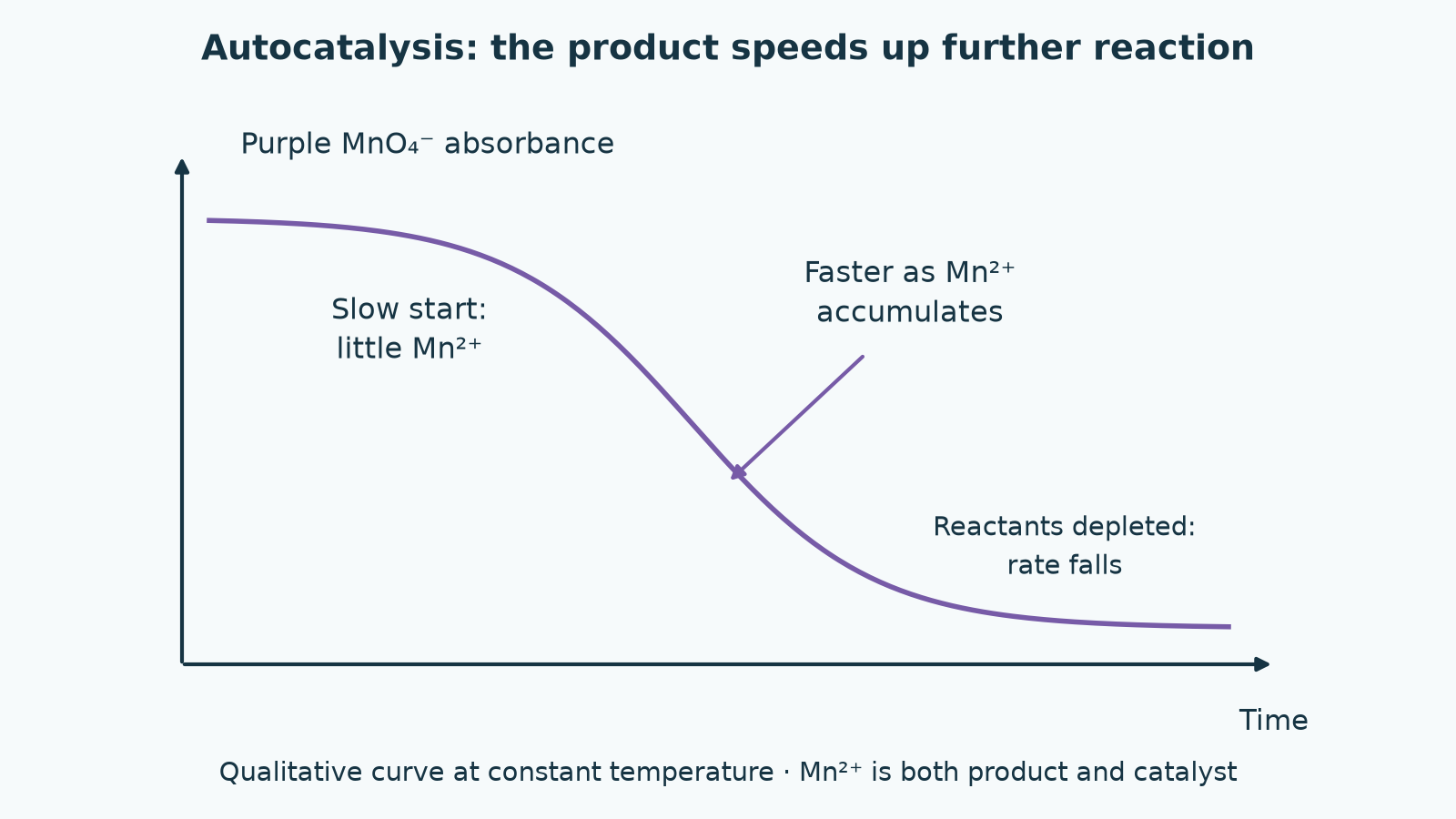
Manganese changes from +7 in to +2 in , so manganate(VII) is reduced. Carbon in oxalate is oxidised to carbon dioxide.
Autocatalysis
Catalysis of a reaction by one of its own products.
This reaction is a classic example. One of the products, , catalyses the reaction that is making more . At the start there is little , so the reaction is slow. As accumulates, the reaction speeds up; later it slows again as the reactant concentrations fall.
One useful A-level model is that helps form a intermediate:
The first step uses ; the second step regenerates . When the steps are scaled and added, the net equation still produces , so the catalyst is also a product. That is the meaning of autocatalyst here.
The observation also fits the model. Acidified is purple and is very pale pink, often appearing almost colourless in dilute solution. The purple colour disappears slowly at first, then more rapidly as the autocatalyst builds up.
Common-error contrast
Saying " is a product, so it cannot be a catalyst" is wrong. A catalyst is defined by its role in the pathway, not by whether it is present at the very beginning. In an autocatalysed reaction, the product catalyses its own formation once enough of it has been produced.
Core Practical 12: Preparing A Copper Complex
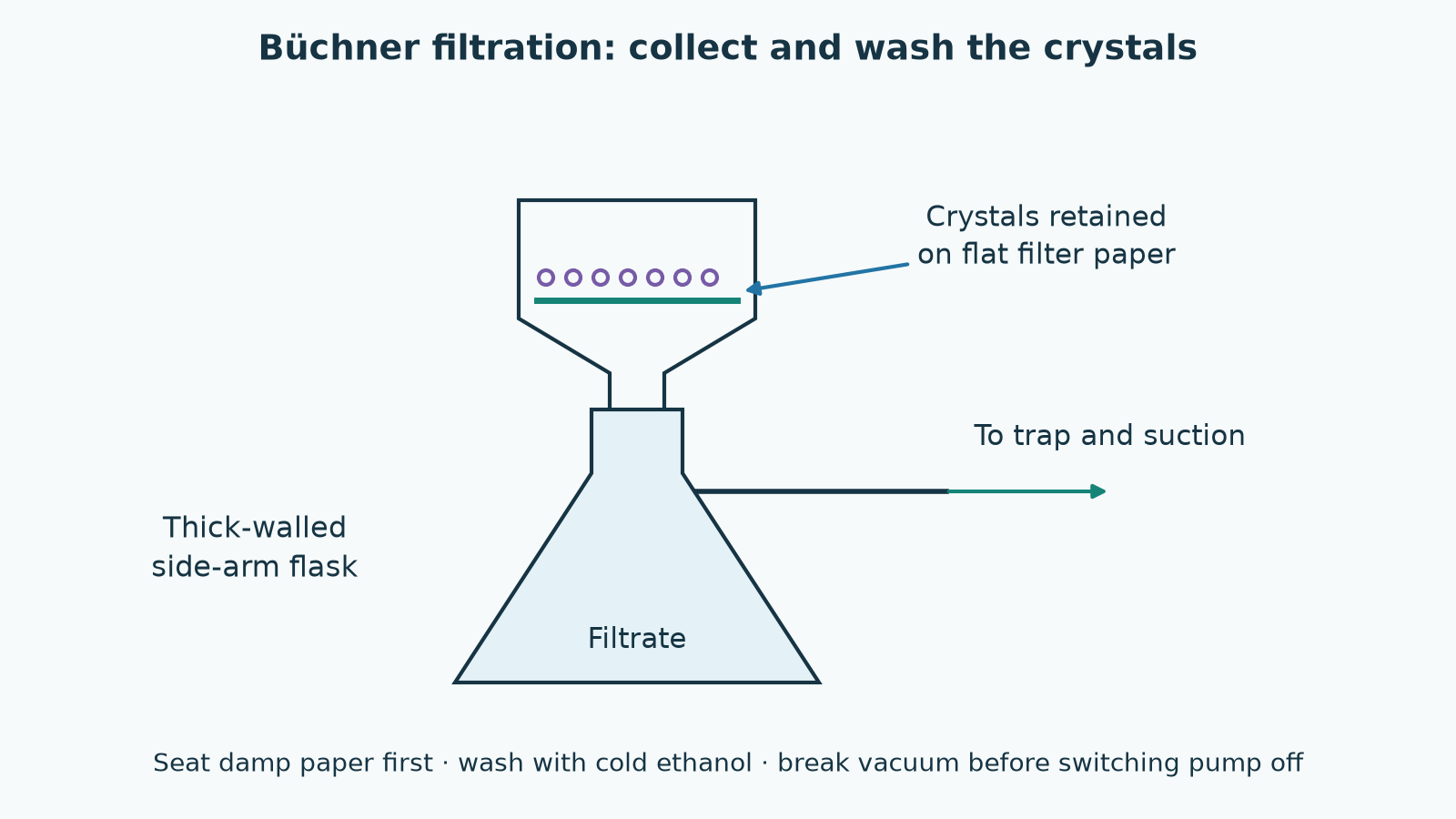
Core Practical 12 uses transition-metal ligand chemistry as a preparation-and-purification experiment. A common route prepares tetraamminecopper(II) sulfate-1-water, often written as , from hydrated copper(II) sulfate and ammonia.
[DIAGRAM: asset_name: Buchner funnel filter paper crystals side arm flask and suction connection; asset_slug: edexcel_a_level_chemistry_l075_buchner_filtration; recommended_method: deterministic_chart; description: Buchner funnel filter paper crystals side arm flask and suction connection.]
Continue this lesson.
You’re previewing NovaLearn without an account. Create a free account to read the rest.
Create free account