6B.8-6B.14 - Alkanes, Fuels And Pollution
Alkane fuels connect molecular structure to everyday choices about energy and pollution. Learn how refineries separate and modify hydrocarbons, how combustion conditions determine pollutants, and how catalytic converters and renewable fuels address different problems.
Fuel Molecules And Saturation
A fuel molecule is useful because its bonds can be rearranged with oxygen to make more stable products, releasing energy. Before discussing engines and pollution, the molecule itself must be pinned down.
Alkanes are saturated hydrocarbons: compounds of carbon and hydrogen only.
Saturated
Containing only single carbon–carbon bonds, so there are no or bonds available for addition reactions.
General formulae of alkanes and cycloalkanes
= number of carbon atoms. Both are saturated; the ring, not a double bond, accounts for the two fewer hydrogens.
For example, if , the alkane formula is . This formula applies to straight-chain and branched-chain alkanes: pentane and 2-methylbutane both have , but their atoms are connected differently.
Cycloalkanes are also saturated hydrocarbons, but a ring changes the hydrogen count. A cycloalkane with one ring has the general formula , not because it contains a double bond, but because closing the chain into a ring removes two hydrogens compared with the equivalent open-chain alkane.
Worked example: formula and saturation
A hydrocarbon has seven carbon atoms. Give the formula of:
- the open-chain alkane
- the cycloalkane with one ring
- state whether each is saturated if all carbon-carbon bonds are single bonds
For the open-chain alkane, use :
, so H and the formula is .
For the one-ring cycloalkane:
, so H and the formula is .
Both are saturated if the displayed or structural formula shows only single bonds. The formula alone should not make you shout "alkene"; it could be a cycloalkane.
Saturated is about bonds, not hydrogen count
"Saturated" does not mean "contains as many hydrogens as possible"; it means no carbon–carbon multiple bonds. Cyclohexane, : it has fewer hydrogens than hexane, , but it is still saturated because the missing hydrogens are due to the ring, not a C=C bond.
From Crude Oil To Useful Fuel Fractions
Crude oil is a mixture of many hydrocarbons. A refinery does not simply "make petrol" in one step: it separates, breaks and rearranges hydrocarbons so that the fuel mixture has useful volatility and combustion behaviour.
[DIAGRAM: asset_name: Crude Oil Processing; asset_slug: edexcel_a_level_chemistry_l030_crude_oil_processing; recommended_method: deterministic_chart; description: Flow diagram showing crude oil entering fractional distillation, heavy fractions going to cracking, straight-chain hydrocarbons going to reforming, and fuel fractions leaving.]
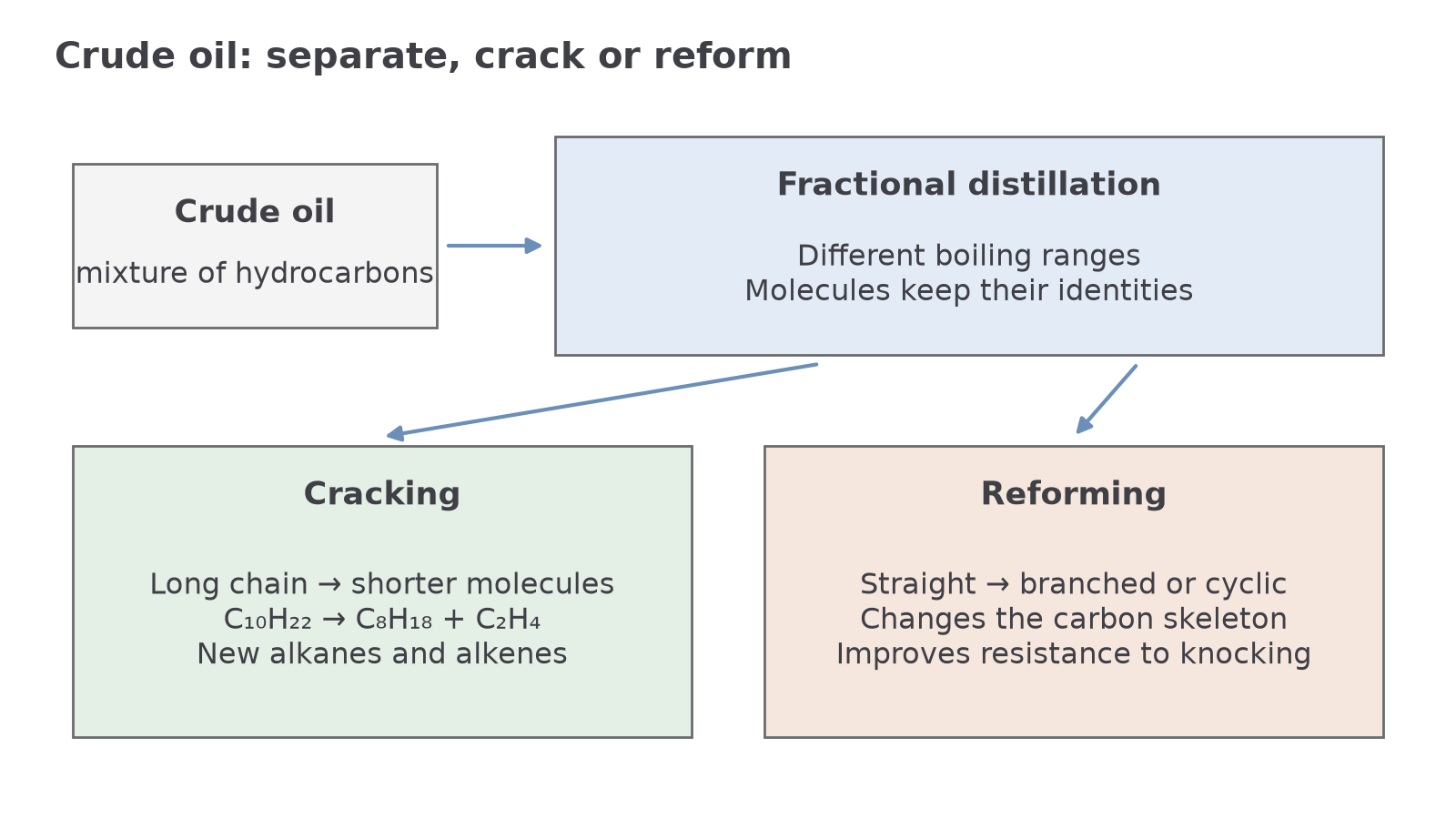
Fractional distillation
A physical separation of a mixture into fractions with different boiling ranges; the molecules are not changed.
The crude oil is vaporised and separated into fractions because different chain lengths have different boiling ranges. Longer-chain hydrocarbons have larger electron clouds and stronger London forces, so they usually have higher boiling points and condense lower in the fractionating column.
Cracking
A chemical process that breaks long-chain hydrocarbons into shorter molecules.
The products are usually a mixture containing shorter alkanes and alkenes. This helps supply lighter fuels and also makes alkenes for later organic chemistry, although alkene reactions are taught in later lessons.
Reforming
A chemical process that converts straight-chain hydrocarbons into branched-chain alkanes and cyclic hydrocarbons.
Branched and cyclic hydrocarbons resist premature ignition (engine knocking), allowing smoother combustion and efficient engine operation. Reforming can also remove hydrogen when a ring forms; it does not mean breaking a long chain into smaller fuels.
Worked example: atom balance in cracking
Decane, , is cracked to form ethene, , and one alkane. Deduce the formula of the alkane and write a balanced equation.
Start with carbon:
10 carbons in decane − 2 carbons in ethene = 8 remaining carbons.
The remaining molecule is an alkane with , so:
formula
Check hydrogen: right-hand side H , matching decane.
The equation is:
The chemistry sense check is that one long molecule has become two shorter molecules, and the atom count is conserved.
Common-error contrast
Fractional distillation sorts molecules by boiling range; cracking changes molecule size; reforming changes the carbon skeleton. An "explain" answer that says fractional distillation "breaks long chains" has swapped a physical separation for a chemical reaction.
Combustion Conditions Decide The Products
Complete combustion is the clean symbolic model for an alkane fuel burning in excess oxygen. For an alkane with formula , complete combustion forms carbon dioxide and water:
Complete combustion of an alkane
Requires excess oxygen; multiply through by 2 to clear the fraction when is even (e.g. octane: ).
For octane, a petrol-range alkane, the balanced equation is:
Real engines are not a perfect textbook flame. Oxygen supply, mixing, temperature and impurities affect the products.
| Condition or source | Pollutants formed | Chemical reason |
|---|---|---|
| Limited oxygen or poor mixing | carbon monoxide, carbon particulates, unburned hydrocarbons | carbon is not fully oxidised to carbon dioxide, or some hydrocarbon escapes the flame zone |
| Very high temperature in air | oxides of nitrogen, often written NOx | nitrogen and oxygen from air react at high temperature, forming compounds such as and |
| Sulfur-containing impurities in fuel | oxides of sulfur, especially | sulfur atoms in the fuel impurity are oxidised during combustion |
Useful symbolic examples are:
The first incomplete-combustion equation forms carbon monoxide. The second forms solid carbon particulates, seen as soot or smoke. In real exhaust there may be a mixture: , particulates and unburned hydrocarbons can all increase when there is not enough oxygen or mixing for full oxidation.
Continue this lesson.
You’re previewing NovaLearn without an account. Create a free account to read the rest.
Create free account