8.5-8.6 - Calorimetry
A measured temperature change can reveal the energy transferred by a reaction. Calculate molar enthalpy changes from cup and combustion experiments, correct for cooling and explain how practical assumptions affect the result.
Temperature Changes And Enthalpy Signs
A thermometer does not measure enthalpy directly. It measures how the surroundings, usually a solution or a known mass of water, change temperature while a chemical system reacts.
In calorimetry the model is:
chemical reaction releases or absorbs energy → surroundings change temperature → temperature change is converted into energy transfer → energy transfer is scaled to one mole of reaction or fuel.
The sign belongs to the chemical system, not to the thermometer reading.
| Observation | Surroundings | Chemical system | Sign of enthalpy change |
|---|---|---|---|
| Temperature rises | gains energy | loses energy | negative, exothermic |
| Temperature falls | loses energy | gains energy | positive, endothermic |
That is why a temperature rise often produces a negative value for . The solution got warmer because the reaction transferred energy out to the surroundings.
The sign trap
A temperature rise belongs to the surroundings. An exothermic reaction loses energy from the chemical system, so the reaction enthalpy change is negative even though the temperature rose.
From Temperature Change To Energy
A larger mass needs more energy for the same temperature rise; the specific heat capacity tells us how much energy one gram needs for a one-kelvin rise.
Energy transferred in calorimetry
= energy transferred to or from the surroundings in ; = mass of water or solution heated or cooled in ; = specific heat capacity, for water and dilute solutions; = temperature change in (same size as in ).
Each symbol has a practical meaning:
| Symbol | Meaning | Unit to use |
|---|---|---|
| energy transferred to or from the surroundings | J | |
| mass of water or solution being heated/cooled | g | |
| specific heat capacity | ||
| temperature change | or same size change in |
For aqueous mixtures, a common assumption is that the solution has density . This lets you estimate:
For example, mixing of one solution with of another gives an estimated mass of , if the density is assumed to be .
Worked example: energy transferred to a solution
of acid is mixed with of alkali in an insulated cup. The temperature rises from to . Assume the density of the final solution is and the specific heat capacity is .
Find the energy transferred to the solution.
Step 1: estimate the mass of solution.
, so
Step 2: find the temperature change.
Step 3: use .
Chemical interpretation: the solution gained of energy. If the reaction caused the temperature rise, the reaction itself lost this energy to the surroundings.
Common-error contrast
| Tempting error | Why it fails | Correct move |
|---|---|---|
| Use only one reactant volume as the mass | both solutions are heated or cooled after mixing | use the total solution volume when density is assumed |
| Put directly into | is mass, not volume | convert volume to mass using the density assumption |
| Give in immediately | is energy for this experiment only | divide by moles later to get an enthalpy change |
From Energy To Molar Enthalpy
An enthalpy change is normally reported per mole, so the calculation does not stop at .
Use this route:
- Calculate in J from .
- Convert from J to kJ.
- Work out the relevant amount in mol.
- Divide by moles.
- Add the correct sign and units.
For many simple calorimetry calculations:
Molar enthalpy change from calorimetry
= energy gained by the surroundings in (negative if they cool); = amount in of the species the enthalpy change is defined for; in . The minus sign reminds you that the system lost the energy the surroundings gained; if the surroundings cool, is positive.
The mole value must match the enthalpy change being asked for. For neutralisation it is often the amount of water formed or the limiting acid/alkali in the ionic equation. For combustion it is the amount of fuel burned. For reaction enthalpy it is the amount of reaction as defined by the balanced equation.
Worked example: enthalpy change of neutralisation
of is mixed with of . The temperature rises from to . Assume density and specific heat capacity .
Calculate the enthalpy change of neutralisation in .
The unrounded energy transfer has already been found:
Now calculate the amount reacting.
When amounts are unequal, calculate both amounts before choosing the limiting reagent. For example, HCl and NaOH form only water; use the total solution mass in , but this limiting water amount in . For a non-1:1 equation, divide each reactant amount by its coefficient first.
The acid and alkali react in a mole ratio, so of water is formed.
The answer needs both sign and units:
Chemical interpretation: the negative sign agrees with the temperature rise. The value is for one mole of water formed, not for the mixture used in this one experiment.
Guided practice
Insulated-Cup Calorimetry
When substances are mixed in an insulated container, the apparatus is designed to make the solution temperature change as close as possible to the energy change caused by the reaction.
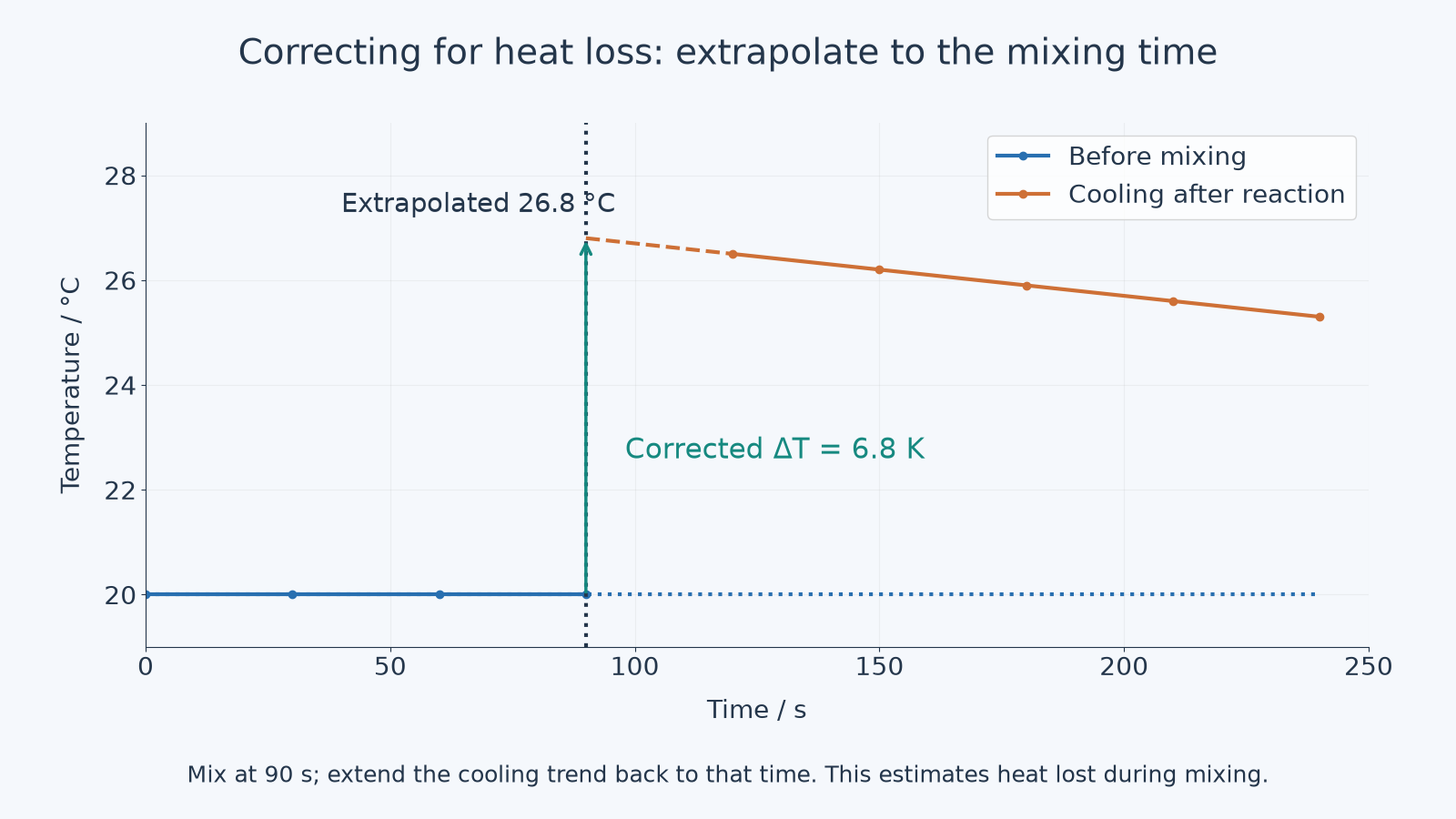
[DIAGRAM: asset_name: Temperature-time extrapolation for calorimetry; asset_slug: edexcel_a_level_chemistry_l043_temperature_extrapolation; recommended_method: deterministic_chart; description: Temperature-time extrapolation for calorimetry, code-drawn on a pale 16:9 canvas.]
Continue this lesson.
You’re previewing NovaLearn without an account. Create a free account to read the rest.
Create free account