13A.9-13A.11 - Solution And Hydration Enthalpy
Explain the temperature change when an ionic solid dissolves. Use lattice and hydration enthalpies to construct Hess cycles, calculate missing values and compare the effects of ionic charge and radius.
Why Dissolving Has An Enthalpy Change
When an ionic solid dissolves, two energetic ideas are competing. Energy is needed to separate the ions from the lattice, but energy is released when the separated ions become surrounded by water molecules. The temperature change you observe depends on the balance between those two effects.
Enthalpy change of solution, \(\Delta H_{\mathrm{sol}}\)
The enthalpy change when one mole of an ionic solid dissolves in enough water to form a solution in which the ions do not interact.
In cycle questions, write the process with aqueous ions:
Enthalpy change of hydration, \(\Delta H_{\mathrm{hyd}}\)
The enthalpy change when one mole of gaseous ions becomes one mole of aqueous ions.
Hydration is defined for a single ion type, not for the whole salt:
Hydration enthalpies are usually negative because ion-water attractions form. The partially negative oxygen end of water is attracted to cations, while the partially positive hydrogen end is attracted to anions. The state symbols carry the chemistry: g means separated gaseous ions; aq means hydrated ions in water.
Common-error contrast
Do not define as "the energy change when a salt dissolves". That is solution enthalpy. Hydration enthalpy is for gaseous ions becoming aqueous ions, so it can be used as one step in the solution cycle.
The Solution-Hydration Cycle
A solution enthalpy cycle is Hess's law applied to dissolving an ionic solid. You can go from gaseous ions to aqueous ions directly by hydrating the ions, or indirectly by first forming the ionic lattice and then dissolving the solid.
[DIAGRAM: asset_name: Solution hydration enthalpy cycle; asset_slug: edexcel_a_level_chemistry_l061_solution_hydration_cycle; recommended_method: deterministic_chart; description: Pale-background colour Hess cycle showing gaseous ions, solid ionic lattice and aqueous ions, with lattice energy in the formation direction, enthalpy change of solution, and the sum of hydration enthalpies.]
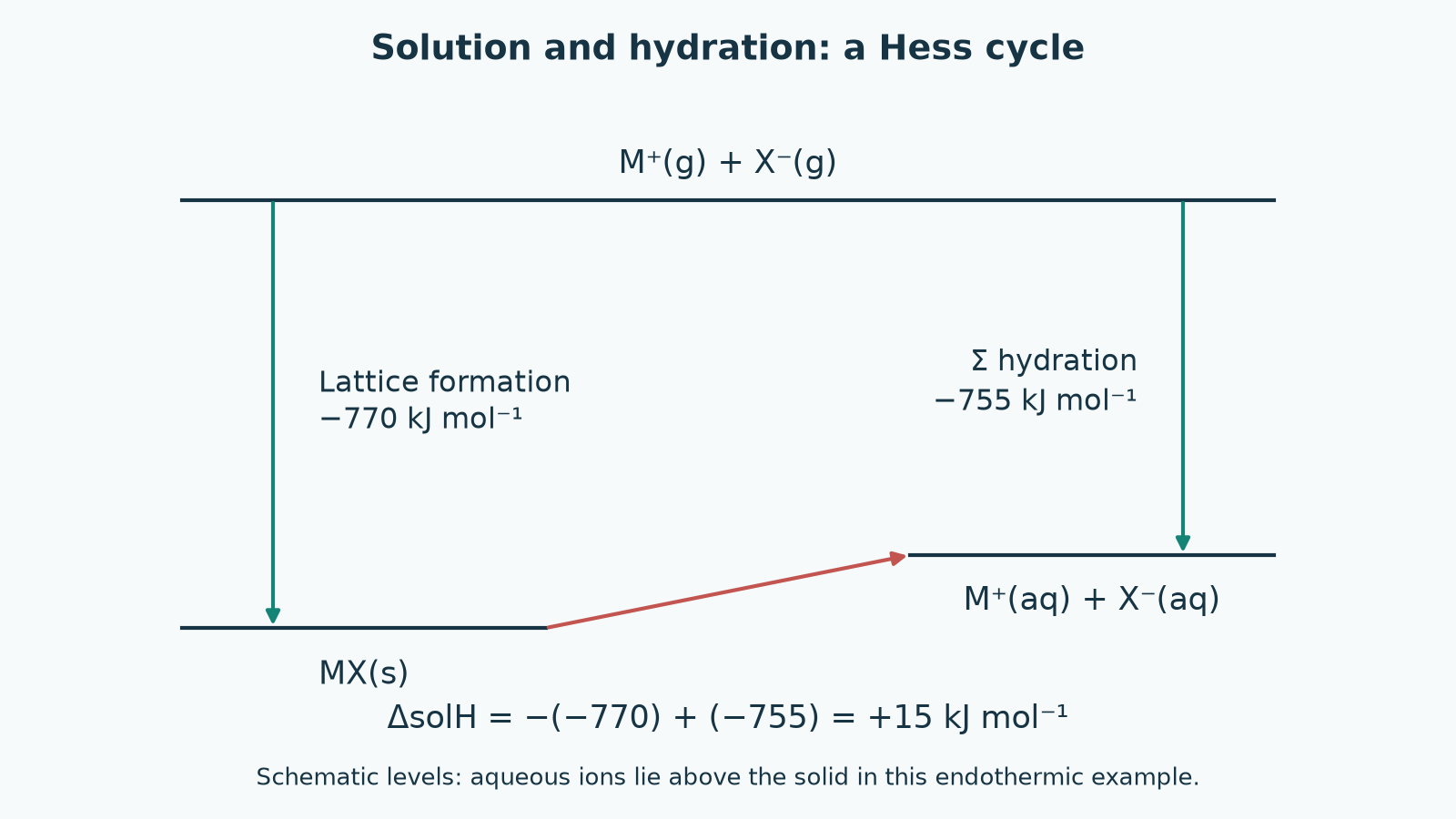
Using the lattice-energy formation convention from the Born-Haber lesson:
— lattice energy,
—
— () + ()
Hess's law gives:
Solution enthalpy from a cycle
= formation lattice energy (negative); = lattice dissociation enthalpy (positive). Multiply each by the number of that ion in the formula. All in .
The first version works when is the formation lattice energy; if a question gives lattice dissociation enthalpy instead, use the second, with the positive dissociation value.
For salts with more than two ions per formula unit, include the formula coefficients. For example:
Worked Cycle Calculations
The safest calculation route is: identify the lattice convention, write the cycle relationship, substitute with signs, then interpret the sign of the final answer.
Worked example 1: calculate an enthalpy change of solution
A question gives these rounded teaching data for an ionic compound .
| Enthalpy term | Value / |
|---|---|
| Lattice energy of , formation convention | |
Calculate for:
First write the cycle relationship:
Substitute with signs:
Chemical interpretation: dissolving is slightly endothermic for one mole of solid dissolving as written. The lattice formation and hydration steps are both exothermic, but the calculation is not asking for either of those steps alone; it is asking for the net change when the solid becomes aqueous ions.
Worked example 2: find an unknown hydration enthalpy
A question gives lattice dissociation enthalpy this time, so the lattice term is positive.
| Enthalpy term | Value / |
|---|---|
| Lattice dissociation enthalpy of | |
Let .
Chemical interpretation: the ion has a very exothermic hydration enthalpy because its charge density gives strong attraction to water molecules. The two chloride hydration terms must be included because one mole of produces two moles of chloride ions.
Continue this lesson.
You’re previewing NovaLearn without an account. Create a free account to read the rest.
Create free account