15A.11-15A.19 - Complex Shapes, Isomerism And Haemoglobin
Count donor atoms to predict coordination number and complex shape. Explore square-planar isomerism, chelating ligands and the ligand exchange that interferes with oxygen transport in haemoglobin.
Coordination Number and Monodentate Ligands
Imagine being given two complexes with four ligands around the metal. One is tetrahedral and one is square planar. The formula alone is not enough: you need to count coordinate bonds, identify how each ligand attaches, and then use the geometry around the central metal ion.
Coordination number
The number of coordinate bonds from ligands to the central metal ion.
It is not the oxidation state of the metal, and it is not always the number of ligand molecules or ions.
Monodentate ligand
A ligand that forms one coordinate bond to a metal ion.
The prefix is useful: "mono" means one, and "dentate" means tooth-like, so a monodentate ligand grips the metal through one donor atom.
, and act as monodentate ligands because each can donate a lone pair from one donor atom to the metal ion:
| Ligand | Donor atom | Why it can act as a ligand | Denticity in this lesson |
|---|---|---|---|
| O | Oxygen has lone pairs that can be donated | Monodentate | |
| O | Oxygen has lone pairs and the ion is electron-rich | Monodentate | |
| N | Nitrogen has a lone pair that can be donated | Monodentate |
Do not count every lone pair as a separate ligand attachment. , for example, has more than one lone pair, but in the complexes considered here it is monodentate because it forms one coordinate bond to the metal through one oxygen atom.
Worked example: count coordination number
In , there are six water ligands. Each water ligand is monodentate, so each forms one coordinate bond to Fe. The coordination number is therefore 6.
In cis-, there are two ligands and two ligands. Each is monodentate, so there are four coordinate bonds to Pt. The coordination number is 4.
In , there are three ethane-1,2-diamine ligands. Each ligand is bidentate because it can donate two nitrogen lone pairs to the same metal ion, so the coordination number is .
The chemical interpretation is that coordination number counts metal-ligand bonds, not formula brackets. This becomes essential when bidentate and multidentate ligands appear.
Octahedral, Tetrahedral And Square Planar Shapes
Once you know the coordination number, the next question is how the coordinate bonds are arranged in space. Transition-metal complexes are three-dimensional structures, so a good explanation normally needs both the coordination number and the shape.
[DIAGRAM: asset_name: coordination geometry comparison; asset_slug: edexcel_a_level_chemistry_l071_coordination_geometries; recommended_method: deterministic_chart; description: Pale-background colour schematic comparing octahedral six-coordinate, tetrahedral four-coordinate and square planar four-coordinate complexes around a central metal ion, with key angle relationships labelled.]
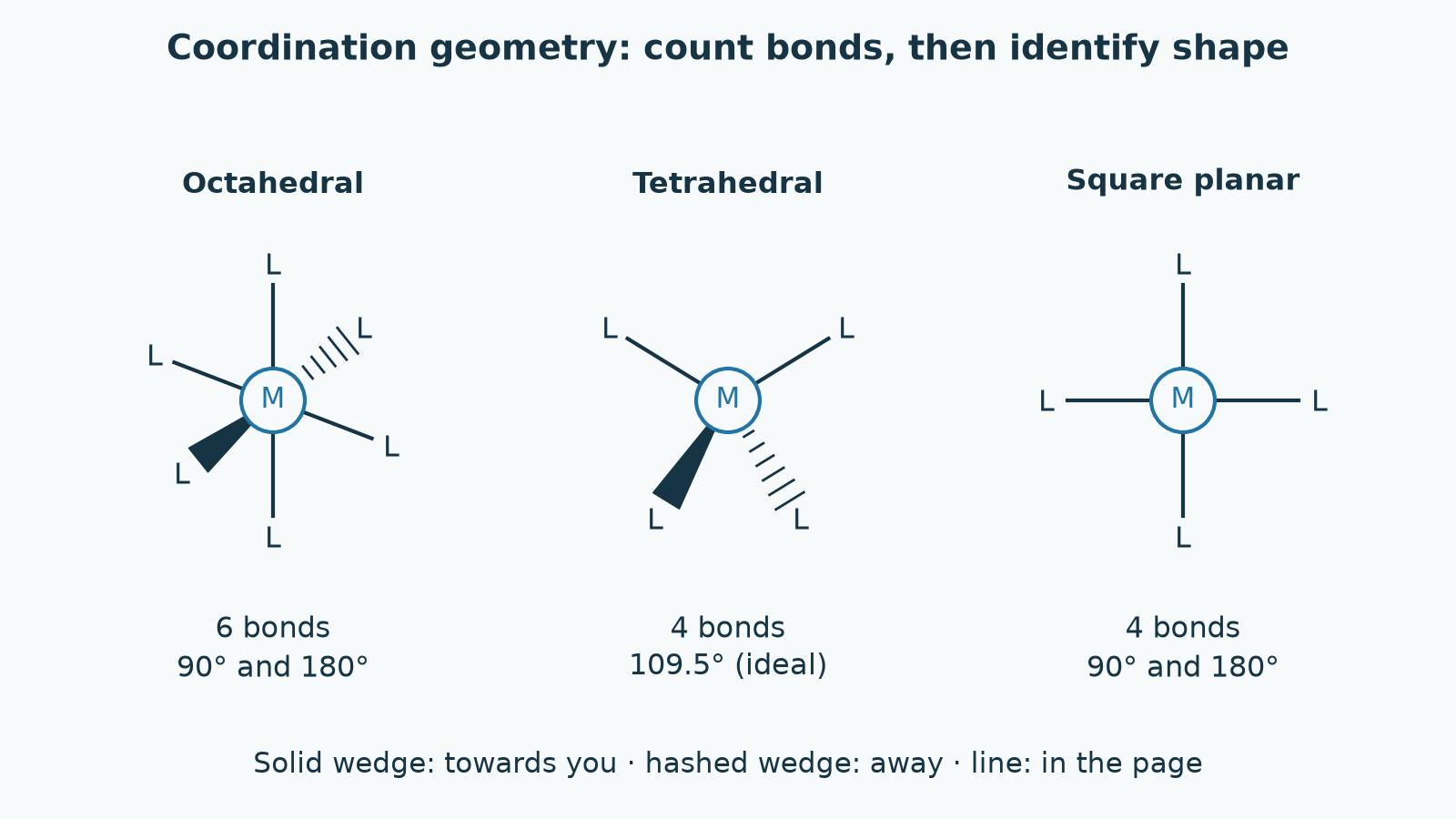
Six-fold coordination usually gives an octahedral complex. Six coordinate bonds can be arranged with four ligands in a square plane and two ligands above and below that plane. Adjacent ligand-metal-ligand angles are 90°, and opposite ligands are 180° apart.
This is why complexes formed by metal ions with six small monodentate ligands such as , or are usually described as octahedral. For example, and represent the common six-coordinate pattern, where is a metal ion and depends on the metal oxidation state and ligand charges.
Four-fold coordination can have more than one shape. Relatively large ligands such as may form tetrahedral complexes, for example a four-chloride complex such as . In a tetrahedral complex, the four coordinate bonds point towards the corners of a tetrahedron, with angles close to 109.5°.
In the cobalt(II) examples used here, is octahedral and is tetrahedral. Naming the metal removes the ambiguity of a generic four-coordinate formula.
Some transition-metal ions also form square planar complexes. A square planar complex has four ligands in one plane, with adjacent ligands 90° apart and opposite ligands 180° apart. Cis-platin, cis-, is a square planar Pt(II) complex.
Common-error contrast
| Tempting shortcut | Why it fails | Better reasoning |
|---|---|---|
| "Coordination number 4 means tetrahedral" | Some coordination number 4 complexes are square planar | Use the metal ion and ligand context as well as the coordination number |
| "Six ligands means hexagonal" | Six-fold coordination in these complexes is octahedral, not a flat hexagon | Picture four ligands in a square plane plus one above and one below |
| " cannot be a ligand because it is an ion" | Charged species can donate lone pairs too | donates through oxygen and is monodentate here |
Worked explanation
Prompt: Explain why is described as octahedral.
Model answer: Each ligand donates one lone pair from oxygen to Fe, so the six water ligands form six coordinate bonds. Six-fold coordination around a metal ion gives an octahedral arrangement, with six ligands arranged around the central ion to reduce repulsion between the coordinate bonds.
Guided practice
Complete the reasoning for a complex ion containing four ligands around a transition-metal ion.
- Each chloride ligand is __________.
- Four chloride ligands give coordination number __________.
- Because chloride is relatively large, the complex may be __________ rather than octahedral.
Answer
- Monodentate.
-
- Tetrahedral.
Square Planar Isomerism And Cis-Platin
Square planar complexes can show a kind of stereoisomerism because ligands can be adjacent or opposite in the plane. The formula may stay the same while the three-dimensional arrangement changes.
[DIAGRAM: asset_name: cis and trans square planar isomers; asset_slug: edexcel_a_level_chemistry_l071_cis_trans_platin; recommended_method: deterministic_chart; description: Pale-background colour square-planar diagrams of cis-[Pt(NH3)2Cl2] and trans-[Pt(NH3)2Cl2], showing adjacent versus opposite chloride ligands around Pt.]
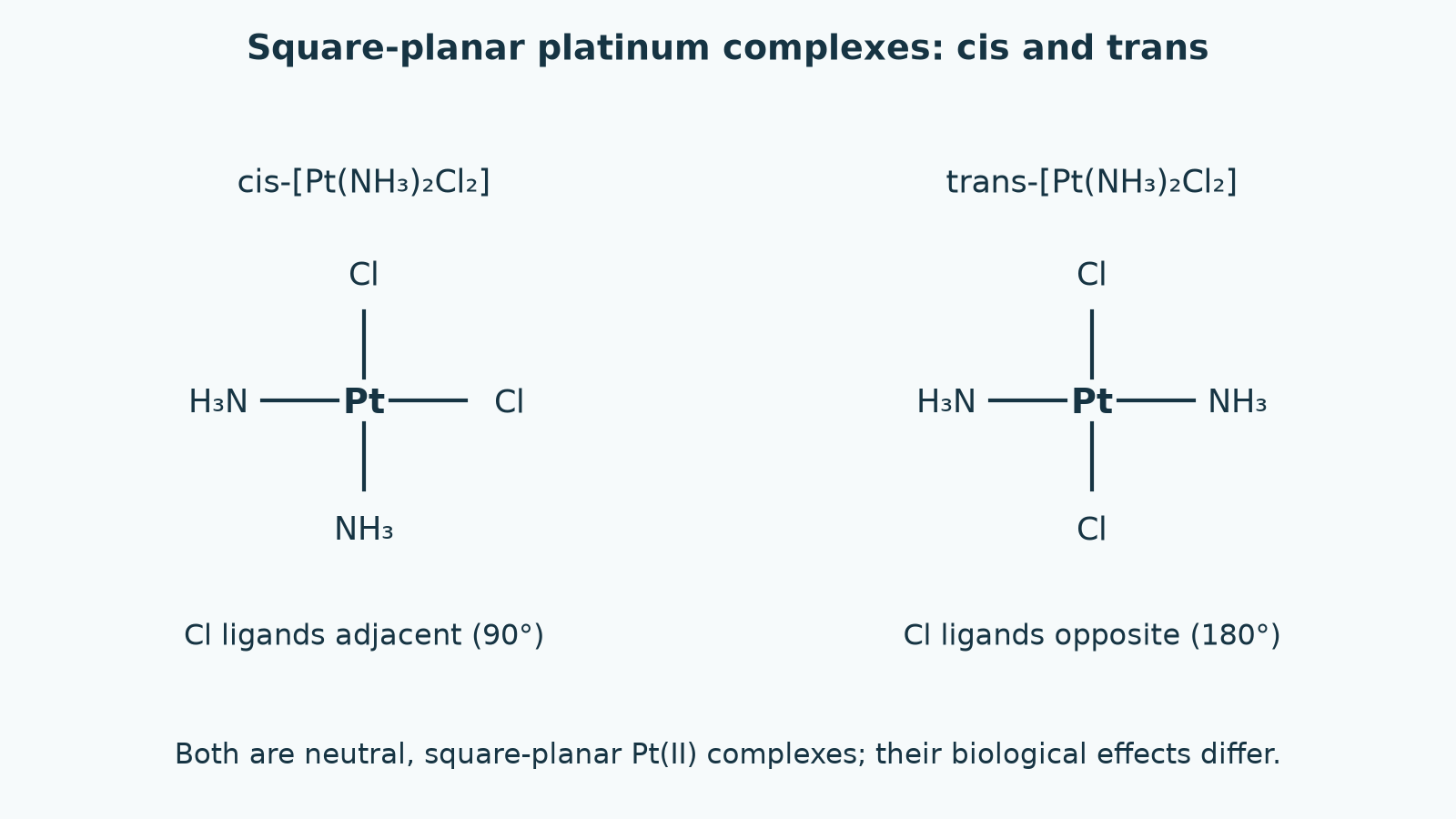
In a cis square planar complex, two identical ligands are next to each other. In a trans square planar complex, two identical ligands are opposite each other. Cis-platin is cis-: the two chloride ligands are adjacent, and the two ammonia ligands are also adjacent.
Continue this lesson.
You’re previewing NovaLearn without an account. Create a free account to read the rest.
Create free account