6A.1-6A.7 - Organic Formulae, Naming And Isomerism
Organic formulae communicate different information: atom ratios, connectivity or arrangement in space. This lesson shows how to translate between representations, name compounds, recognise reaction types and distinguish structural isomers from E/Z stereoisomers.
Why One Molecule Can Have Several Formulae
A label such as gives the atoms present, but it does not tell you how the atoms are connected. That is a serious limitation in organic chemistry: the same molecular formula can describe more than one molecule. The first job is to choose the representation that carries the information the question needs.
Hydrocarbon
A compound containing carbon and hydrogen only.
, , and are hydrocarbons; is not, because oxygen is present.
[DIAGRAM: asset_name: Organic Representation Motifs; asset_slug: edexcel_a_level_chemistry_l029_organic_representation_motifs; recommended_method: deterministic_chart; description: Butane shown as molecular, structural, displayed and skeletal formulae; each skeletal end or vertex represents carbon.]
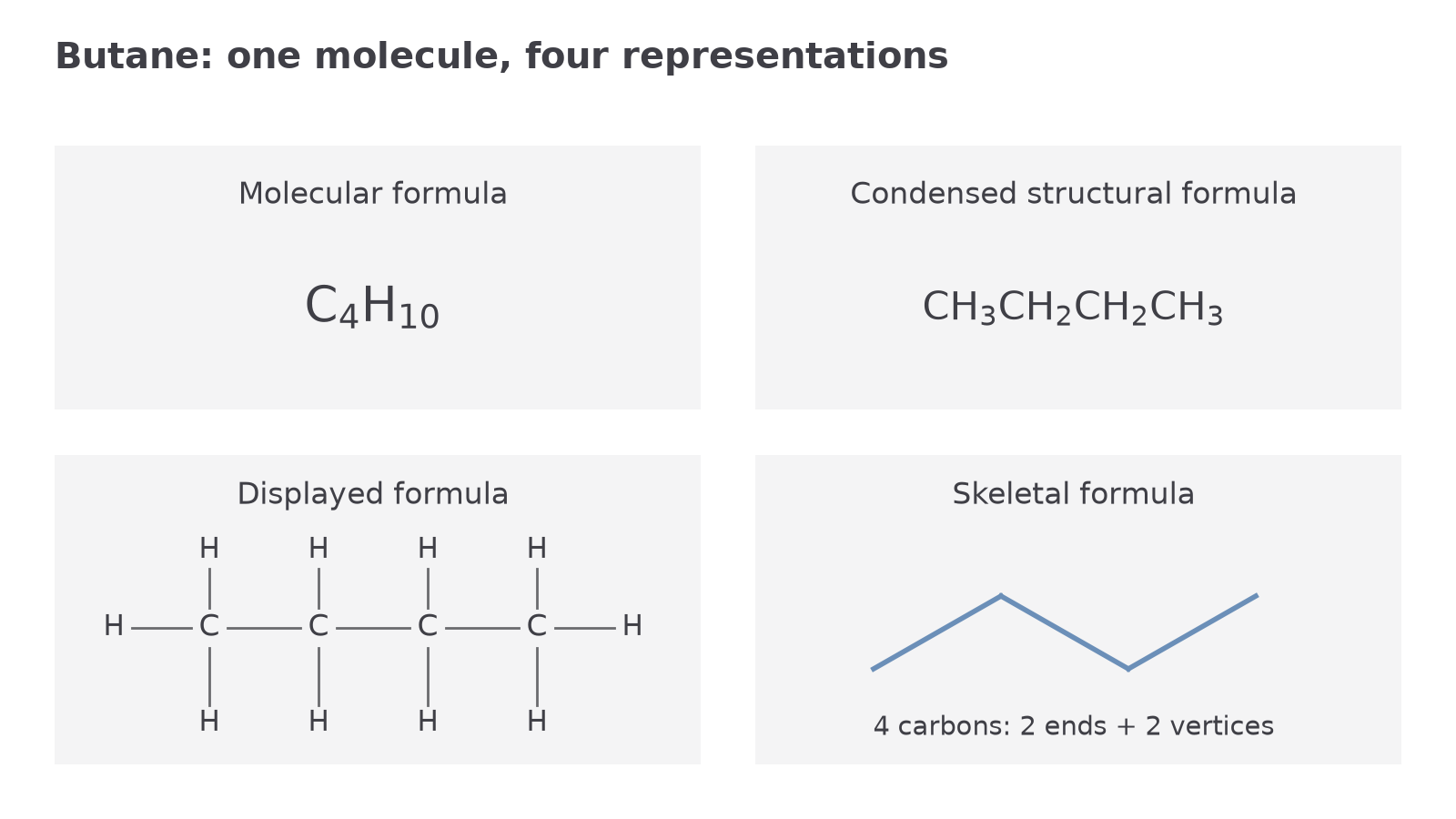
Use these formula types with different expectations:
| Representation | What it tells you | Example using ethane or propane | What it hides |
|---|---|---|---|
| Empirical formula | Simplest whole-number ratio of atoms | has empirical formula | Actual molecule size and connectivity |
| Molecular formula | Actual number of each atom in one molecule | Which atom is bonded to which | |
| General formula | Pattern for a homologous series | Alkanes use | The identity of a particular molecule |
| Structural formula | Connectivity in a compact form | Some individual bonds to hydrogen | |
| Displayed formula | Every atom and every bond | All three carbon atoms and all eight hydrogens in propane shown with bonds | Shape is still drawn on a page, not a full 3D model |
| Skeletal formula | Carbon skeleton with carbon atoms and most carbon-bound hydrogens omitted | Propane as a two-line carbon chain | The reader must supply carbon atoms at line ends/vertices and enough hydrogens for carbon valency four |
In skeletal formulae, each line end or vertex is a carbon atom unless another atom is written. Hydrogens attached to carbon are usually not shown; heteroatoms such as , , and hydrogens attached to them must be shown. Double and triple bonds are still drawn because they change both bonding and formula.
Worked Example
Represent butane, molecular formula , in several ways.
| Route | Result | Reasoning |
|---|---|---|
| Empirical formula | Divide by 2 to get the simplest ratio. | |
| Molecular formula | This gives the actual atom count in one molecule. | |
| Structural formula | This shows four carbons connected in a straight chain. | |
| Displayed formula | Four carbon atoms joined in a chain, with ten bonds shown | Carbon must make four bonds in a neutral organic molecule. |
| Skeletal formula | A three-segment zig-zag line | Four carbon atoms are implied by the two ends and two internal vertices. |
The chemical interpretation is that these are not five different substances. They are five levels of detail for the same substance, and a question may ask you to translate from one level to another.
A molecular formula is not a structural formula
only gives the atom count. A structural formula must show how the atoms are connected, for example .
Homologous Series, Functional Groups And Names
Organic chemistry becomes manageable because molecules fall into families.
Homologous series
A family of organic compounds with the same functional group and general formula, similar chemical reactions, and successive members differing by .
Successive members differ by , so their physical properties such as boiling temperature change gradually as the carbon chain gets longer.
Functional group
The atom, group of atoms or bond pattern in a molecule that is responsible for its characteristic reactions.
For example, a bond gives alkene behaviour, -OH gives alcohol behaviour, and a halogen atom in a haloalkane changes the molecule's polarity and reactions. You do not need every later reaction yet; you do need to recognise that the functional group is the reactive handle.
For IUPAC-style naming in this specification, the carbon-chain prefixes up to are essential:
| Carbon atoms | Prefix | Example parent name |
|---|---|---|
| 1 | meth- | methane |
| 2 | eth- | ethane |
| 3 | prop- | propane |
| 4 | but- | butane |
| 5 | pent- | pentane |
| 6 | hex- | hexane |
| 7 | hept- | heptane |
| 8 | oct- | octane |
| 9 | non- | nonane |
| 10 | dec- | decane |
Use a naming route rather than guessing:
- Find the longest carbon chain that contains the main functional group or multiple bond.
- Choose the parent prefix from the number of carbons in that chain.
- Choose the ending from the family, such as -ane for an alkane or -ene for an alkene.
- Number the chain to give the important feature the lowest possible number.
- Add side-chain names and position numbers, such as 2-methyl-. Repeated identical branches use di-, tri- and so on, with every locant shown: is 2,2-dimethylpropane, because both methyl branches are on carbon 2 of a three-carbon parent. When several branches are present, use the lowest set of locants at the first point of difference; different branch names are listed alphabetically, ignoring di-/tri- for ordering.
Worked Example
Name .
The longest continuous chain has four carbon atoms, so the parent is butane. There is a one-carbon branch, methyl, on carbon 2 when the chain is numbered from the nearer end. The name is 2-methylbutane.
The tempting wrong name is 3-methylbutane. That uses the same chain but numbers from the far end; IUPAC numbering gives the lowest possible locant to the branch.
Guided Practice
Name each structure.
| Structure | Decision | Name |
|---|---|---|
| Five-carbon saturated chain | pentane | |
| Four-carbon chain; number from the double-bond end | but-1-ene | |
| Three-carbon parent with a methyl branch on carbon 2 | 2-methylpropane |
Common-Error Contrast
But-1-ene and but-2-ene have the same molecular formula, but the number is not decorative. It tells you where the double bond is. In organic naming, a missing or wrong locant can describe a different molecule.
Classifying Organic Reaction Types
Before you learn detailed mechanisms, you need to classify what sort of change has happened. The classification comes from the structural change, not from the size of the equation or the memorised topic heading.
| Reaction class | Recognition clue | Simple organic example |
|---|---|---|
| Addition | Two reactants form one main product; atoms add across a multiple bond | |
| Elimination | A small molecule is removed and a multiple bond often forms | |
| Substitution | One atom or group is replaced by another | |
| Oxidation | Oxidation state increases; in organic shorthand often gain of O or loss of H | |
| Reduction | Oxidation state decreases; in organic shorthand often gain of H or loss of O | |
| Hydrolysis | A bond is broken by reaction with water, aqueous acid or aqueous alkali | as an ester pattern |
| Polymerisation | Many monomers join to form a long-chain molecule |
Continue this lesson.
You’re previewing NovaLearn without an account. Create a free account to read the rest.
Create free account