4A.1-4A.8 - Groups 1 And 2: Trends And Reactions
Explain Group 2 reactivity and the reactions of magnesium to barium, then compare hydroxide and sulfate solubility. Use ion size and polarisation to explain thermal stability, and electron transitions to explain flame colours and practical observations.
Group 2 Reactivity
Imagine four small pieces of Group 2 metal are added separately to water: magnesium, calcium, strontium and barium. The reaction generally becomes more vigorous down the group, even though the atoms lower down have more protons in the nucleus. The key question is not just "what is the trend?", but "why does the trend happen?"
The particle model
Group 2 metals react by losing two outer-shell electrons:
Down Group 2:
- atoms have more occupied electron shells
- the outer electrons are farther from the nucleus
- inner-shell shielding increases
- the attraction between the nucleus and the outer electrons decreases
- the first and second ionisation energies decrease
The increased nuclear charge down the group does not reverse the trend, because the extra shielding and larger distance from the nucleus dominate for the outer electrons. Lower ionisation energies mean the atom loses its two outer electrons more readily, so the metal is more easily oxidised and is more reactive.
Worked example: explaining barium versus magnesium
Question: Barium reacts more vigorously with water than magnesium. Explain why, in terms of ionisation energy.
Model answer route:
- In the reaction, the Group 2 atom is oxidised to by losing two electrons.
- Barium atoms have more electron shells than magnesium atoms, so the outer electrons in barium are farther from the nucleus.
- Barium also has more shielding between the nucleus and the outer electrons.
- The attraction for the outer electrons is weaker, so the first two ionisation energies of barium are lower.
- Barium loses its outer electrons more easily, so it reacts more vigorously.
Chemical interpretation: the reactivity trend is an electron-loss trend. It is not enough to write "barium is lower down the group"; the answer must link position to shielding, distance, ionisation energy and electron loss.
More protons, yet lower ionisation energy
Atoms lower down Group 2 do have more protons, but their outer electrons are farther from the nucleus and more shielded. These effects outweigh the extra nuclear charge, so attraction for the outer electrons and the ionisation energies decrease down the group.
Group 2 Metal Reactions
Group 2 reactions are easier to learn when each reaction is treated as the same electron-loss pattern written in different symbolic forms. The metal is oxidised from oxidation state 0 to +2, and the product contains ions.
Core reactions from to
| Reagent | General product | General equation | Key observations and cautions |
|---|---|---|---|
| Oxygen | metal oxide, | white solid oxide; magnesium burns with a bright white flame. Strontium and barium can also form peroxides in oxygen, so follow the equation requested by the stimulus. | |
| Chlorine | metal chloride, | white ionic chloride; reaction is redox because chlorine is reduced to chloride ions. | |
| Cold water, to | metal hydroxide and hydrogen | effervescence from hydrogen; solution or suspension becomes alkaline. Vigour increases down the group. | |
| Steam, | magnesium oxide and hydrogen | magnesium reacts very slowly with cold water but reacts with steam when heated. |
For calcium, strontium and barium with cold water, the hydroxide becomes more soluble down the group. At the same temperature, saturated barium hydroxide solution has a higher hydroxide concentration than saturated calcium hydroxide solution. Comparisons of solutions made using arbitrary amounts of metal also depend on the amount reacted and water volume.
Worked example: calcium and water
Question: Calcium is added to water. Write the equation and state the test for the gas.
Model answer:
The gas is hydrogen. A lighted splint gives a squeaky pop.
Chemical interpretation: calcium atoms lose electrons to form ; hydrogen in water is reduced to hydrogen gas. The observation of effervescence is not the conclusion by itself; the gas test confirms the identity of the gas.
Common-error contrast
Magnesium burning with a very bright white flame does not prove that magnesium is more reactive than barium. The brightness depends on the conditions of the demonstration, surface oxide layers, temperature, and light emitted. The reactivity trend is judged from the ease of electron loss and comparable reaction conditions, especially reaction with water.
Oxides, Hydroxides And Solubility
The Group 2 metal oxides and hydroxides are basic. In exam questions, the same idea may appear as an equation, a pH observation, a neutralisation reaction, or a solubility trend.
Oxides with water
Group 2 oxides react with water to form hydroxides:
The displayed hydroxide equations show solid hydroxide. Use (aq) for the dissolved fraction when the conditions produce an aqueous solution; a suspension can contain both solid and dissolved hydroxide. The state of the hydroxide depends on its solubility. Magnesium hydroxide is sparingly soluble, calcium hydroxide is only slightly soluble, and barium hydroxide is much more soluble. More dissolved hydroxide means a higher concentration of ions and a more alkaline solution.
Oxides and hydroxides with dilute acid
Oxides neutralise dilute acids to form salts and water:
Hydroxides also neutralise dilute acids:
With sulfuric acid, the sulfate salt forms instead. Barium sulfate is very insoluble, so a white barium sulfate solid can form and may coat a reacting surface.
Solubility trends to know
| Group 2 compound type | Trend down Group 2 | Consequence |
|---|---|---|
| Hydroxides, | solubility increases | saturated solutions at the same temperature become more alkaline down the group because more ions dissolve |
| Sulfates, | solubility decreases | barium sulfate is very insoluble and forms a white precipitate in sulfate tests |
Do not force the thermal-stability explanation onto solubility. Here the essential demand is to know the two opposite solubility trends and use them correctly in observations and equations.
Reading solubility data
Compare solubilities at the same temperature and on the same basis. If a saturated hydroxide solution contains of dissolved , complete dissociation gives . A value quoted in per must first be converted using the molar mass and volume before comparing concentrations of hydroxide ions.
Worked example: barium oxide and dilute hydrochloric acid
Question: Write an equation for the reaction of barium oxide with dilute hydrochloric acid and identify the type of reaction.
Model answer:
This is neutralisation: a basic oxide reacts with an acid to form a salt and water.
Chemical interpretation: the oxide ion accepts protons from the acid to form water. The ion becomes part of the salt.
Solubility, not reactivity, explains these observations
Saturated barium hydroxide is more alkaline than saturated magnesium hydroxide at the same temperature because more barium hydroxide dissolves, not because the formulae differ. Barium chloride gives a white precipitate with sulfate ions because sulfate solubility decreases down Group 2 and is very insoluble, not because barium is more reactive.
Thermal Stability
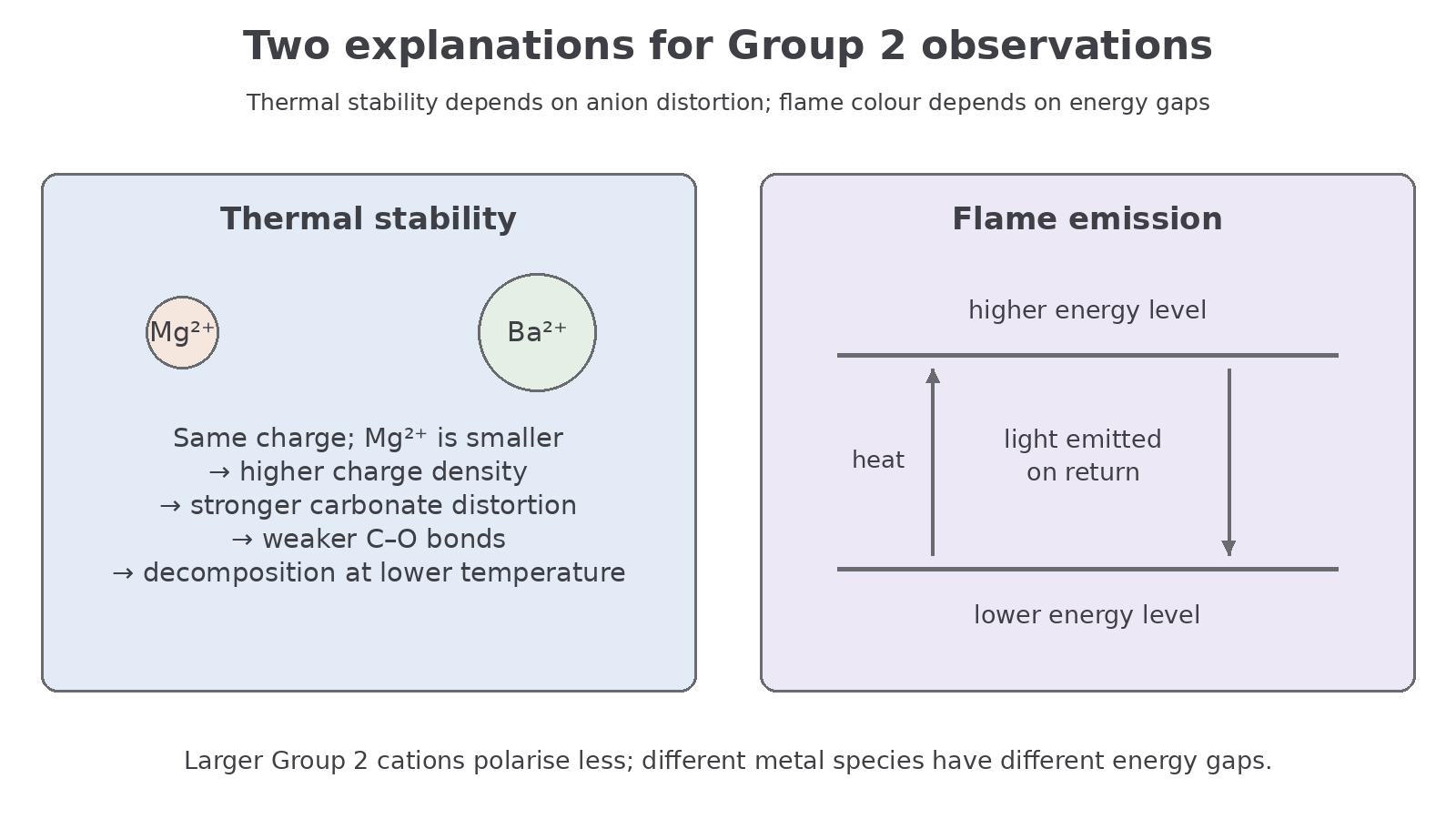
Thermal decomposition asks a different question from metal reactivity. A lower Group 2 metal such as barium is more reactive as an element, but its carbonate and nitrate are more thermally stable than magnesium carbonate and magnesium nitrate. The deciding model here is charge density and polarisation of the anion.
[DIAGRAM: asset_name: Edexcel 9Ch0 Group2 Polarisation Flames; asset_slug: edexcel_9ch0_group2_polarisation_flames; recommended_method: deterministic_code; description: Magnesium versus barium charge density explains thermal stability; energy-level absorption and emission explains flame colour. Pale 1600 by 900 diagram rendered with Pillow; technical geometry and Unicode chemical labels inspected.]
The polarisation model
Polarisation of an anion
Distortion of the electron cloud of a large anion by a nearby cation; a small, highly charged cation (high charge density) polarises an anion most strongly.
Carbonate ions and nitrate ions are large negative ions whose electron density is easily distorted in this way. Distortion weakens bonds within the anion, such as C–O bonds in carbonate. Less energy is needed to break these bonds during decomposition, so the compound is less thermally stable.
Down Groups 1 and 2:
- cation radius increases
- charge density decreases for ions of the same charge
- polarising power decreases
- carbonate and nitrate ions are less distorted
- more heat is needed for decomposition
- thermal stability increases
Charge also matters. A cation usually has greater polarising power than a cation of similar size. Lithium compounds often behave differently from the rest of Group 1 because is especially small.
Carbonates on heating
Group 2 carbonates decompose to the metal oxide and carbon dioxide:
Lithium carbonate behaves similarly:
Most other Group 1 carbonates do not decompose under normal Bunsen heating in the school laboratory. Their decomposition requires much higher temperatures, and the temperature needed increases down the group.
Gas evidence: carbon dioxide turns limewater milky.
Nitrates on heating
Group 2 nitrates decompose to the metal oxide, nitrogen dioxide and oxygen:
Lithium nitrate behaves similarly:
The other Group 1 nitrates give a different product pattern, forming the metal nitrite and oxygen:
Gas evidence: nitrogen dioxide is a brown acidic toxic gas, and oxygen relights a glowing splint.
Worked example: magnesium carbonate and barium carbonate
Question: Magnesium carbonate decomposes at a lower temperature than barium carbonate. Explain why.
Model answer route:
- is smaller than .
- Both ions have the same charge, so the smaller ion has the higher charge density.
- polarises the carbonate ion more strongly.
- The more strongly polarised carbonate ion decomposes more easily to form oxide and carbon dioxide.
- Therefore magnesium carbonate is less thermally stable and decomposes at a lower temperature.
Chemical interpretation: the comparison is about the cation's effect on the anion, not about which metal is more reactive in water.
Metal reactivity is not carbonate stability
"Barium is more reactive than magnesium, so barium carbonate should decompose more easily" is wrong. Reactivity of the metal is about losing electrons. Thermal stability of the carbonate is about the ability of to polarise . is larger and has lower charge density than , so it polarises the carbonate ion less and barium carbonate is more thermally stable.
Flame Colours
Flame tests are qualitative evidence for some metal ions. They work because heating excites electrons to higher energy levels; when electrons fall back to lower energy levels, energy is emitted as visible light. Different metal atoms or ions have different energy gaps, so they emit different wavelengths and give characteristic flame colours.
Flame colours to know
| Ion in compound | Characteristic flame colour |
|---|---|
| crimson red | |
| yellow or yellow-orange, very strong and persistent | |
| lilac | |
| red-violet | |
| blue-violet | |
| no useful characteristic flame-test colour; magnesium metal burns bright white | |
| brick red or orange-red | |
| crimson or scarlet red | |
| apple green or pale green |
Small differences in wording are acceptable if the colour is recognisable, but the sodium flame is a special practical hazard for interpretation because even tiny sodium contamination can mask other colours.
Practical procedure for a flame test
A standard wire-loop method is:
- Clean a nichrome or platinum wire loop by dipping it in hydrochloric acid and heating it in a roaring blue Bunsen flame until no flame colour is seen.
- Moisten the loop again, pick up a small amount of the solid sample, and place it in the hottest part of the blue flame.
- Record the flame colour immediately.
- Clean the wire again before testing another sample.
- Compare an unknown with known samples when colours are close, especially for red flames.
A wooden splint method can also be used for some salts: soak splints in solutions of the salts, allow them to drain, then place them in the flame. The practical principle is the same: the metal species is heated strongly enough for electron transitions to produce visible light.
Worked example: an unknown gives a green flame
Question: A Group 2 compound gives a pale green flame. Identify the metal ion and explain the origin of the colour.
Model answer: the metal ion is . Heat from the flame excites electrons to higher energy levels. When the electrons return to lower energy levels, they emit light. For barium compounds, some emitted wavelengths combine to give a pale green or apple green flame.
Chemical interpretation: the compound is not "turning green" in the chemical sense. The colour is emitted light from electron transitions.
Reading a flame test
The colour is not a paint-like property of the solid: it comes from the energy gaps between electron energy levels and the wavelengths emitted when excited electrons fall back. A lilac flame with a strong yellow flash suggests with sodium contamination, so clean the loop, repeat the test and compare with a known potassium compound.
Comparing Thermal Decomposition
Topic 4A practical work is not a separate memory list. It is how the chemical patterns are made visible: hydrogen from water reactions, alkaline hydroxide solutions, carbon dioxide from carbonates, oxygen or nitrogen dioxide from nitrates, and flame colours from electron transitions.
Showing thermal decomposition patterns
A practical route for comparing carbonates or nitrates is:
- Place a small, similar amount of each solid in a dry hard-glass test tube.
- Clamp the tube at a slight downward angle so condensed water does not run back onto hot glass.
- Heat with a Bunsen burner, using comparable heating for each sample.
- For carbonates, pass any gas produced into limewater and look for a milky white suspension showing carbon dioxide.
- For nitrates, observe for brown nitrogen dioxide where relevant and test for oxygen with a glowing splint only when it is safe to do so.
- Record the ease of decomposition, such as how quickly a gas is produced under similar heating.
Risk management matters. Use small quantities, eye protection, a heat-resistant mat, and suitable ventilation. Nitrate decomposition can produce toxic nitrogen dioxide, so this should be done with teacher direction and appropriate fume control. Never heat a sealed system. For a gas test, fit a bung and delivery tube with an unobstructed outlet to limewater; do not seal the gas outlet. Remove the delivery tube from the limewater before stopping heating to prevent suck-back. Remember that hot glass looks like cold glass.
Showing flame colours
A valid flame-colour procedure must include:
- cleaning the loop or using separate prepared splints
- using a non-luminous blue flame
- testing known compounds for comparison when needed
- recording the observed colour promptly
- considering sodium contamination
- handling barium and other salts according to the centre risk assessment
The conclusion should connect the observation to a metal ion. For example: "A persistent yellow flame suggests sodium ions" is stronger than "the sample is sodium", because the sample is a compound and the flame test identifies the metal ion.
Command-word habits
| Command style | What the answer must do in this lesson |
|---|---|
| State or give | recall the trend, colour, product, or observation accurately |
| Write | produce a balanced formula equation, with states if requested |
| Explain | link the observation to shielding, ionisation energy, charge density, polarisation, solubility, or electron transitions |
| Deduce | use the supplied observation, such as a flame colour or gas test, to identify a species |
| Describe a procedure | give apparatus, sequence, observation, control of variables, and safety/risk logic |
| Compare and contrast | refer to both substances and include a similarity and a difference |
Guided practice
A student heats solid strontium nitrate and solid barium nitrate using the same apparatus and similar amounts. The strontium nitrate produces brown gas sooner.
- Write the general equation for the decomposition of a Group 2 nitrate.
- Explain why strontium nitrate decomposes more readily than barium nitrate.
- Name the brown gas and give a safety implication.
Worked route:
- Use for a Group 2 metal:
- is smaller than , so it has higher charge density. It polarises nitrate ions more strongly, making decomposition easier. Therefore strontium nitrate is less thermally stable than barium nitrate.
- The brown gas is nitrogen dioxide, . It is toxic and acidic, so the experiment needs very small quantities and appropriate ventilation or fume control.
Check
Recap
The highest-value answers connect the right level of chemistry to the evidence. Use shielding and ionisation energy for Group 2 metal reactivity, balanced equations for reactions of metals, oxides and hydroxides, solubility trends for hydroxides and sulfates, charge density and polarisation for thermal stability, and electron transitions for flame colours. The practical skill is to design or interpret tests so that each observation supports a clear chemical conclusion.