6E.39 - Organic Preparation And Purification
Making a liquid organic compound requires both a reaction and a separation strategy. Use volatility, solubility, density and boiling range to choose and explain reflux, extraction, drying and distillation in the oxidation of ethanol and preparation of a chloroalkane.
The Method Chain
A liquid organic preparation is not just "do the reaction, collect the product". The chemist has to solve a sequence of practical problems:
make enough product → keep volatile material from escaping → separate organic and aqueous layers → remove dissolved acid, water or unreacted reagent → purify by boiling-temperature difference → check purity from the boiling range.
The specification names five techniques because each one answers a different question.
| Technique | Main practical question | What it protects or improves |
|---|---|---|
| Heating under reflux | How can the mixture be heated for long enough without losing volatile reactants or products? | yield and safety, because vapour condenses and returns |
| Extraction with a solvent in a separating funnel | How can the organic product be moved away from an aqueous layer or soluble impurities? | separation of immiscible layers |
| Distillation | How can a volatile liquid product be collected from a mixture? | purity, by collecting a fraction with the right boiling range |
| Drying with an anhydrous salt | How can traces of water be removed from an organic liquid? | dry product and a more reliable mass or boiling temperature |
| Boiling-temperature determination | How can the product's purity be judged using physical data? | evidence of purity, not proof of identity by itself |
Core Practical 5, oxidation of ethanol, uses reflux and distillation to connect reaction conditions with product collection. Core Practical 6, chlorination of 2-methylpropan-2-ol with concentrated hydrochloric acid, uses layer separation, washing, drying and distillation to turn a crude organic layer into a purer liquid product.
A yield calculation compares the dry product collected with the theoretical mass. Convert the starting reactant mass to moles, use the balanced equation ratio, and multiply the theoretical product moles by its relative molecular mass. Then percentage yield = actual mass / theoretical mass × 100. For example, 0.0500 mol of a starting alcohol gives at most 0.0500 mol of a 92.5 relative-mass product in a 1:1 conversion: theoretical mass 4.625 g. Collecting 3.70 g gives 80.0% yield. Wet product can falsely inflate the measured mass.
The key habit is to state both the action and the reason. "Use a separating funnel" is weaker than "use a separating funnel because the organic product and aqueous impurities form immiscible layers, so one layer can be run off through the tap after settling".
Common-error contrast
| Tempting answer | Why it is incomplete | Stronger version |
|---|---|---|
| Reflux is used to heat the reaction | Heating is only half the purpose | reflux heats while preventing loss of volatile substances |
| Distillation is used to make the product | Distillation does not make the product; it separates it | distillation separates or purifies a volatile liquid using boiling-temperature differences |
| Drying means evaporating the product | That risks losing a volatile organic liquid | an anhydrous salt removes traces of water from the organic layer |
| Boiling point proves identity | Different substances can have similar boiling temperatures | a narrow boiling range near the data value supports purity and possible identity |
Heating Under Reflux
A volatile reaction mixture can be heated for a sustained time if its vapour is condensed and returned to the same flask.
Heating under reflux
Heating a reaction mixture with a vertical condenser, open at the top, so that vapour condenses and returns to the flask to minimise loss of volatile material.
Vapour rises into a vertical condenser, the condenser cools it, and the liquid runs back into the reaction mixture.
[DIAGRAM: asset_name: CP5 Reflux Apparatus; asset_slug: edexcel_a_level_chemistry_l039_cp5_cp6_reflux_apparatus; recommended_method: deterministic_chart; description: Reflux apparatus with separate coolant jacket, open vertical vapour path, low inlet, high outlet, clamp and electric heating.]
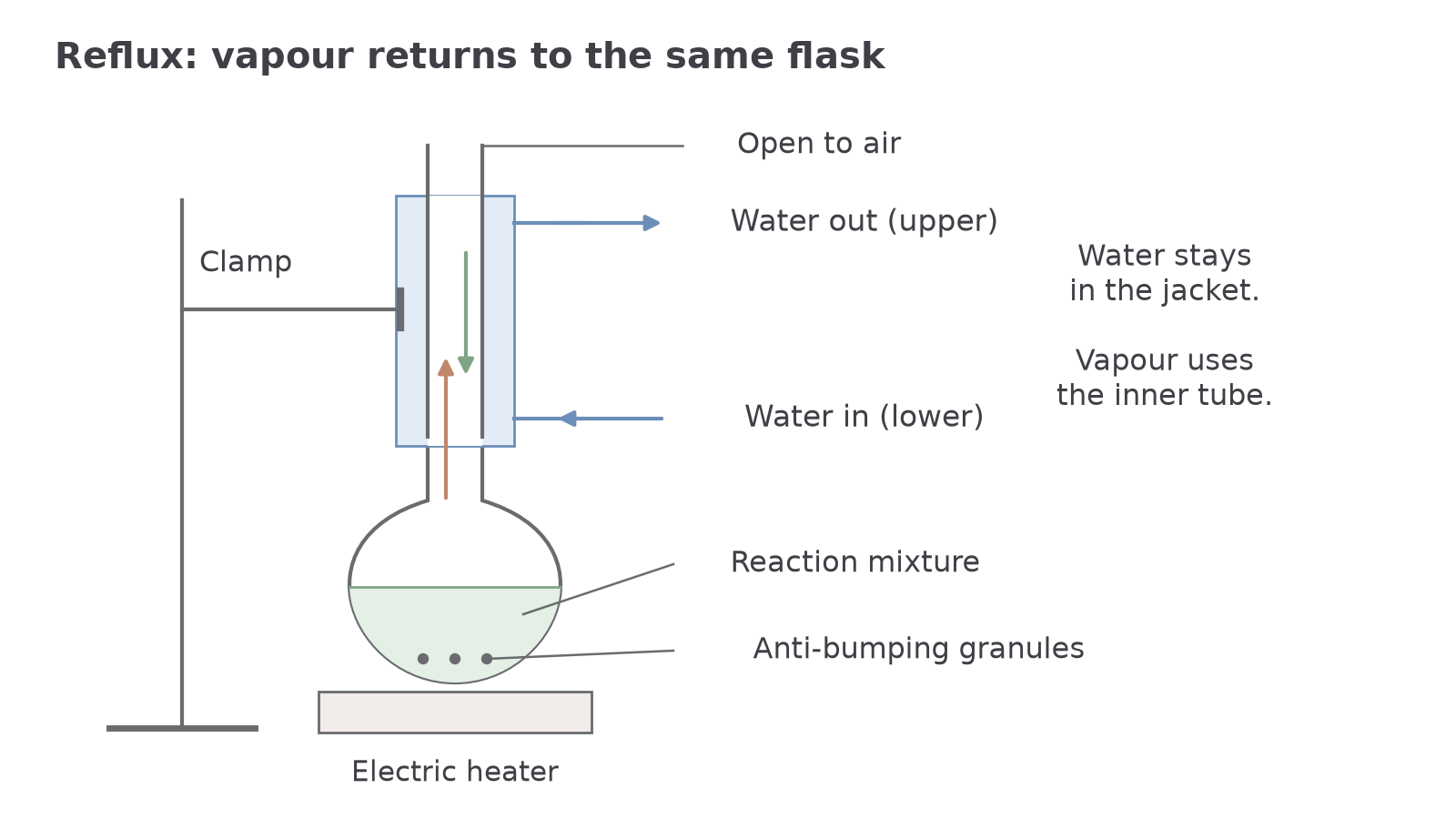
For reflux apparatus, the key details are:
- the condenser is vertical above the reaction flask
- the top of the condenser is open to air, not sealed
- cooling water enters at the lower side-arm and leaves from the upper side-arm
- add anti-bumping granules before heating; adding them to a hot liquid can cause sudden violent boiling
- the flask is heated by an appropriate source, often a water bath or electric heater for flammable organic liquids
The chemistry reason is volatility. Many organic reactants and products have low boiling temperatures compared with inorganic salts or aqueous solutions. If the flask were heated without a condenser, useful material could escape as vapour and the yield would fall. In reflux, the reaction mixture can be kept hot for long enough for the reaction to proceed, while condensed liquid returns to the flask.
Core Practical 5 uses this logic during oxidation of ethanol. Ethanol is volatile and flammable, and the oxidising mixture is acidic and hazardous. Reflux allows controlled heating after careful addition of ethanol, while reducing loss of volatile organic material.
The equation-level context is:
The equation tells you the organic change; the reflux apparatus tells you how the reaction conditions are maintained safely enough to collect useful product. Questions can assess either side: the chemical transformation or the practical reason for the apparatus.
Reflux is not distillation
Both involve boiling, but in reflux vapour condenses and returns to the reaction flask so the mixture can keep reacting without loss. In distillation, vapour condenses and is collected in a different vessel, so a volatile component is separated from the mixture.
Core Practical 5: select the oxidation product
Acidified potassium dichromate(VI) oxidises ethanol, changing from orange to green. For ethanoic acid, add ethanol carefully to excess oxidant, control the exothermic reaction and reflux to allow further oxidation. For ethanal, use a limited amount of oxidant and distil the aldehyde as it forms, collecting the very volatile product in a cooled receiver. Removing ethanal from the oxidising mixture limits its further oxidation:
Warm a separate sample of the distillate with Fehling’s or Benedict’s solution: a brick-red precipitate from the blue solution supports an aldehyde. Use a small sample for testing so the collected product is not contaminated. The acid product does not give this aldehyde result.
Clamp the flask and condenser securely without stressing the glass joints. The coolant circulates through the outer jacket, separately from the vapour and condensate in the inner tube. Reflux and distillation use different arrangements because their aims differ: retaining a volatile substance versus removing it.
Extraction And Drying
After an organic reaction, the desired liquid is often mixed with water, acid, salts or unreacted reagents. A separating funnel is used when the product and an aqueous layer are immiscible.
[DIAGRAM: asset_name: Cp6 Separating Funnel Drying; asset_slug: edexcel_a_level_chemistry_l039_cp6_separating_funnel_drying; recommended_method: deterministic_chart; description: CP6 upper organic layer retained, lower aqueous layer drained with stopper removed, and anhydrous salt followed by decanting or filtration.]
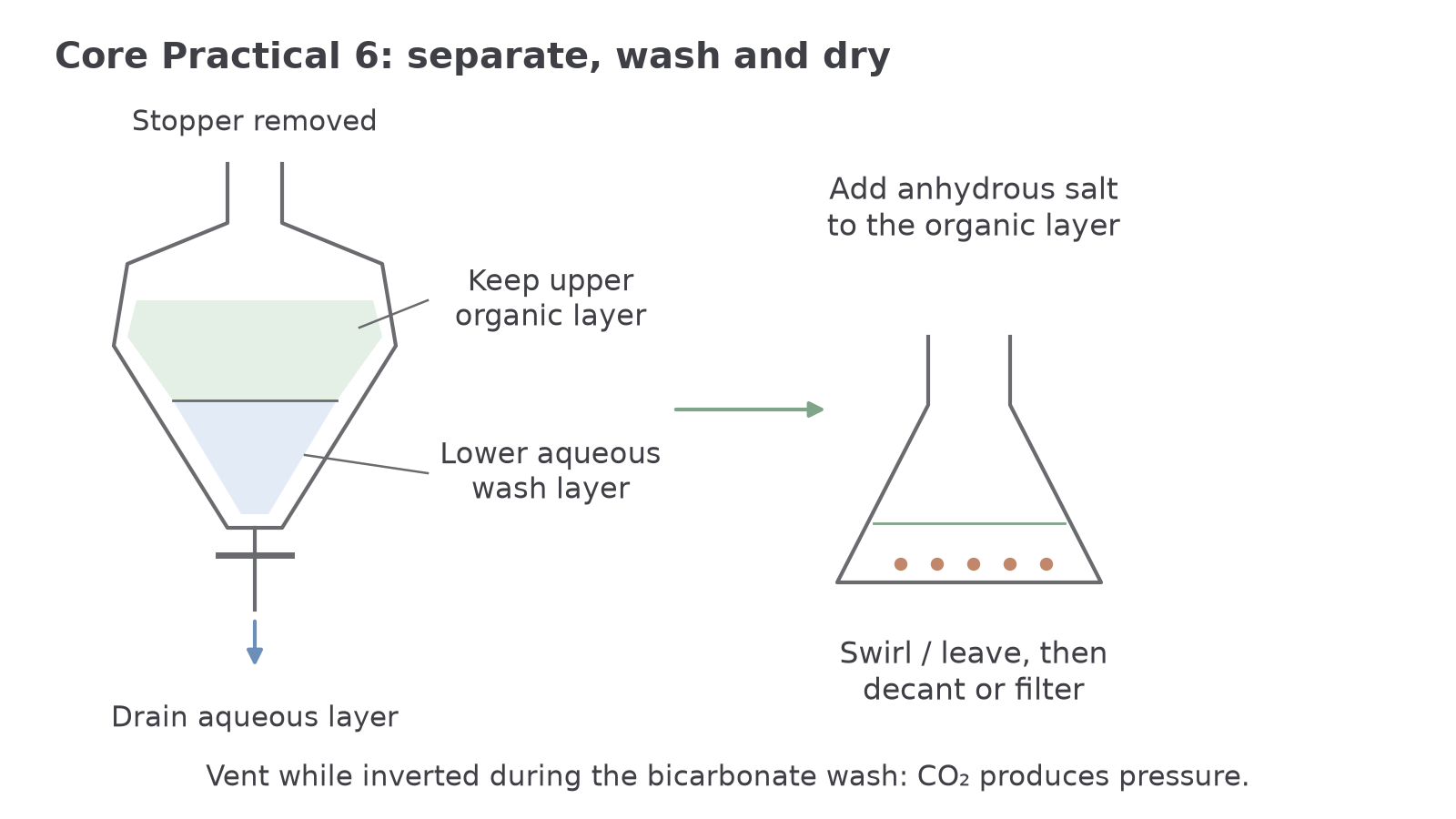
In a separating funnel, the mixture is allowed to settle into two layers. The lower layer is run out through the tap, then the desired layer is kept or transferred depending on where the product is. The product might be the upper layer or the lower layer; do not assume "organic" always means "top". Decide from the density information, the stated method, or the product data.
The stopper matters. When the funnel is shaken, pressure can build, especially if an acid is washed with sodium hydrogencarbonate solution and carbon dioxide is produced:
The funnel must be vented carefully by opening the tap while inverted and pointing away from people. Before draining the lower layer, the stopper is removed so liquid can flow smoothly.
Core Practical 6 gives a clear purification sequence. 2-methylpropan-2-ol reacts with concentrated hydrochloric acid to form 2-chloro-2-methylpropane:
The crude organic product is separated from the aqueous layer. Washing with sodium hydrogencarbonate helps remove acidic impurities, but the carbon dioxide produced means regular venting is essential. The organic layer is then dried before distillation.
Drying is not the same as distilling. Drying removes small amounts of water dissolved or suspended in the organic layer. An anhydrous salt, such as anhydrous sodium sulfate, binds water. The practical sign that drying is working is that the liquid becomes clearer and the drying agent no longer clumps heavily with water.
Worked example: choose and justify a purification sequence
A crude liquid from an organic preparation contains the desired chloroalkane, water, dissolved hydrochloric acid and a little unreacted alcohol. The product is immiscible with water and has a lower boiling temperature than most of the remaining liquid impurities. Describe a suitable purification sequence and justify each stage.
Model route:
Continue this lesson.
You’re previewing NovaLearn without an account. Create a free account to read the rest.
Create free account