6D.36 - Nucleophilic Substitution Mechanisms
A nucleophile replaces a halogen by donating an electron pair to carbon as the carbon–halogen bond breaks. Compare hydroxide and ammonia: both substitute at a primary carbon, but ammonia first forms a charged organic ion that must lose a proton.
Why Primary Halogenoalkanes Are Attacked
A primary halogenoalkane has a polar carbon-halogen bond. The halogen atom is more electronegative than carbon, so the bonding pair is pulled towards the halogen:
The carbon bonded to the halogen is electron deficient enough to be attacked by a nucleophile. A nucleophile is an electron-pair donor. In this lesson the two nucleophiles are:
| Reagent | Species that acts as the nucleophile | Electron pair donated from |
|---|---|---|
| aqueous potassium hydroxide | lone pair on oxygen | |
| ammonia | lone pair on nitrogen |
is a spectator ion in the hydroxide reaction. It helps identify the reagent, but it is not the species whose lone pair attacks the carbon.
Primary substrate focus
Here, the substrate is a primary halogenoalkane, such as or . The carbon attached to the halogen is bonded to one other carbon atom and has relatively open access for the nucleophile. At this stage, use the one-step substitution pattern for primary halogenoalkanes: nucleophile attack and carbon-halogen bond breaking happen together.
For a singly negative nucleophile, the general substitution pattern is:
represents a singly negative nucleophile with a lone pair, such as hydroxide. Neutral ammonia instead gives a positively charged organic ion in its first step, as explained below.
Leaving group
The atom or group that departs from the substrate with the bonding electron pair; here the halide ion, , formed when the carbon–halogen bond breaks heterolytically.
Aqueous Hydroxide Forms An Alcohol
Aqueous potassium hydroxide converts a primary halogenoalkane into an alcohol. The ionic equation shows the species involved in the electron-pair movement:
For example:
If the equation is written using potassium hydroxide, the spectator ion appears in the salt:
Curly-arrow route
For the mechanism, the key electron movement is:
- Put a dipole on the carbon-halogen bond: and .
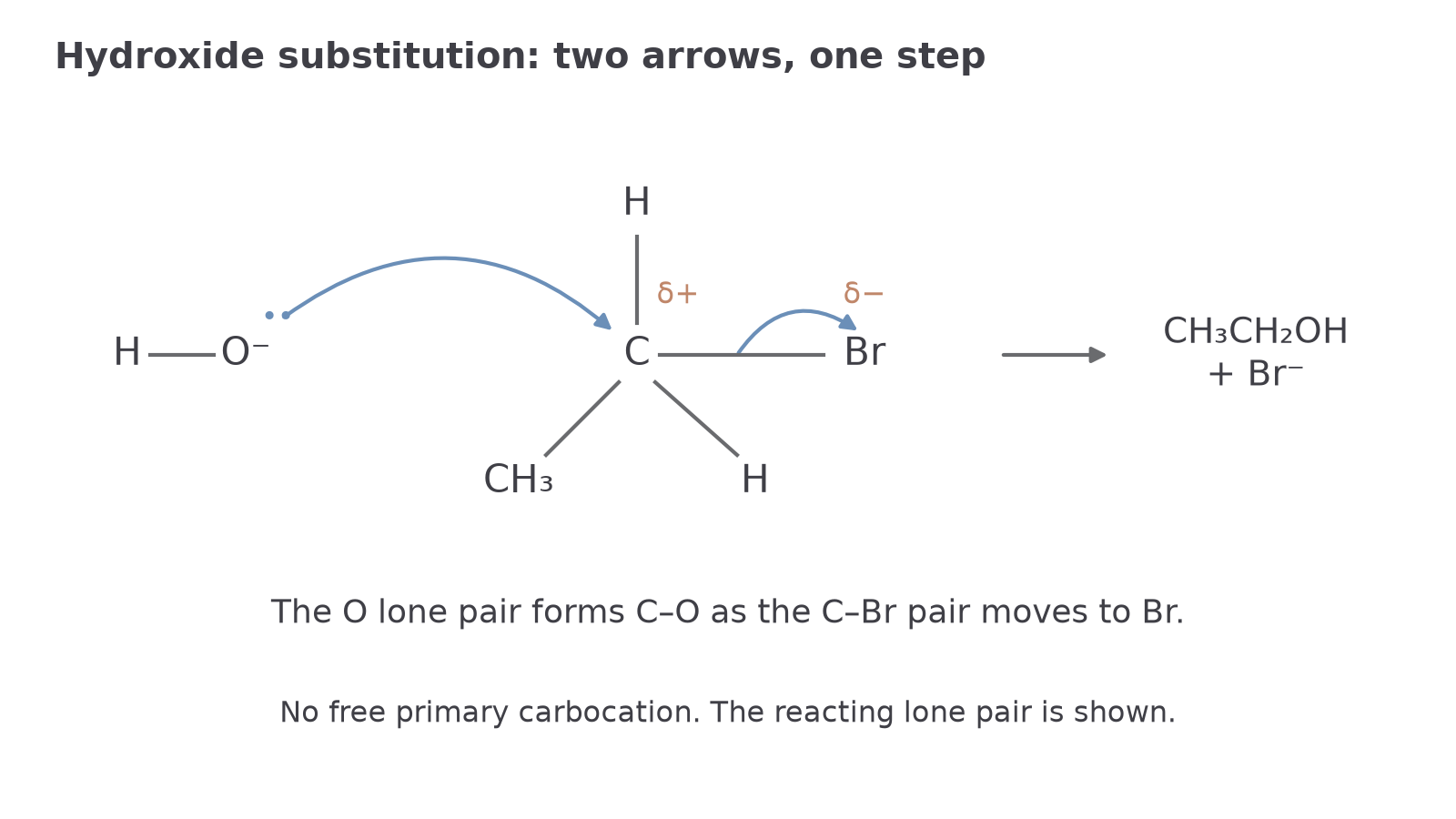
- Draw a curly arrow from a lone pair on the oxygen of to the electron-deficient carbon bonded to .
- Draw a curly arrow from the bond to the halogen atom.
- Form the bond as the bond breaks.
- Give the products as the alcohol and the halide ion.
The two curly arrows are simultaneous in this primary substitution mechanism. Do not draw a free carbocation intermediate for this primary halogenoalkane mechanism.
Worked example: bromoethane to ethanol
Question: Describe the mechanism for the reaction between bromoethane and aqueous potassium hydroxide.
Model answer route:
- The bond in bromoethane is polar, with the carbon atom and bromine .
- A lone pair on the oxygen atom of attacks the carbon.
- The bond breaks and its electron pair moves to bromine.
- Ethanol forms and bromide ion is released.
Chemical interpretation: hydroxide is acting as a nucleophile, not as a base, because its lone pair forms a new bond to carbon. The reaction is substitution because replaces on the carbon skeleton.
Applying the equation to an amount
The balanced substitution equation gives a 1:1 halogenoalkane:alcohol ratio. To find a maximum product mass, divide the starting mass by its relative molecular mass, transfer the amount using this ratio, then multiply by the product's relative molecular mass. For example, 2.50 g of bromoethane (relative molecular mass 108.9) with excess hydroxide gives at most of ethanol. Using ethanol's relative molecular mass 46.0, the maximum mass is to three significant figures. This is a theoretical mass, assuming complete conversion and no product loss.
Start the arrow at the lone pair
The curly arrow starts from the lone pair on oxygen, not from the negative charge symbol on . The charge helps you locate the electron-rich species, but the arrow represents movement of an electron pair from oxygen to the electron-deficient carbon.
[DIAGRAM: asset_name: Hydroxide Substitution Mechanism; asset_slug: organic_sn2_hydroxide; recommended_method: deterministic_chart; description: Hydroxide substitution of bromoethane: oxygen lone pair attacks the carbon opposite bromine while the C–Br bond pair goes to bromine.]
Ammonia Forms A Primary Amine
Ammonia is a neutral nucleophile. Its nitrogen atom has a lone pair, so it can attack the electron-deficient carbon in a primary halogenoalkane. The first substitution step gives a positively charged alkylammonium ion.
The product of the lesson reaction is a primary amine, . To reach it, another ammonia molecule removes a proton from the alkylammonium ion:
Combining the two stages gives the common overall equation:
For bromoethane:
Continue this lesson.
You’re previewing NovaLearn without an account. Create a free account to read the rest.
Create free account