3.3-3.8 - Redox And Disproportionation
Use electron transfer and oxidation-number changes to recognise redox reactions, identify oxidising and reducing agents, and explain disproportionation. Comparisons with neutralisation show why a visible chemical change is not always redox.
Recognising Redox
Magnesium ribbon burning in oxygen gives a bright white flame and a white solid, magnesium oxide. The visible change is dramatic, but the redox claim is not "something burned"; the redox claim is that electrons and oxidation numbers have changed.
For the reaction:
the useful A level question is: what has happened to each element's oxidation number?
| Element | Oxidation number in reactant | Oxidation number in product | Change |
|---|---|---|---|
| 0 in | +2 in | increases | |
| O | 0 in | -2 in | decreases |
Oxidation
Loss of electrons; an increase in oxidation number.
Reduction
Gain of electrons; a decrease in oxidation number.
The same reaction can therefore be described in two linked ways:
- magnesium is oxidised because its oxidation number increases from 0 to +2
- oxygen is reduced because its oxidation number decreases from 0 to -2
This is stronger than the older GCSE shortcut "oxidation is gain of oxygen". That shortcut works for magnesium oxide, but A level chemistry uses the more general model: redox is about electron transfer and oxidation-number change.
Observation To Model
When sodium reacts with chlorine:
there is no oxygen in the equation, but it is still redox. Sodium atoms become ions in the product, so sodium's oxidation number increases from 0 to +1. Chlorine atoms in become ions in sodium chloride, so chlorine's oxidation number decreases from 0 to -1.
This is a typical s-block/p-block redox pattern: an electropositive s-block metal loses electrons, while a p-block non-metal gains electrons.
Redox does not need oxygen
is redox even though no oxygen is involved: sodium's oxidation number increases as it loses electrons, while chlorine's decreases as it gains electrons.
Electron Transfer And Oxidation Numbers
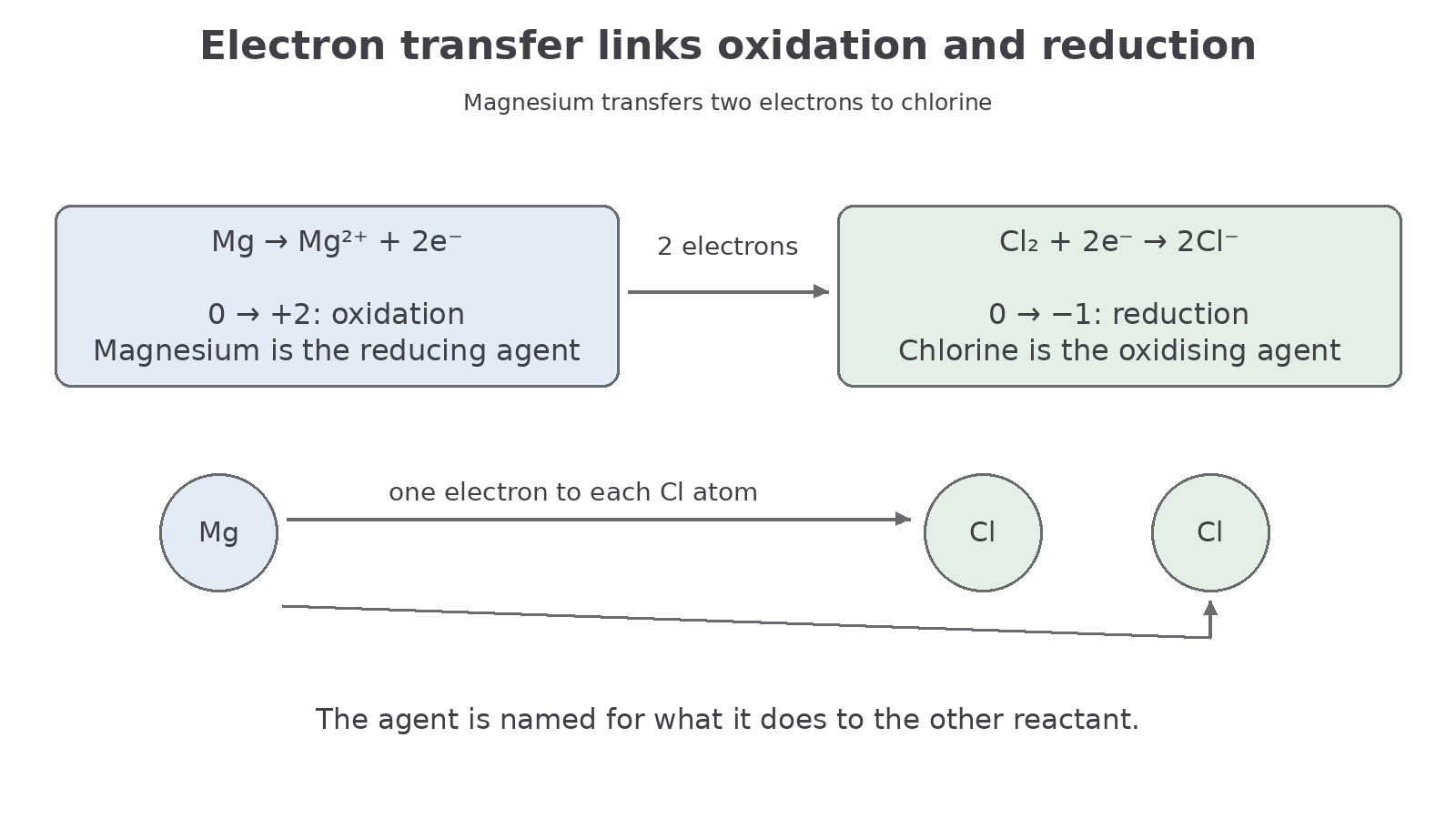
The two definitions of oxidation and reduction must point in the same direction:
[DIAGRAM: asset_name: Edexcel 9Ch0 Redox Electron Transfer; asset_slug: edexcel_9ch0_redox_electron_transfer; recommended_method: deterministic_code; description: Magnesium supplies two electrons, one to each chlorine atom; oxidising and reducing agents are labelled. Pale 1600 by 900 diagram rendered with Pillow; technical geometry and Unicode chemical labels inspected.]
| Process | Electron definition | Oxidation-number definition |
|---|---|---|
| Oxidation | loss of electrons | oxidation number increases |
| Reduction | gain of electrons | oxidation number decreases |
The phrase "oxidation is loss" is useful, but A level answers should normally connect it to the chemical species in the equation. For a monatomic ion, losing electrons makes the actual charge more positive; gaining electrons makes it more negative. In covalent substances, an oxidation-number change tracks assigned electron ownership without implying that free ions appear.
Worked Example: Calcium And Chlorine
Classify the redox changes in:
Step 1: assign oxidation numbers.
- in is 0 because it is an element.
- in is 0 because it is an element.
- in is +2 because the compound contains and two ions.
- in is -1.
Step 2: compare reactant and product values.
| Element | Change | Classification |
|---|---|---|
| 0 to +2 | oxidised | |
| 0 to -1 | reduced |
Step 3: connect to electrons.
Calcium can be represented by the electron-change statement:
Electrons appear on the product side, so calcium has lost electrons. Chlorine can be represented by:
Electrons appear on the reactant side, so chlorine has gained electrons.
Chemical interpretation: calcium transfers electrons to chlorine. Calcium is oxidised; chlorine is reduced. The next lesson will make the formal construction of ionic half-equations explicit, but the electron placement already tells you the redox direction.
Guided Practice
For:
fill the missing words.
- Aluminium changes from 0 to ___, so aluminium is ___.
- Bromine changes from 0 to ___, so bromine is ___.
- Aluminium has ___ electrons.
- Bromine has ___ electrons.
Answer: aluminium changes from 0 to +3, so aluminium is oxidised. Bromine changes from 0 to -1, so bromine is reduced. Aluminium has lost electrons. Bromine has gained electrons.
Common Error Contrast
Do not decide oxidation and reduction from the size of a formula alone. In , there are three bromine atoms for each aluminium atom, but that coefficient pattern does not decide the redox change. The key comparison is oxidation number before and after reaction.
Oxidising And Reducing Agents
Agent language is where many correct redox answers get flipped. The agent is named for what it does to the other species, not for the change happening to itself.
| Reactant role | What it does to electrons | What happens to it | What it causes |
|---|---|---|---|
| Oxidising agent | gains electrons | is reduced | oxidises another species |
| Reducing agent | loses electrons | is oxidised | reduces another species |
Oxidising agent
A species that gains electrons (and is reduced), so it oxidises another species.
Reducing agent
A species that loses electrons (and is oxidised), so it reduces another species.
That can feel backwards at first. It becomes less strange if you think of the oxidising agent as the electron acceptor: by taking electrons from another species, it makes that other species lose electrons and become oxidised.
Worked Example: Chlorine And Bromide Ions
Consider the reaction:
Oxidation-number changes:
| Element | Change | Process |
|---|---|---|
| 0 to -1 | reduction | |
| -1 to 0 | oxidation |
Chlorine is reduced because it gains electrons. Therefore chlorine is the oxidising agent: it has caused bromide ions to lose electrons and become bromine.
Bromide ions are oxidised because they lose electrons. Therefore bromide ions are the reducing agent: they have caused chlorine to gain electrons and become chloride ions.
The agent labels belong to the reactants, not to the products. In this example, is the oxidising agent and is the reducing agent.
An oxidising agent is itself reduced
"An oxidising agent is oxidised" is wrong. An oxidising agent oxidises another species; the oxidising agent itself gains electrons and is reduced.
Disproportionation
One reactant species can supply atoms that undergo two opposite oxidation-number changes.
Disproportionation
A redox reaction in which the same element, starting in a single species, is simultaneously oxidised and reduced.
Redox requires both oxidation and reduction. These may involve different elements or different starting species. Disproportionation specifically takes the same element from a single starting species to both higher and lower oxidation numbers.
Worked Example: Hydrogen Peroxide
Hydrogen peroxide decomposes as follows:
Assign oxidation numbers to oxygen:
- In , oxygen is -1. This is the peroxide exception from oxidation-number rules.
- In , oxygen is -2.
- In , oxygen is 0.
Now compare oxygen before and after:
| Oxygen-containing species | Oxidation number of oxygen | Meaning |
|---|---|---|
| -1 | starting value | |
| -2 | oxygen is reduced | |
| 0 | oxygen is oxidised |
Oxygen in has simultaneously decreased in oxidation number and increased in oxidation number. This is disproportionation. Hydrogen peroxide is acting as both an oxidising agent and a reducing agent because the same reactant species supplies oxygen atoms for both changes.
Second Example: Chlorine In Alkali
The detailed halogen chemistry belongs later in Topic 4, but the classification pattern is useful here:
Chlorine begins at 0 in . It ends at -1 in and +1 in . The same element from the same starting species has been reduced and oxidised, so the reaction is disproportionation.
Redox And Non-Redox Reactions
When a question asks you to identify, deduce, explain or justify a redox classification, use a repeatable routine.
- Assign oxidation numbers to the elements likely to change.
- Compare each element in reactants and products.
- Label increases as oxidation and decreases as reduction.
- If at least one oxidation and one reduction occur, classify the reaction as redox.
- If the same element in one reactant species is both oxidised and reduced, classify it as disproportionation.
- Name oxidising and reducing agents from the reactant species: the electron gainer is the oxidising agent; the electron loser is the reducing agent.
Worked Classification Set
Reaction A:
Magnesium changes from 0 to +2, so magnesium is oxidised. Hydrogen changes from +1 in to 0 in , so hydrogen ions are reduced. This is redox. is the reducing agent; from the acid is the oxidising agent. It is not disproportionation because magnesium and hydrogen are different elements.
Reaction B:
Oxidation numbers do not change: remains +1, remains -1, H remains +1 and O remains -2. This is acid-base neutralisation, not redox. There is no oxidising agent or reducing agent in this reaction.
Reaction C:
Oxygen changes from -1 to -2 and from -1 to 0. This is redox and also disproportionation. The useful evidence is not just that oxygen gas is produced; it is the two different oxidation-number changes for oxygen from the same reactant species.
Recap
A redox answer earns marks by making the oxidation-number or electron-transfer evidence visible. "Oxidised" means electron loss and an increase in oxidation number; "reduced" means electron gain and a decrease in oxidation number. Oxidising agents gain electrons and are reduced; reducing agents lose electrons and are oxidised. Disproportionation is the special case where one element in a single starting species is simultaneously oxidised and reduced.