6D.33-6D.35 - Halogenoalkane Hydrolysis Rates
A cloudy precipitate can reveal how quickly a halogenoalkane releases halide ions. In Core Practical 4, use controlled conditions and timing data to distinguish carbon-structure effects from the carbon–halogen bond-strength trend.
The Observation That Measures Hydrolysis
The practical question is simple: if two halogenoalkanes are warmed with aqueous silver nitrate in ethanol, which one releases halide ions first?
Hydrolysis replaces the halogen atom in a halogenoalkane with an -OH group. For a halogenoalkane written as , where is , or , the useful summary equation is:
The water comes from the aqueous silver nitrate. It acts as the nucleophile, while ethanol helps the halogenoalkane mix with the aqueous reagent because halogenoalkanes are poorly soluble in water.
Silver ions then test for the halide ions as soon as they are released:
The solid makes the mixture cloudy. The faster the cloudiness appears, the faster the hydrolysis has supplied halide ions under those conditions.
For the three common halide ions:
| Halide released | Precipitate | Usual observation |
|---|---|---|
| white precipitate | ||
| cream precipitate | ||
| yellow precipitate |
The precipitate identity tells you which halide ion was formed. The time taken for cloudiness tells you about the relative rate.
Worked example: connect the organic reaction to the silver nitrate observation
When 1-bromobutane hydrolyses, the organic change is:
The evidence reaction is:
So a cream precipitate is evidence that bromide ions have been released. If the cream precipitate appears after in one tube and after in another fair test, the second tube has the faster hydrolysis.
Precipitate colour is not rate
Yellow means iodide is present; it does not by itself prove that reaction was fastest. To compare rates, compare the time taken to reach the same visible endpoint under the same conditions.
Core Practical 4 Method Logic
Core Practical 4 is a rate comparison, not a product-preparation practical. The method is designed so that the only planned change is the halogenoalkane being tested.
A typical fair-test sequence is:
- Add equal volumes of ethanol to labelled test tubes.
- Add the same measured volume, or consistently delivered equal drop counts in the published school comparison, of each halogenoalkane.
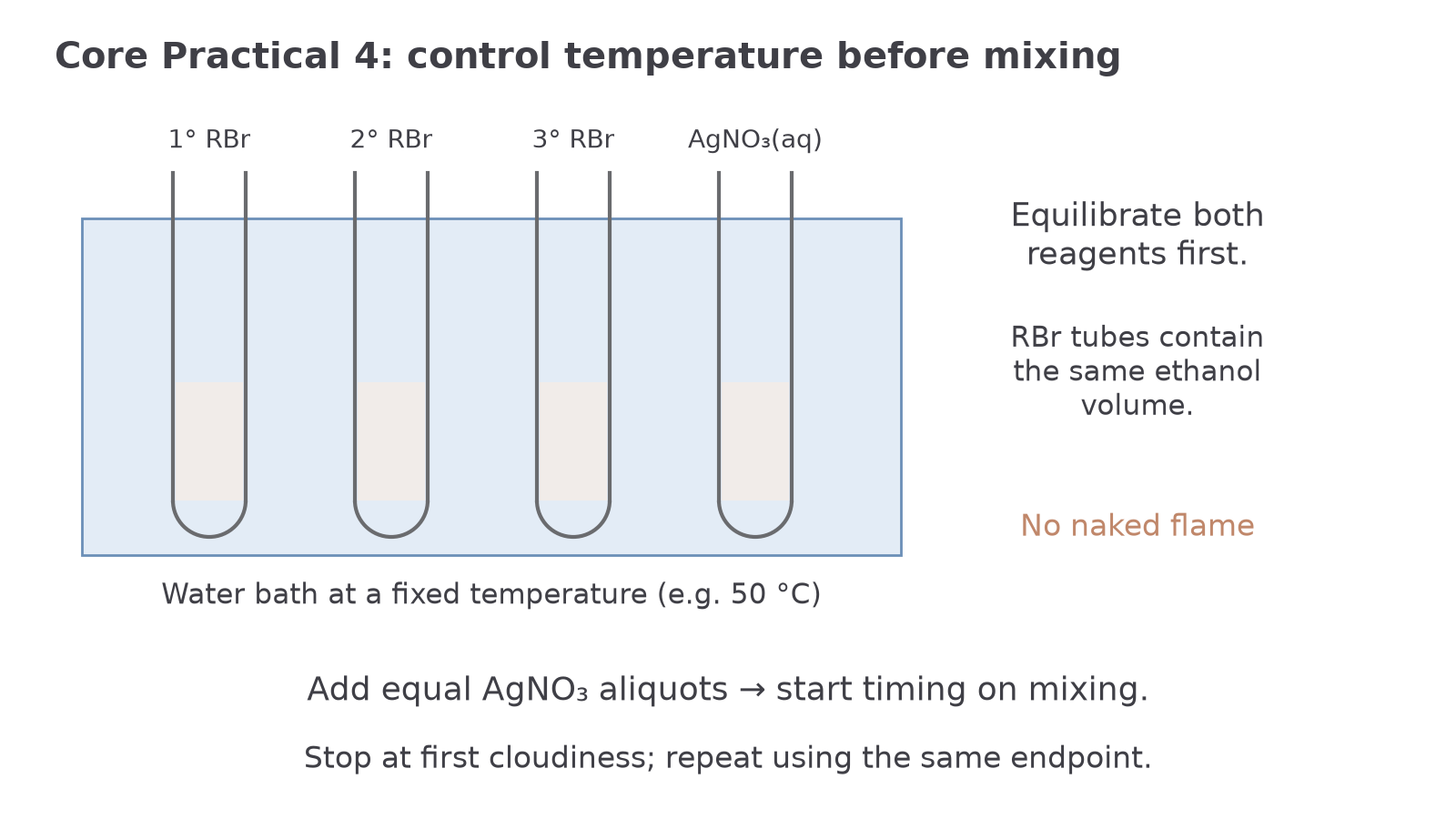
- Place the tubes in a water bath at about 50 °C so that they reach the same temperature.
- Warm equal volumes of aqueous silver nitrate in separate tubes in the same water bath.
- Add the silver nitrate to one halogenoalkane tube, loosely replace the bung, start the stop clock immediately, and keep the tube in the water bath.
- Stop timing when the mixture first becomes cloudy.
- Repeat for the other halogenoalkanes, then repeat the whole comparison if time allows.
The chemical purpose of each choice matters:
| Method choice | Why it matters |
|---|---|
| Ethanol solvent | helps the organic halogenoalkane mix with the aqueous reagent |
| Aqueous silver nitrate | supplies water for hydrolysis and to show released halide ions |
| Water bath | keeps temperature constant and avoids a flame near flammable ethanol and halogenoalkanes |
| Same volumes and same concentration | keeps the amount of reagent and endpoint comparable |
| Same endpoint, first cloudiness | gives a consistent timing point for relative rate comparison |
| Repeats and mean time | reveal scatter and reduce random timing error in a mean; systematic endpoint bias can remain |
Safety is part of the chemistry evidence. Ethanol and many halogenoalkanes are flammable, so a Bunsen burner is unsuitable. Silver nitrate is corrosive and stains skin, so eye protection, small volumes and careful disposal in the correct waste container are required. Loosely fitted bungs reduce vapour escape, but the tubes should not be treated as sealed pressure vessels.
Practical reasoning: variables
| Variable type | In this practical |
|---|---|
| Independent variable | the halogenoalkane, such as 1-chlorobutane, 1-bromobutane or 1-iodobutane |
| Dependent variable | time for the first visible precipitate or cloudiness |
| Key controls | temperature, volume of ethanol, volume and concentration of silver nitrate, amount of halogenoalkane, water-bath time before mixing, endpoint judgement |
If the endpoint is judged by eye, the uncertainty is not just the stop clock resolution. The largest uncertainty may be the moment a student decides "cloudy" has been reached. A white background, the same observer, repeat timings and a light sensor or colorimeter can improve consistency.
Equal drop counts are a convenient school comparison, but drop size and liquid density vary. For a stronger quantitative comparison use equal aliquots of solutions of known, equal molar concentration and keep the solvent composition the same. Record repeats, spread and anomalous results; do not discard a time merely because it disagrees with the expected trend.
[DIAGRAM: asset_name: CP4 Water Bath And Endpoint; asset_slug: organic_cp4_waterbath; recommended_method: deterministic_chart; description: Core Practical 4: equilibrate substrate mixtures and aqueous silver nitrate in the same water bath, then mix and time first cloudiness.]
Turning Times Into Rate Evidence
For this core practical, a shorter time to the same cloudy endpoint means a faster relative hydrolysis. If all tubes contain the same reagent volumes and are judged at the same endpoint, a simple rate index can be calculated:
Relative rate index
= time to the same visible endpoint, in s; the index has unit . It compares relative rates only when temperature, volumes and the endpoint are the same.
This is an approximate comparison index. It assumes a comparable amount of halide is required to reach the chosen endpoint; different silver-halide colours/visibility can add an endpoint limitation when different halogens are compared. It is not an absolute chemical rate or a full rate equation and it is not proof of reaction order. Detailed rate equations and mechanism evidence belong later in the course.
Worked example: compare three primary halogenoalkanes
A class obtains these original timing data at the same temperature:
Continue this lesson.
You’re previewing NovaLearn without an account. Create a free account to read the rest.
Create free account