13B.18-13B.22 - Gibbs Energy And Feasibility
Combine enthalpy, entropy and temperature to predict thermodynamic feasibility. Calculate a temperature boundary and an equilibrium constant, then distinguish a favourable equilibrium from a reaction that is fast enough to observe.
Enthalpy, Entropy And Temperature
Some reactions release heat and proceed readily, but enthalpy alone is not enough to decide feasibility. An endothermic process can be feasible if it gives a large enough increase in entropy, and an exothermic process can become less favourable at high temperature if it causes a large enough decrease in entropy.
Gibbs free energy is the quantity that combines those two effects:
Gibbs free energy change
and in ; in K; in (divide J values by 1000). A reaction is feasible when .
The sign of gives the thermodynamic prediction for the reaction as written under the stated conditions.
| sign | Thermodynamic meaning |
|---|---|
| feasible as written | |
| at the feasibility boundary, linked to equilibrium | |
| not feasible as written under those conditions |
The equation is closely related to total entropy. From the previous lesson, a feasible change has a positive total entropy change. Since the surroundings entropy term depends on the enthalpy change, Gibbs free energy packages the balance between system entropy and enthalpy into one value: negative corresponds to the entropy balance favouring the reaction.
Common-error contrast: "feasible" does not mean "fast". Gibbs free energy tells you whether the final state is thermodynamically favoured; it does not tell you whether particles can get over the activation energy barrier quickly enough to observe the reaction.
Using the Gibbs Equation
Most errors in Gibbs calculations are unit errors. must be in kelvin, and and must use the same energy unit before they are subtracted.
Two safe routes are possible:
| Route | How to handle units |
|---|---|
| kJ route | Convert from to , then report in |
| J route | Convert from to , then report in or convert back to |
Worked example: predict feasibility at 298 K.
A reaction has , and .
Use the kJ route:
The prediction is thermodynamically feasible at because is negative. The chemical interpretation matters: the enthalpy term is unfavourable because the reaction is endothermic, but the positive entropy term is large enough at this temperature to outweigh it.
Finding the Feasible Temperature
When a question asks for the temperature at which a reaction becomes feasible, set . That gives the boundary temperature:
[DIAGRAM: asset_name: Free energy against temperature for positive enthalpy and entropy; asset_slug: edexcel_a_level_chemistry_l063_gibbs_temperature; recommended_method: deterministic_chart; description: Free energy against temperature for positive enthalpy and entropy.]
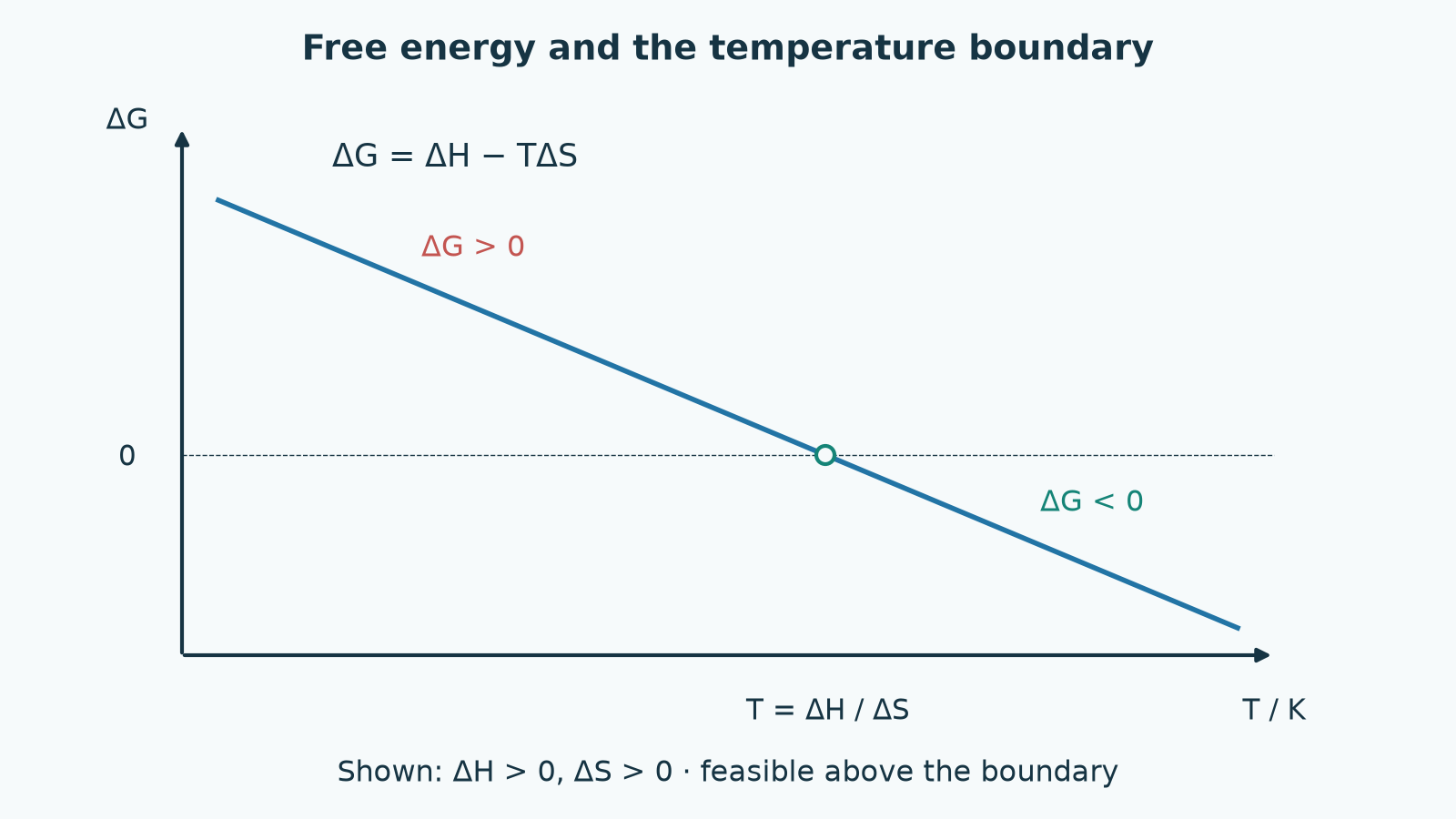
Feasibility boundary temperature
and in matching units (kJ and kJ K⁻¹, or J and J K⁻¹); in K. Assumes and are roughly constant with temperature.
This calculation only makes sense when and are in matching units. The answer is in kelvin.
Worked example: determine the temperature boundary.
A decomposition has:
Convert entropy to kJ:
At the boundary:
Because both and are positive, the reaction becomes feasible above this temperature. Below , the term is too small to overcome the positive enthalpy change. Above , the entropy contribution is large enough to make negative.
The sign pattern is a useful sense check:
| Temperature effect | ||
|---|---|---|
| negative | positive | feasible at all positive temperatures in this simple test |
| positive | negative | not feasible at any positive temperature in this simple test |
| positive | positive | feasible above the boundary temperature |
| negative | negative | feasible below the boundary temperature |
Guided practice: a reaction has:
Determine the temperature boundary and state whether the reaction is feasible above or below it.
Expected answer:
The reaction is feasible below . For example, at , , but at , .
Gibbs Energy and Equilibrium
The standard reaction Gibbs free energy, , is linked to the dimensionless equilibrium constant . The specification often abbreviates this symbol to in this relationship:
Gibbs energy and the equilibrium constant
; in K; in when is in joules; is the dimensionless equilibrium constant; is the natural logarithm.
The signs explain the chemistry:
| Equilibrium constant | Interpretation | ||
|---|---|---|---|
| positive | negative | products are favoured; feasible as written | |
| zero | zero | boundary case | |
| negative | positive | reactants are favoured; not feasible as written |
Worked example: show the link for a large equilibrium constant.
At , a reaction has:
Calculate:
Continue this lesson.
You’re previewing NovaLearn without an account. Create a free account to read the rest.
Create free account