6C.24 - Electrophilic Addition Mechanisms
Curly arrows track electron pairs as an alkene reacts with an electrophile. Work through halogen and hydrogen-halide addition, compare carbocation pathways, and transfer the same logic to an unfamiliar polar reagent.
Why Alkenes Attract Electrophiles
An alkene is reactive because the C=C double bond contains a sigma bond and a pi bond. The pi bond is an exposed region of electron density above and below the carbon-carbon bond, so it can donate an electron pair to an electron-deficient species. That electron-deficient species is the electrophile.
In electrophilic addition, two things happen together:
- the pi bond is broken
- two new sigma bonds are formed to the two carbons that used to be joined by the double bond
For mechanism work, the most important convention is this:
Curly arrow
An arrow showing the movement of an electron pair. It starts from a bond or a lone pair, never from a positive charge, an atom label or empty space, and points to where the pair goes.
Common arrow origins in this lesson are:
| Situation | Curly arrow starts from | Curly arrow points to |
|---|---|---|
| The alkene attacks an electrophile | the C=C bond | the electrophilic atom, such as or |
| A reagent bond breaks heterolytically | the bond being broken, such as or | the atom taking both bonding electrons |
| A negative ion attacks a carbocation | a lone pair on the negative ion | the positively charged carbon |
| A neutral molecule such as water attacks | a lone pair on oxygen | the positively charged carbon |
Heterolytic fission is essential here. When a bond breaks heterolytically, both bonding electrons go to one atom, forming ions. This is different from the radical substitution mechanism of alkanes, where homolytic fission makes radicals and curly half-arrows are not expected in this specification.
Worked Example: Find The Electrophile And Arrow Origins
In the reaction between ethene and hydrogen bromide:
The bond is polar because bromine is more electronegative than hydrogen:
H()-Br()
The electrophile is . The first curly arrow starts at the C=C bond and points to , because the pi electrons form a new bond. A second curly arrow starts at the bond and points to , because bromine takes the bonding pair to become .
The intermediate is a carbocation.
Carbocation
An ion containing a positively charged carbon atom.
In the second step, a lone pair on attacks that positively charged carbon to form the bond.
Halogens Add Through An Induced Dipole
Halogen molecules such as and are non-polar overall, but an approaching alkene can polarise them. The electron-rich C=C bond repels the electron cloud in the halogen molecule, making the nearer halogen atom and the farther halogen atom . The nearer halogen atom behaves as the electrophile.
For bromine addition to ethene, the overall reaction is:
The simple carbocation mechanism used at this level has two steps. A bridged halonium ion is a chemically valid alternative for halogen addition; it is not an extra required intermediate in the route drawn here.
Step 1: the C=C bond donates an electron pair to the nearer bromine atom, and the bond breaks heterolytically.
Step 2: donates a lone pair to the carbocation carbon.
[DIAGRAM: asset_name: Bromine Addition Mechanism; asset_slug: edexcel_a_level_chemistry_l033_bromine_addition_mechanism; recommended_method: deterministic_chart; description: Two-step electrophilic addition of bromine to ethene, showing curly arrows from the C=C bond to bromine, from the Br-Br bond to bromide, then from a bromide lone pair to the carbocation.]
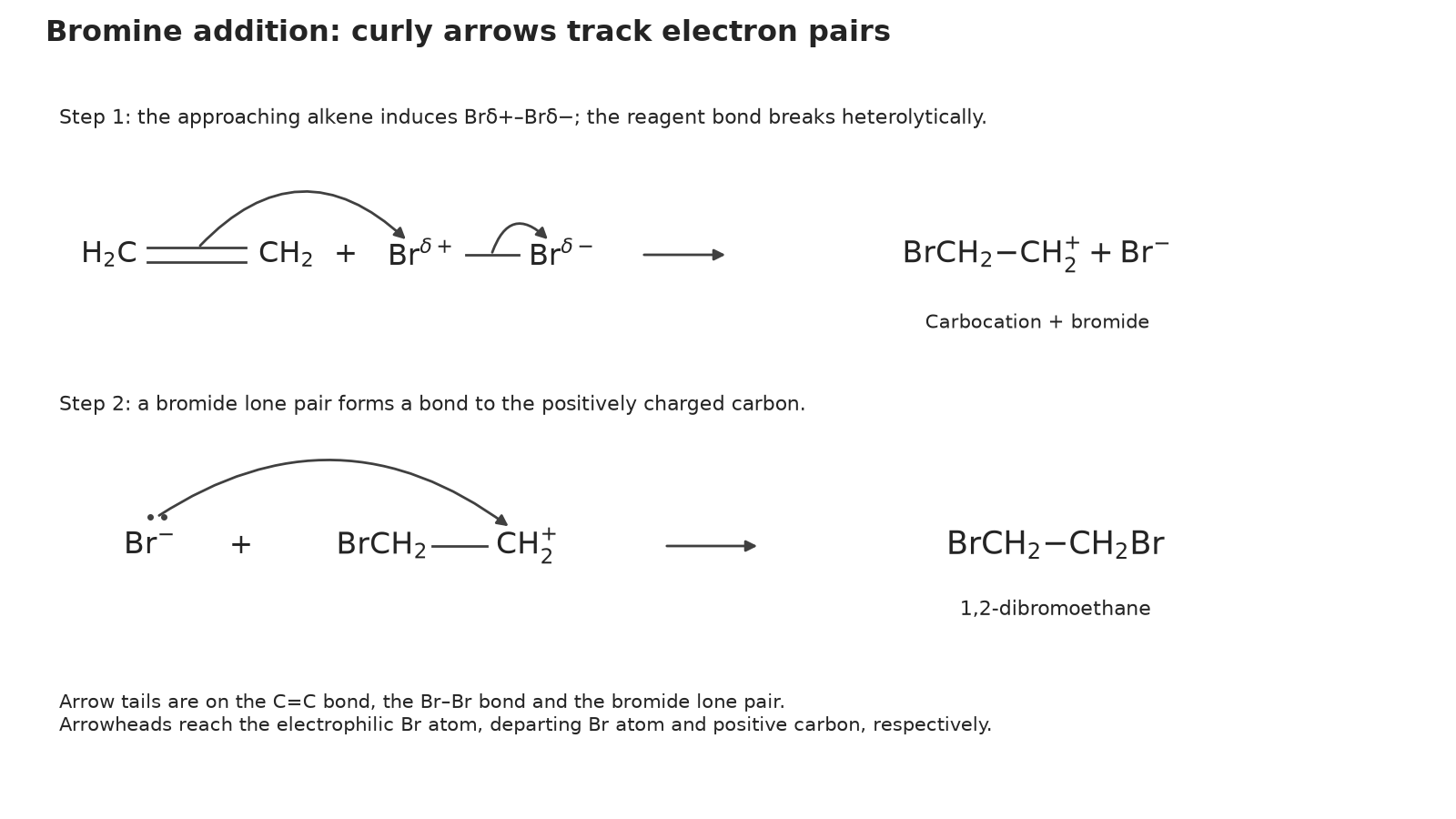
The product is a dihalogenoalkane because one halogen atom adds to each carbon of the original double bond. This lesson explains the mechanism; the qualitative test using bromine or bromine water is assessed in the next lesson.
Worked Example: Chlorine Addition To Propene
Predict the product when propene reacts with chlorine.
Start from the carbon skeleton:
Addition removes the double bond and puts one chlorine atom on each of the two carbons that were in the double bond:
The product can be named 1,2-dichloropropane. A mechanism drawing would show the alkene pi bond attacking , the bond breaking to form , and then attacking the carbocation.
Common-Error Contrast
Do not put both halogen atoms onto the same carbon unless a supplied mechanism specifically justifies that. In ordinary halogen addition to an alkene, the two halogen atoms end up on the two carbons that formed the C=C bond.
Hydrogen Halides And Unsymmetrical Alkenes
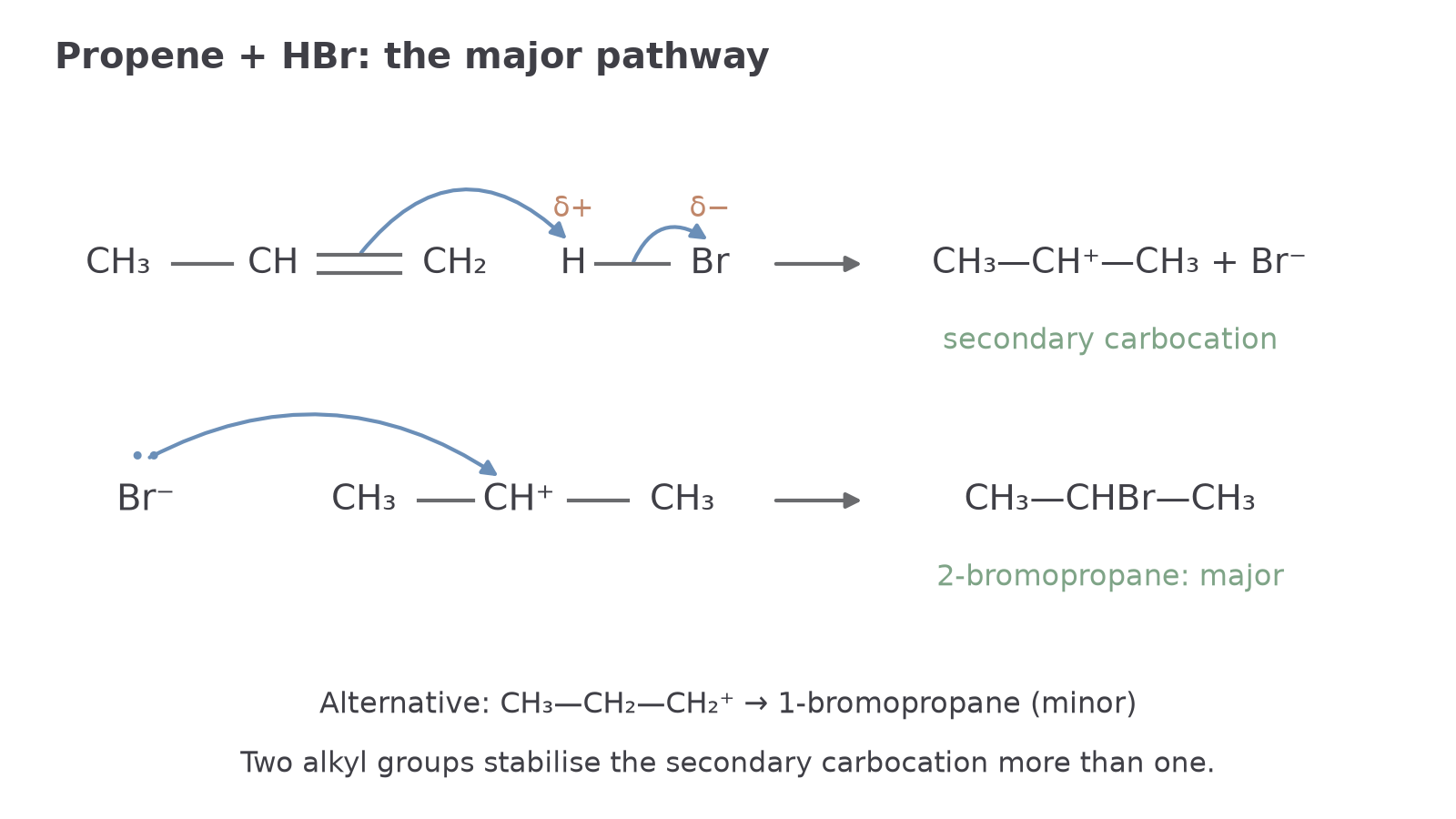
Hydrogen halides, such as , and , are already polar. The hydrogen atom is , so it is the electrophile. The halogen becomes a halide ion after heterolytic fission and attacks the carbocation in the second step.
For a symmetrical alkene such as ethene, there is only one possible carbocation arrangement. For an unsymmetrical alkene, protonation can give different carbocations, and the major product forms through the more stable carbocation.
Carbocation stability
tertiary > secondary > primary. The major product of an unsymmetrical addition forms through the more stable carbocation.
A tertiary carbocation has the positively charged carbon attached to three carbon groups; a secondary carbocation is attached to two carbon groups; a primary carbocation is attached to one carbon group. More alkyl groups help stabilise the positive charge by donating electron density through sigma bonds, so the intermediate is lower in energy and more likely to form.
[DIAGRAM: asset_name: Propene HBr Carbocations; asset_slug: edexcel_a_level_chemistry_l033_propene_hbr_carbocations; recommended_method: deterministic_chart; description: Propene reacting with hydrogen bromide by two possible carbocation routes, with the secondary carbocation route leading to 2-bromopropane as the major product.]
Continue this lesson.
You’re previewing NovaLearn without an account. Create a free account to read the rest.
Create free account