13A.4-13A.8 - Ionic Bond Strength And Polarisation
Use lattice energies to compare ionic attraction and test the purely ionic model. Explain differences between predicted and experimental values through distortion of anion electron clouds.
Lattice Energy As Bond Strength
Two ionic solids can both contain positive and negative ions, but one may be much harder to melt or pull apart than the other. Lattice energy gives a way to compare that ionic attraction. In the formation definition used here, lattice energy is the enthalpy change when one mole of an ionic solid is formed from its gaseous ions, so it is normally quoted as an exothermic, negative value.
For this lesson, the important comparison is the magnitude of the value. A lattice energy of has a larger magnitude than , so it represents stronger attraction between ions in the lattice. The more strongly the oppositely charged ions attract, the more energy is released when the lattice forms and the more energy would be needed to separate the ions.
[DIAGRAM: asset_name: Lattice Energy Comparison; asset_slug: edexcel_a_level_chemistry_l060_lattice_energy_comparison; recommended_method: deterministic_chart; description: Pale-background colour conceptual comparison of two ionic lattices, one with weaker attraction and smaller lattice-energy magnitude and one with stronger attraction and larger lattice-energy magnitude.]
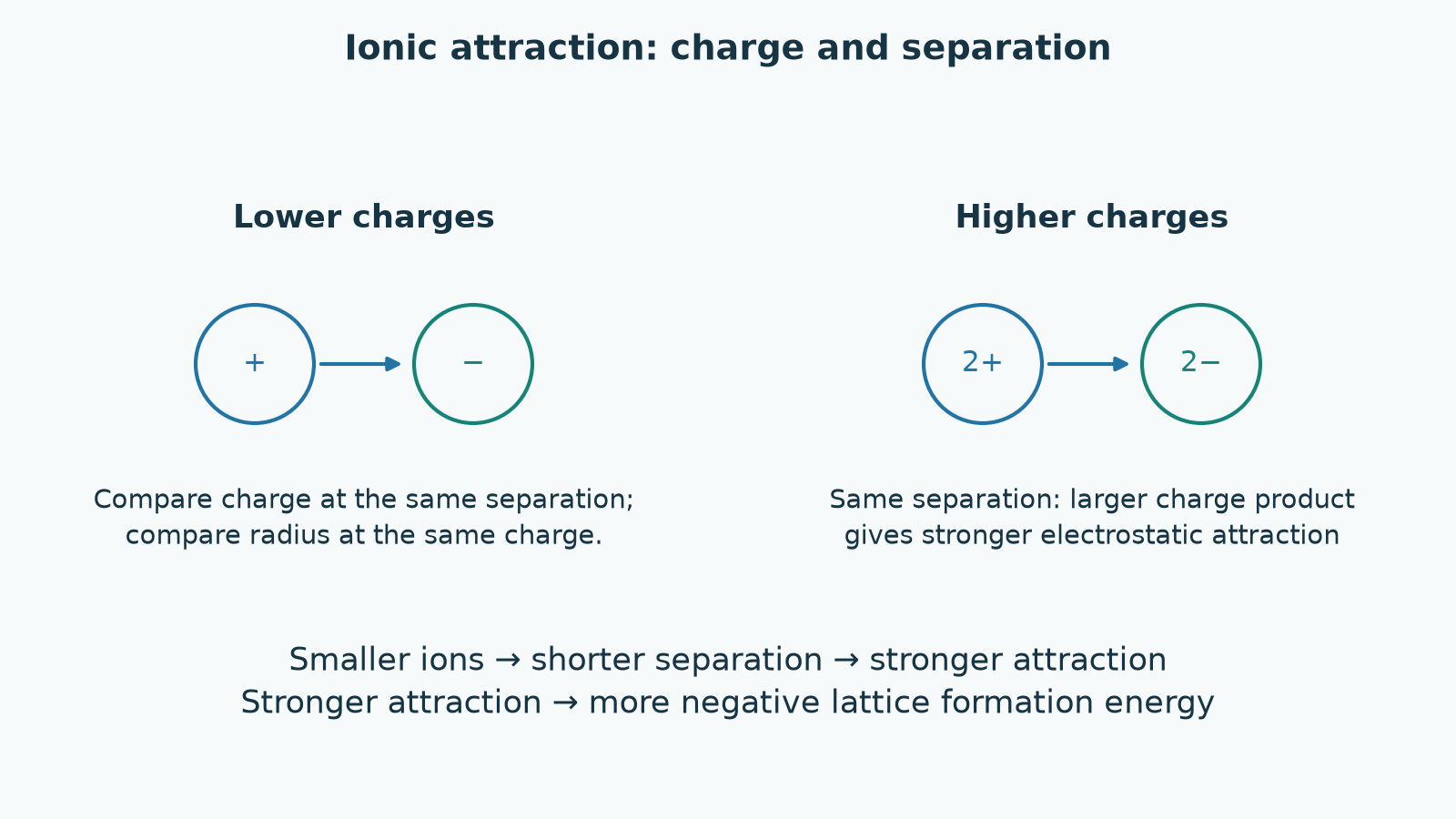
The charge and radius model from earlier bonding work is still the particle explanation behind the energy value.
| Particle factor | Effect on ionic attraction | Effect on lattice energy magnitude |
|---|---|---|
| Higher ionic charges | Stronger electrostatic attraction between oppositely charged ions | Larger magnitude |
| Smaller ionic radii | Ion centres can be closer together | Larger magnitude |
| Lower ionic charges or larger radii | Weaker electrostatic attraction | Smaller magnitude |
Worked example: compare ionic bond strength
A question gives these lattice energy values, using the same formation definition:
| Compound | Lattice energy / |
|---|---|
has the stronger ionic bonding because its lattice energy has the larger magnitude. The answer should not say only " is smaller". For formation lattice energies, the more negative value means more energy is released when the lattice forms, so the electrostatic attractions in the lattice are stronger.
Experimental And Theoretical Lattice Energies
A Born-Haber cycle gives an experimental lattice energy. It is "experimental" in the A-level sense because it is found from measured enthalpy changes combined in a cycle, not because someone directly watches one mole of gaseous ions crystallise. The theoretical lattice energy is calculated from electrostatic theory, treating the ions as fully charged, spherical particles arranged in a lattice.
That theoretical model is useful because it gives a purely ionic prediction. If the experimental value is close to the theoretical value, the compound is well described as mainly ionic. If the experimental lattice energy has a much larger magnitude than the theoretical value, the real lattice is more stable than a purely ionic model predicts; that extra stabilisation is evidence for covalent character.
With the formation definition, this usually appears as: experimental value more negative than theoretical value → larger experimental magnitude than predicted → extra stabilisation → greater covalent character.
Worked example: deducing covalent character from data
The following values are simplified stimulus data, not data-book values.
| Compound | Theoretical lattice energy / | Experimental lattice energy / | Difference in magnitude |
|---|---|---|---|
| A | |||
| B |
Compound A has a small difference between the theoretical and experimental values, so its bonding is close to the purely ionic model. Compound B has an experimental value with a much larger magnitude than the theoretical value. That suggests compound B has more covalent character, because electrostatic theory alone has not accounted for all the stabilisation in the lattice.
The key step is the comparison within each compound. A raw lattice energy value by itself does not prove covalent character; the evidence comes from comparing the Born-Haber experimental value with the theoretical electrostatic value for the same compound.
What Polarisation Means
A cation can pull an anion’s electrons away from their undistorted distribution.
Polarisation
The distortion of an ion's electron cloud by a neighbouring ion.
In the common lattice-energy context, a positive cation attracts the electrons in a negative anion. If that attraction distorts the anion's electron cloud towards the cation, some electron density lies between the two nuclei, so the bonding has some covalent character.
[DIAGRAM: asset_name: Ion Polarisation Model; asset_slug: edexcel_a_level_chemistry_l060_ion_polarisation_model; recommended_method: deterministic_chart; description: Pale-background colour particle schematic showing a small highly charged cation pulling the electron cloud of a large anion towards it, producing distorted electron density between the ions.]
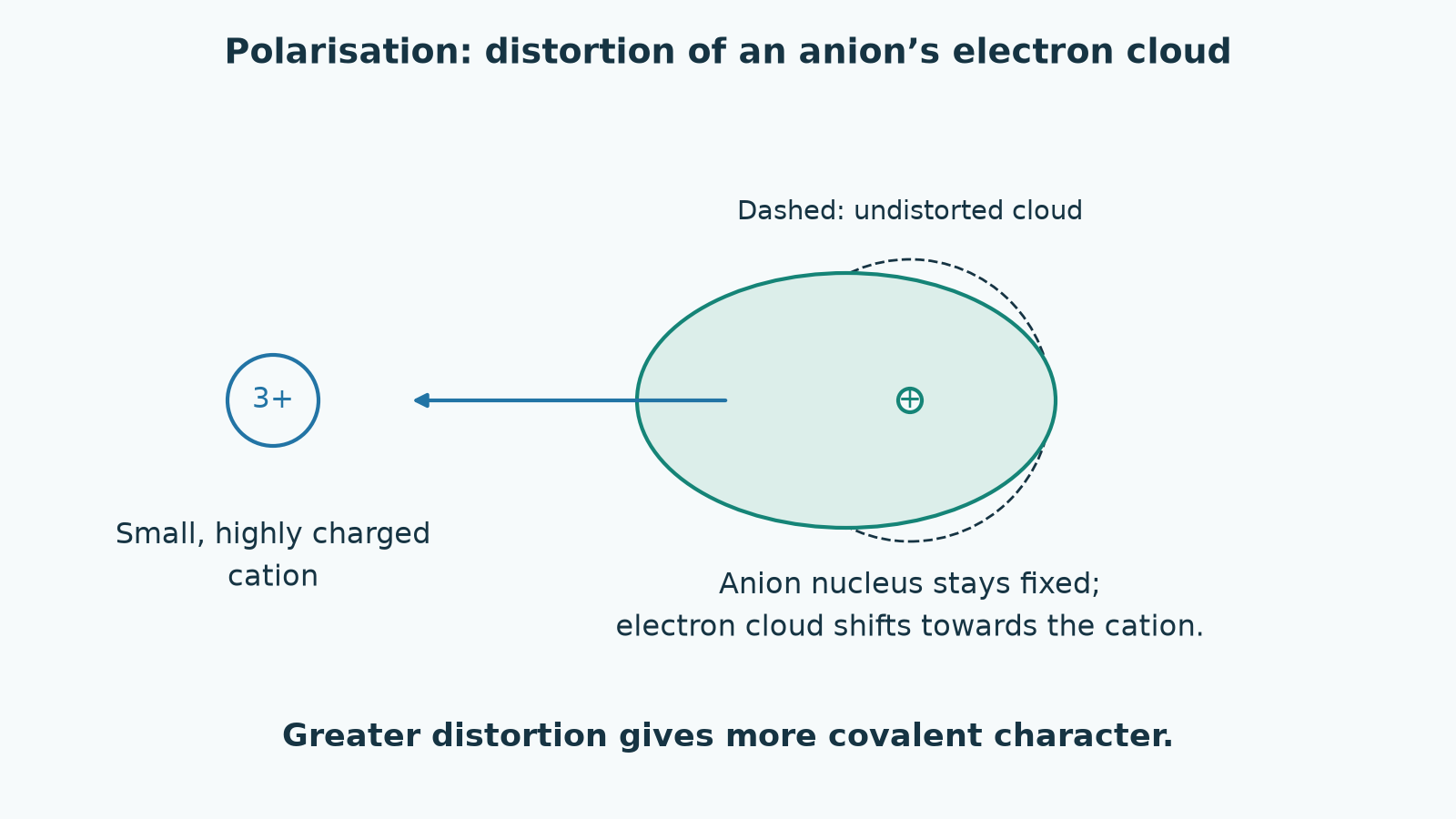
This is not a claim that the compound has stopped being ionic in every way. It is a continuum idea. A compound can be mostly ionic but still have more covalent character than another ionic compound because its ions are more strongly polarised.
The language needs to be precise:
Continue this lesson.
You’re previewing NovaLearn without an account. Create a free account to read the rest.
Create free account