9.1-9.3 - Collision Theory And Reaction Rates
Explain how particle collisions control reaction rate, then calculate rates from timed endpoints and graph tangents. Distinguish a faster reaction from a greater final amount of product, and design a fair comparison of rate variables.
Rate Starts With A Measurable Change
A reaction that fizzes quickly feels "fast", but chemistry needs a measurable change. If magnesium reacts with dilute hydrochloric acid, the reaction rate can be followed by measuring the volume of hydrogen produced each second, or the time taken for a fixed amount of magnesium to react. A balance is better suited to a gas such as carbon dioxide from marble and acid: hydrogen has a very small mass, so its loss is difficult to measure accurately on an ordinary laboratory balance.
Reaction rate means change per unit time:
Rate of reaction
The unit comes from the quantity measured, e.g. , or .
The quantity depends on the method:
| Measurement | Example rate unit | What the rate describes |
|---|---|---|
| volume of gas formed | how quickly product gas appears | |
| mass lost | how quickly gas leaves an open vessel | |
| concentration change | how quickly a reactant is used or product forms in solution | |
| fixed visual endpoint | for | a relative rate for the same endpoint |
A rate is not just "how much product forms". A reaction could eventually make the same volume of gas but do it slowly or quickly. Rate is about the steepness of change with time.
Common-error contrast
| Tempting statement | Why it fails | Better statement |
|---|---|---|
| "More gas means a faster reaction." | Total gas volume may only show how much reactant was present. | Faster means more gas per second, especially near the start. |
| "A shorter time is the rate." | Time and rate change in opposite directions. | For the same endpoint, relative rate is usually . |
| "All rates have unit ." | The unit depends on what is changing. | Use , then attach the unit from the measurement. |
Collision Theory And Rate Variables
Collision theory explains rate by asking two questions: how often particles collide, and whether those collisions have enough energy to lead to reaction. If more collisions are successful each second, the rate increases.
[DIAGRAM: asset_name: Collision Variables; asset_slug: edexcel_a_level_chemistry_l046_collision_variables; recommended_method: deterministic_chart; description: Four-panel monochrome particle model comparing lower and higher concentration, pressure, surface area and temperature as rate variables in collision theory.]
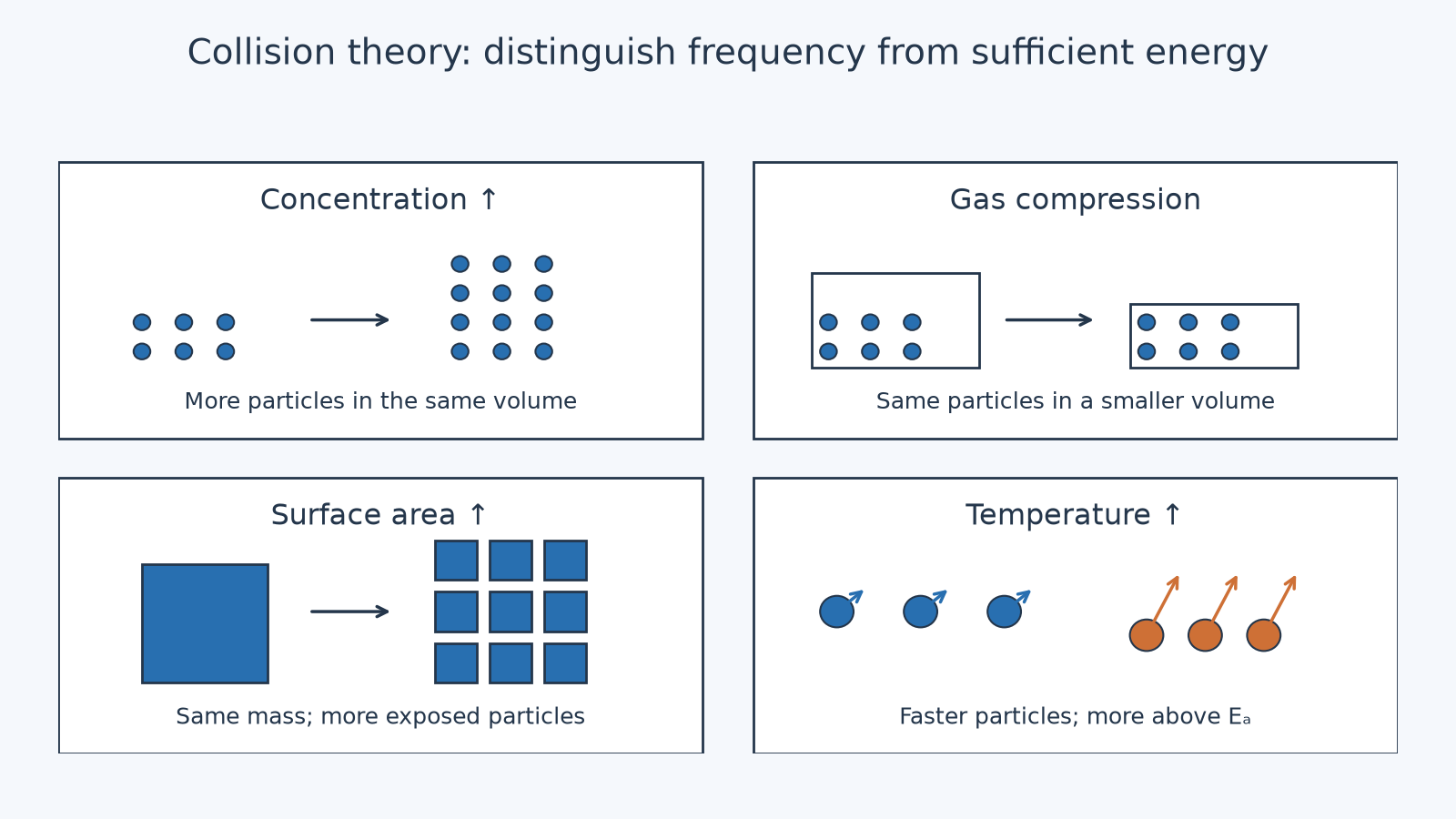
| Change | Particle-level explanation | Rate effect |
|---|---|---|
| Increase concentration of a solution reactant | More reacting particles in each unit volume, so collisions between reacting particles happen more often. | Rate increases. |
| Increase pressure of a gaseous reactant | The same number of gas particles occupy a smaller volume, so particles are closer together and collide more often. | Rate increases for gaseous reactions. |
| Increase surface area of a solid reactant | More solid particles are exposed at the surface, so solution or gas particles can collide with more reaction sites. | Rate increases. |
| Increase temperature | Particles move faster, so they collide more often and a larger proportion of collisions have enough energy to react. | Rate increases. |
These simple predictions assume the changed reactant affects the rate-controlling pathway. Later rate-equation experiments show exceptions such as zero order; concentration alone is not a universal rate law.
For a pressure comparison, compress the reacting gases at constant temperature. Adding an inert gas at constant volume changes total pressure but not reactant concentration or collision frequency.
Pressure is mainly useful as a rate variable when a gas is involved. Increasing pressure on a sealed liquid reaction does not usually increase collision frequency in the same direct way, because liquids are already close-packed compared with gases.
Surface area is also specific: it matters when a solid reacts with a gas or solution. Crushing a solid into smaller pieces does not create more substance; it exposes more of the existing solid at once.
Activation Energy And Successful Collisions
Particles can collide and still fail to react. A successful collision must have a suitable orientation as well as enough energy to start breaking bonds, overcoming repulsions, or rearranging electrons so that products can form.
Activation energy, \(E_{\mathrm a}\)
The minimum energy that colliding particles must have for a reaction to occur (for a collision to be successful).
For an exothermic or endothermic reaction, is not the overall enthalpy change. It is the energy barrier between reactants and the transition state. A reaction can release energy overall and still need an initial energy input to get started.
Think about hydrogen and oxygen at room temperature. They do not immediately react just because the reaction can be highly exothermic. Many collisions happen, but without enough energy to overcome the barrier, the mixture remains largely unchanged until an ignition source supplies energy to start successful collisions.
Common-error contrast
| Error | Correction |
|---|---|
| "Every collision causes a reaction." | Only successful collisions lead to reaction. |
| "Activation energy is the energy released." | Activation energy is the minimum energy particles must have for a successful collision. |
| "Higher temperature only means more collisions." | Higher temperature also means a greater proportion of collisions exceed ; the Maxwell-Boltzmann curve details come next lesson. |
Calculating Rate From Time Data
When a reaction reaches the same visible endpoint each time, a shorter time means a faster reaction. In this kind of experiment, questions often use relative rate:
Continue this lesson.
You’re previewing NovaLearn without an account. Create a free account to read the rest.
Create free account