16.8-16.11 - Rate-Determining Steps And Mechanisms
Use the acid-catalysed iodination of propanone and halogenoalkane hydrolysis to connect rate equations with possible mechanisms. Check both rate-controlling steps and overall stoichiometry, and distinguish supporting evidence from unique proof.
Rate Equations As Mechanism Evidence
The chemical problem is this: the balanced equation tells you what is used up overall, but it does not usually tell you which particles collide in the slowest step.
For a reaction with overall equation:
A + B + C → products
the rate equation might be:
That rate equation says that changing or changes the rate, but changing does not affect the rate at the conditions used. The most direct mechanism inference is that A and are involved in the rate-determining step, or in fast steps before it that control the concentration of the species in the rate-determining step. A possible explanation is that reacts in a faster step after the rate-determining step. If is held in large excess, its approximately constant concentration may instead be incorporated into an observed rate constant. Those possibilities need the experimental conditions; absence from the displayed rate law is not a universal proof of the sequence.
Rate-determining step (RDS)
The slowest step in a multi-step mechanism.
The RDS acts like the narrowest point in the route from reactants to products: faster later steps cannot make products faster than the slow step supplies the intermediate.
Do not read a rate equation from the overall stoichiometric equation unless the reaction is known to occur in one elementary step. For most A level mechanisms, the rate equation is experimental evidence; the mechanism is a model built to fit that evidence and the overall equation.
Common-error contrast
| Tempting claim | Why it fails | Correct move |
|---|---|---|
| "The coefficient in the balanced equation gives the order." | Orders are found experimentally, not copied from the overall equation. | Use initial-rate, graph or half-life evidence. |
| "Zero order means the substance is not reacting." | It may react after the RDS. | Say it is not involved in the rate-controlling stage. |
| "A matching mechanism must be the true mechanism." | Different mechanisms can sometimes fit the same rate law. | Say the data support a possible mechanism. |
Iodination Of Propanone Rate Data
In the acid-catalysed iodination of propanone, iodine is consumed and the brown iodine colour fades. A useful molecular summary is:
[DIAGRAM: asset_name: Core Practical 13 aliquot titration and iodine clock; asset_slug: edexcel_a_level_chemistry_l079_cp13_methods; recommended_method: deterministic_chart; description: Core Practical 13 aliquot titration and iodine clock, code-drawn on a pale 16:9 canvas.]
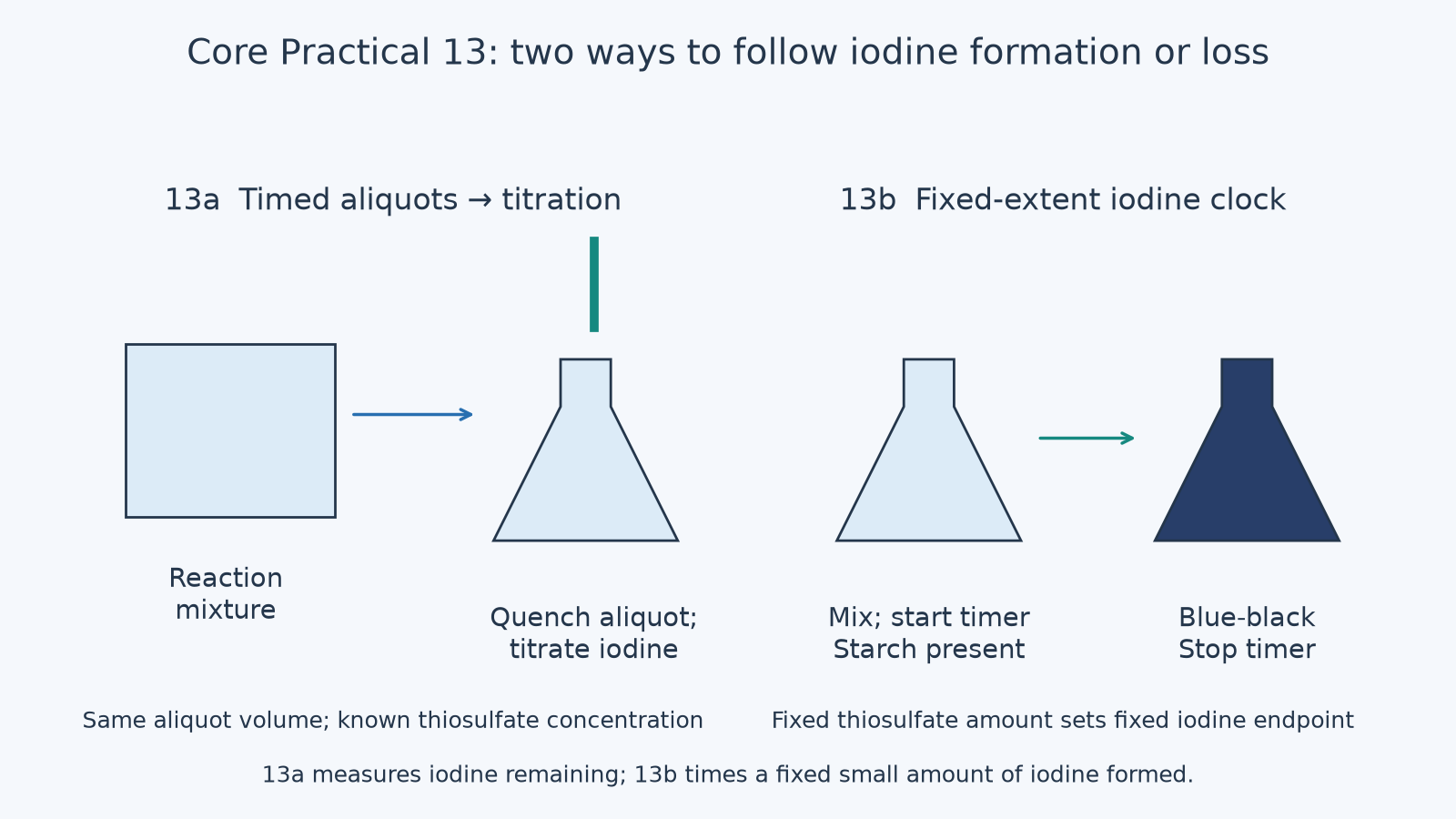
In water, is present mainly as and . The reaction is acid-catalysed, so the hydrogen ion concentration affects the rate even though acid is not just an ordinary stoichiometric reactant.
A catalyst can be regenerated while the overall reaction also produces the same species. Here the catalytic proton used in protonation is returned during enol formation; the HI produced by iodination supplies additional acid. Keep propanone and added acid in sufficient excess over iodine so their concentrations change little during a run, or use initial gradients. Otherwise acid production can change the measured rate as the reaction proceeds.
Core Practical 13a follows the iodine-propanone reaction by a titrimetric method. Samples can be taken at known times, the reaction is slowed or quenched, and the remaining iodine is titrated with sodium thiosulfate, using starch near the endpoint:
A titre gradient can also be converted to iodine concentration change: multiply the thiosulfate titre-volume change (in per unit time) by its concentration, divide by two using the iodine:thiosulfate mole ratio, then divide by the sampled volume in . Divide a per-minute rate by 60 to obtain a per-second rate. For example, a titre fall with thiosulfate for a sample represents iodine disappearance.
For CP13a, equilibrate the measured propanone, iodine and acid solutions at the chosen temperature, mix and start timing. Withdraw equal pipetted samples at recorded times into a validated quench (for example sodium hydrogencarbonate solution to remove the acid catalyst); titrate promptly and add starch only near the pale-yellow endpoint. Keep the main reaction temperature constant. Plot iodine concentration or titre against sampling time and use an initial tangent. Repeat with only one initial concentration changed, calculating all concentrations after mixing. Confirm that the quench itself neither consumes iodine nor leaves appreciable reaction during analysis.
For CP13b, the Harcourt–Esson clock uses acidified hydrogen peroxide to oxidise iodide:
A small, fixed amount of thiosulfate removes the iodine by the iodine–thiosulfate equation above. When thiosulfate is exhausted, iodine persists and gives a blue-black colour with starch. If the starting thiosulfate amount is , the endpoint corresponds to mol iodine. Keep thiosulfate amount, total volume, temperature and endpoint judgement constant, and make the endpoint early enough that the reactant concentrations have hardly changed. Vary iodide or peroxide independently, replacing omitted solution volume with water. Use for relative initial rates, or for a concentration rate estimate. For 2.00×10⁻⁵ mol thiosulfate in 0.0500 dm³ with a 40.0 s endpoint, the rate estimate is 5.00×10⁻⁶ mol dm⁻³ s⁻¹. Use dilute reagents and eye protection; avoid skin contact with iodine and peroxide, and follow the centre’s risk controls.
These written methods prepare for supervised work; actual handling and reliable observations must be demonstrated in the laboratory.
To calculate orders, chemists compare initial rates from experiments where one initial concentration is changed and the others are controlled. Core Practical 13b, the Harcourt-Esson iodine clock, reinforces the same initial-rate idea: if each run is timed to the same visible endpoint, can be used as a rate index. The propanone mechanism evidence comes from varying , and separately.
Safety and data quality belong in the chemical reasoning. Propanone is flammable, iodine is harmful/irritant, and acid is corrosive, so use small volumes, eye protection, no naked flames, and appropriate disposal. Keep temperature, total volume and endpoint method the same, because each of those can change the measured rate.
Worked example: deduce the orders
The following original initial-rate data are collected at constant temperature. The rates are positive magnitudes for the disappearance of iodine.
| Experiment | Initial rate / | |||
|---|---|---|---|---|
| 1 | 0.80 | 0.100 | 0.0050 | |
| 2 | 1.60 | 0.100 | 0.0050 | |
| 3 | 0.80 | 0.200 | 0.0050 | |
| 4 | 0.80 | 0.100 | 0.0100 |
Compare experiments 1 and 2. doubles while and stay constant. The rate doubles, so the reaction is first order with respect to propanone.
Compare experiments 1 and 3. doubles while and stay constant. The rate doubles, so the reaction is first order with respect to hydrogen ions.
Compare experiments 1 and 4. doubles while and stay constant. The rate is unchanged, so the reaction is zero order with respect to iodine.
The rate equation is therefore:
The overall order is . Using experiment 1:
Chemical interpretation: the rate-controlling chemistry depends on propanone and acid, but not on iodine concentration.
Predicting The Iodination Rate-Determining Step
The rate equation:
Continue this lesson.
You’re previewing NovaLearn without an account. Create a free account to read the rest.
Create free account