12.14-12.15 - pH Experiments And Ka
Use pH measurements to compare acids, bases and salts and follow the effects of dilution. Prepare a known weak-acid concentration and combine mass, volume and measured pH to determine its dissociation constant.
pH Data As Chemical Evidence
Two solutions can have the same concentration but very different values. That is not a measuring accident: is evidence about how many or ions are actually present after particles have dissociated or reacted with water.
The example patterns below refer to about 25 . When the solutions are equimolar, concentration has been controlled. Differences in can then be linked to the chemical behaviour of the solute.
| Equimolar solution, such as | Typical pattern | What the data show |
|---|---|---|
| Strong acid, e.g. | about | Almost complete dissociation gives high |
| Weak acid, e.g. | about | Partial dissociation gives much lower |
| Strong base, e.g. | about | Almost complete release of gives very alkaline |
| Weak base, e.g. | about | Partial reaction with water gives fewer ions |
| Salt from strong acid and strong base, e.g. | about | Neither ion reacts appreciably with water |
| Salt containing a weak conjugate acid, e.g. | below | donates protons to water to make the solution acidic |
| Salt containing a weak conjugate base, e.g. | above | accepts protons from water to make the solution alkaline |
The values in real data depend on concentration and temperature, so questions usually provide the values or enough information to calculate them. Your job is to analyse the pattern, not memorise one table of numbers.
The salt explanations can be written as proton-transfer equilibria:
For weak ammonia, . These equations identify the source of acidity or alkalinity; the salt itself is normally fully dissociated into its ions.
Common-error contrast. A low does not automatically mean "concentrated acid". In this experiment the strong acid and weak acid may be equimolar, so the difference is mainly evidence about degree of dissociation, not about how much acid was put into the flask.
Dilution Patterns For Strong And Weak Acids
Dilution is a clean way to test whether follows the total acid concentration or the equilibrium position. A strong monoprotic acid is almost fully dissociated, so diluting it by a factor of reduces by a factor of .
If becomes ten times smaller, increases by 1.00.
| Solution | Original | 10-fold dilution | 100-fold dilution | 1000-fold dilution |
|---|---|---|---|---|
| Strong acid, starting near | 1.00 | 2.00 | 3.00 | 4.00 |
| Weak acid, same starting concentration | about 2.9 | about 3.4 | about 3.9 | about 4.5 |
The weak acid behaves differently because the acid equilibrium responds to dilution:
For weak-acid solutions where remains much smaller than the initial acid concentration , and water ionisation is negligible:
So a 10-fold dilution makes fall by about , not by , and rises by about 0.5 rather than 1.0. The fraction of acid molecules dissociated increases on dilution, even though the total hydrogen ion concentration still decreases. The half-unit rule is approximate: once dissociation is a substantial fraction of c, retain rather than in . At extremely low acid concentrations water ionisation also matters; neither simple dilution rule should be extrapolated indefinitely.
Data-analysis habit. Do not identify the weak acid only because its is higher. Use the whole pattern: the strong acid has increases of roughly one unit for each 10-fold dilution; the weak acid has smaller increases because the equilibrium shifts as it is diluted.
Core Practical 9 Measurement Route
A dissociation constant connects a measured pH to equilibrium concentrations. The number is only useful if the solution concentration is known from a reliable preparation method.
[DIAGRAM: asset_name: Cp9 Ka From pH Apparatus; asset_slug: edexcel_a_level_chemistry_l056_cp9_ka_from_ph_apparatus; recommended_method: deterministic_chart; description: Core Practical 9 sequence showing a solid weak acid being weighed, dissolved and made up to a known volume in a volumetric flask, then measured with a calibrated pH meter or pH probe.]
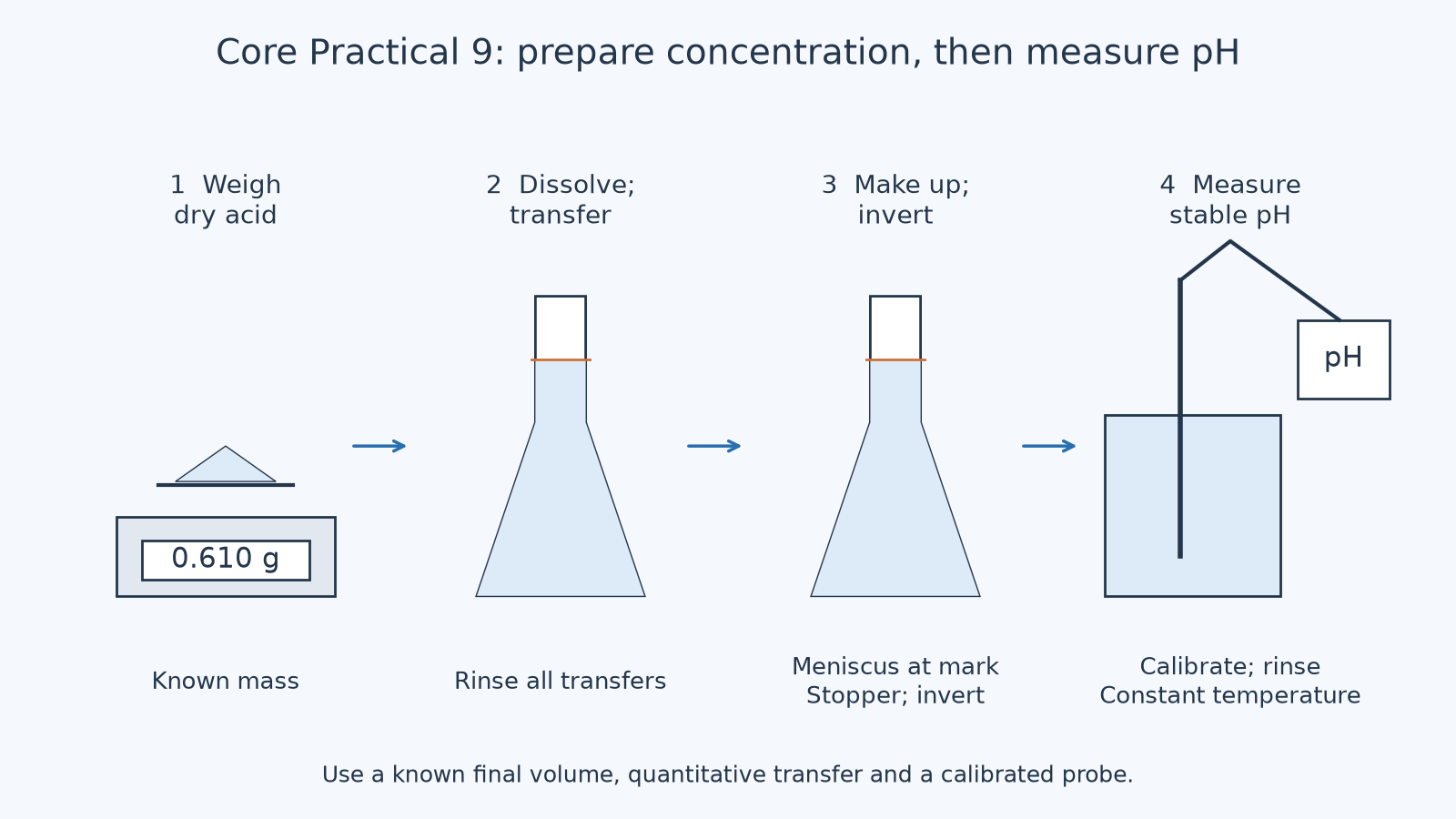
A good route is:
- Weigh a known mass of a pure, dry monobasic weak acid.
- Dissolve the acid in deionised water in a beaker.
- Transfer the solution quantitatively into a volumetric flask.
- Rinse the beaker, stirring rod and funnel into the flask so all acid reaches the flask.
- Make up to the calibration mark with deionised water, stopper and invert to mix.
- Calibrate the meter or probe using buffer solutions near the expected .
- Rinse the probe with deionised water between solutions, gently blot it, then measure the of the weak acid solution at a consistent temperature.
Read the bottom of the meniscus at eye level and add the last drops with a dropping pipette. Wait for a stable probe reading; repeat measurements and investigate an outlier before deciding which results to average. A written account can assess planning, calculation and evaluation, but practical competence also requires supervised performance.
The final volume matters because mass alone gives amount of acid, not concentration. The meter matters because paper is usually too coarse for a reliable calculation: an error of 0.1 unit changes by a noticeable factor.
Continue this lesson.
You’re previewing NovaLearn without an account. Create a free account to read the rest.
Create free account