15A.4-15A.10 - Ligands, Complex Ions And Colour
Connect ligand bonding and complex-ion charge to the absorption of visible light. Use d-electron configurations to explain colour, while recognising the limits of the simple d-orbital model.
Colour In Transition-Metal Complexes
Aqueous transition-metal chemistry is often visible. Some solutions are blue, green, yellow or purple; others that contain metal ions are colourless. A colour change may therefore be useful evidence, but it is not enough to say "transition metals are colourful" and stop there.
The model has three layers:
| Layer | What to ask | Example answer style |
|---|---|---|
| Structure | What is around the metal ion? | A central metal ion is surrounded by ligands. |
| Bonding | How are the ligands attached? | Each ligand donates a lone pair to form a coordinate bond. |
| Electronic energy | Why is light absorbed? | Ligands split the d-orbital energies, so some wavelengths of visible light can promote d electrons. |
The observed colour is the light transmitted through the solution after selected wavelengths have been absorbed.
Ligands And Coordinate Bonds
A surrounding molecule or ion binds by donating an electron pair from a particular donor atom.
Ligand
An ion or molecule that donates a lone pair of electrons to a central metal ion.
Coordinate (dative covalent) bond
A covalent bond in which both bonding electrons come from the same atom, here the ligand's donor atom.
Once formed, the coordinate bond behaves like an ordinary covalent bond, but its origin matters because the metal ion is accepting electron pairs from surrounding species.
Complex ion
A central metal ion surrounded by ligands bonded to it by coordinate bonds.
The central metal ion is usually positive, so it can attract electron-pair donors. Ligands may be neutral or negatively charged.
| Ligand | Donor atom | Ligand charge | Why it can act as a ligand |
|---|---|---|---|
| Oxygen | Oxygen has lone pairs. | ||
| Nitrogen | Nitrogen has a lone pair. | ||
| Chlorine | Chloride has lone pairs and a negative charge. | ||
| Oxygen | Oxygen has lone pairs and a negative charge. |
Worked example: identify the ligand and bonding
In , the central metal ion is and the ligands are six molecules. Each water molecule donates a lone pair from oxygen to the copper ion, forming a coordinate bond. The square brackets show that the metal and ligands are being treated as one complex ion with an overall charge.
Complex-Ion Charge
The charge on a complex ion comes from the charge on the central metal ion plus the charges on all the ligands. Neutral ligands such as and do not change the overall charge. Charged ligands such as and do.
Worked example: charge of a complex ion
For , assume the metal ion is cobalt(II), .
So the complex ion is written as .
This charge accounting is useful because questions may ask you to deduce an oxidation number, write a complex ion formula, or explain a colour change from a formula. The brackets and charge are not decorative: they show that the central metal ion and its ligands behave as a single charged species.
Common-error contrast
Do not give the charge on the ligand as the charge on the whole complex. In , each chloride ligand is , but the whole ion is because the cobalt ion contributes .
d-Orbital Splitting And Colour
A free transition-metal ion has five d orbitals at the same energy in a simple model. When ligands surround the metal ion, their electron pairs interact with the metal's d orbitals. The ligands do not affect all five d orbitals equally, so the d orbitals split into different energy levels.
[DIAGRAM: asset_name: Octahedral d orbital splitting and visible photon absorption; asset_slug: edexcel_a_level_chemistry_l070_d_level_splitting; recommended_method: deterministic_chart; description: Octahedral d orbital splitting and visible photon absorption.]
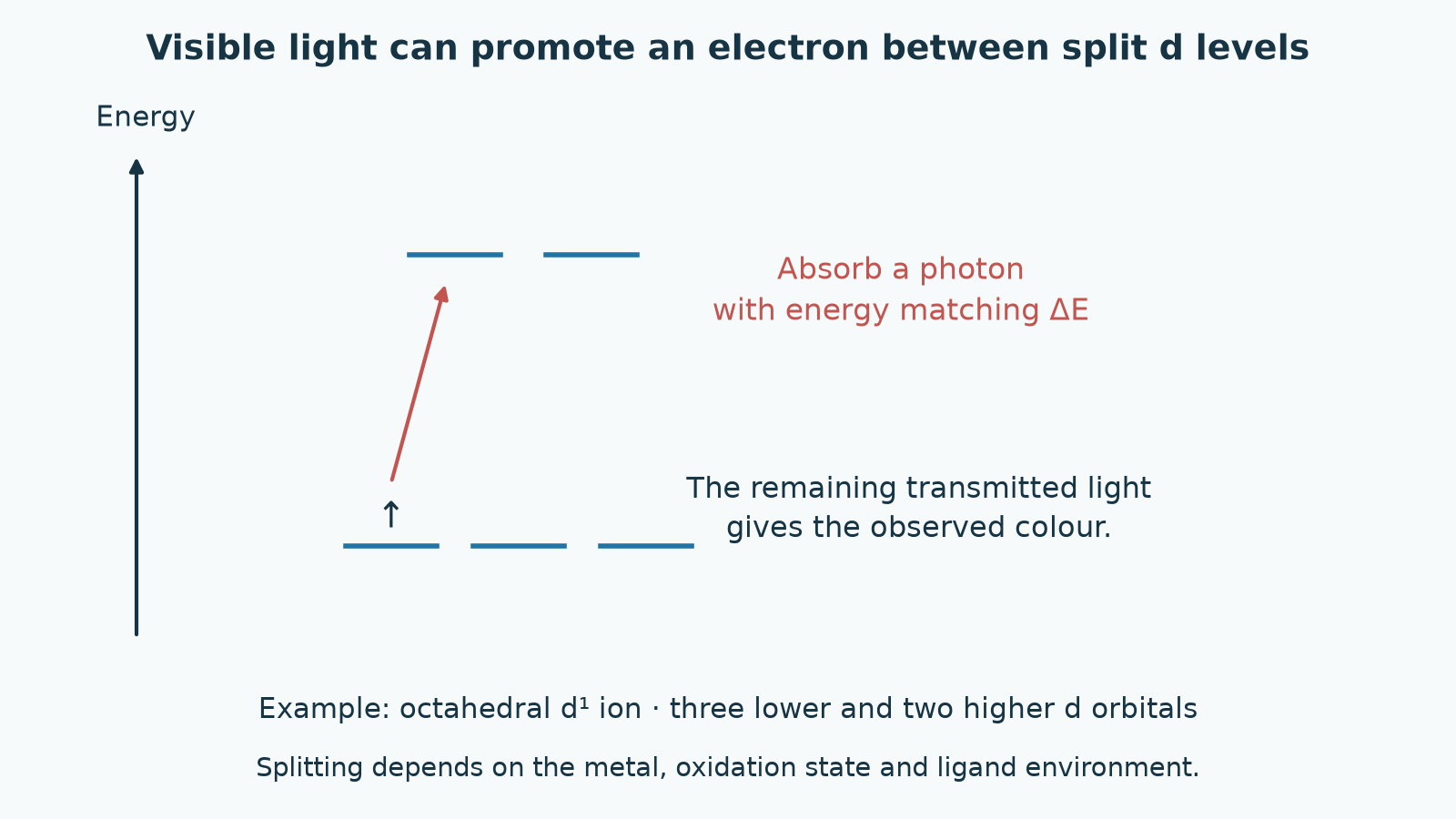
If the metal ion has suitable d electrons, one d electron can absorb energy from visible light and move from a lower d level to a higher d level. The energy absorbed corresponds to a particular wavelength or range of wavelengths. The colour observed is the light not absorbed by the complex.
Continue this lesson.
You’re previewing NovaLearn without an account. Create a free account to read the rest.
Create free account