3.9-3.13 - Formulae And Redox Equations
Use Roman numerals to name oxidation states, balance charges to write formulae, and combine half-equations into full ionic equations. Each step conserves atoms and charge while making the transfer of electrons explicit.
Roman Numerals
A bottle labelled iron(II) chloride and a bottle labelled iron(III) chloride do not contain the same iron ion. The Roman numeral is a compact way of saying which oxidation number the named element has in that compound or ion.
Roman numerals used here are positive oxidation numbers written without a plus sign:
| Roman numeral | Oxidation number meant |
|---|---|
| I | +1 |
| II | +2 |
| III | +3 |
| IV | +4 |
| V | +5 |
| VI | +6 |
| VII | +7 |
The numeral belongs to the element just named. In iron(III) oxide, iron has oxidation number +3. Oxygen is not being called "III"; oxygen is usually -2 in oxides. In sulfate(VI), sulfur has oxidation number +6 inside the sulfate group. In manganate(VII), manganese has oxidation number +7.
Worked example: naming from a formula
Name using a Roman numeral.
Chlorine in a simple chloride ion has oxidation number -1. There are two chloride ions, so the total contribution from chlorine is -2. The compound is neutral, so iron must be +2.
is iron(II) chloride.
The chemical meaning is that the formula contains with two ions. The Roman numeral shows the oxidation number of iron, not the number of chlorine atoms.
A Roman numeral is not a subscript
Copper(II) sulfate does not contain two sulfate ions. II tells you copper is +2; the sulfate ion is , so one sulfate ion balances one and the formula is .
Formulae From Oxidation Numbers
For an ionic compound, formula writing is charge balance: combine actual ion charges in the smallest whole-number ratio giving overall neutrality. Oxidation number is not automatically the charge of a polyatomic ion: sulfur is +6 in sulfate, but the whole sulfate ion is .
Use this route:
- Identify the positive ion and its charge; for a monatomic metal ion this equals its oxidation number.
- Write the negative ion or group with its charge.
- Find the smallest ratio that makes total positive charge equal total negative charge.
- Use brackets around a compound ion when more than one of that ion is needed.
Worked example: iron(III) sulfate
Write the formula for iron(III) sulfate.
Iron(III) means . Sulfate is .
The lowest common total charge is 6:
| Ion | Charge on each ion | Number needed | Total charge |
|---|---|---|---|
| +3 | 2 | +6 | |
| -2 | 3 | -6 |
So the formula is .
The brackets matter because there are three whole sulfate ions, not three oxygen atoms added separately.
Common-error contrast
is not iron(III) sulfate. In , sulfate is -2 and the compound is neutral, so iron is +2. is iron(II) sulfate. For iron(III), the formula needs enough sulfate ions to balance two ions: .
Guided practice
Write the formula for copper(II) nitrate.
Route:
- copper(II) gives
- nitrate is
- two nitrate ions are needed for each copper ion
- formula:
Ion Formation And Electron Transfer
Ion formation connects formulae to particles. Metals generally form positive ions by losing electrons; non-metals generally form negative ions by gaining electrons. Oxidation number tracks that electron transfer.
For a metal atom forming a positive ion:
Magnesium loses two electrons. Its oxidation number increases from 0 in the element to +2 in the ion, so this is oxidation.
For a non-metal atom forming a negative ion:
Each chlorine atom gains one electron. Chlorine's oxidation number decreases from 0 in to -1 in , so this is reduction.
The wording "metals, in general" and "non-metals, in general" matters. It is a broad pattern for ion formation, not a claim that every compound is purely ionic or that oxidation number is always the same as a real isolated ion charge. Oxidation number is a bookkeeping model that lets us track electron transfer consistently.
Worked example: deciding whether electron loss or gain happened
Aluminium forms from aluminium atoms.
The half-equation is:
Electrons are on the product side, so aluminium has lost electrons. Its oxidation number has increased from 0 to +3, so aluminium has been oxidised.
Positive ions form by losing electrons
"Metals form positive ions because protons move away" is wrong. The nucleus does not lose protons in ordinary chemical reactions; the atom loses electrons, and losing negative charge leaves the species positive with a higher oxidation number.
Writing Half-Equations
A half-equation records one electron-transfer change while conserving both atoms and charge.
Half-equation
An equation showing either the oxidation or the reduction process in a redox reaction, with electrons included to balance the charge.
A half-equation is not complete by itself because electrons cannot be created or destroyed overall; it is one side of the electron-transfer story.
For simple ion changes, balance atoms first, then balance charge with electrons.
Worked example: iron(II) to iron(III)
Write the half-equation for forming .
Atoms are already balanced: one iron atom on each side.
Charges:
- left: +2
- right before electrons: +3
Add one electron to the right to make the total right-hand charge +2:
Electrons are produced, so this is oxidation. The oxidation number of iron increases from +2 to +3.
Worked example: manganate(VII) to manganese(II) in acidic solution
Write the half-equation for forming in acidic solution.
Start with the species containing manganese:
Balance oxygen using water:
Balance hydrogen using :
Now balance charge with electrons. The left-hand side is . The right-hand side is . Add five electrons to the left so the left-hand charge becomes +2:
Electrons are used up, so this is reduction. Manganese decreases from +7 in to +2 in .
Half-equation checklist
- Atoms are balanced.
- Charge is balanced.
- Electrons are on the product side for oxidation.
- Electrons are on the reactant side for reduction.
- In acidic aqueous equations, use and to balance hydrogen and oxygen.
Combining Half-Equations
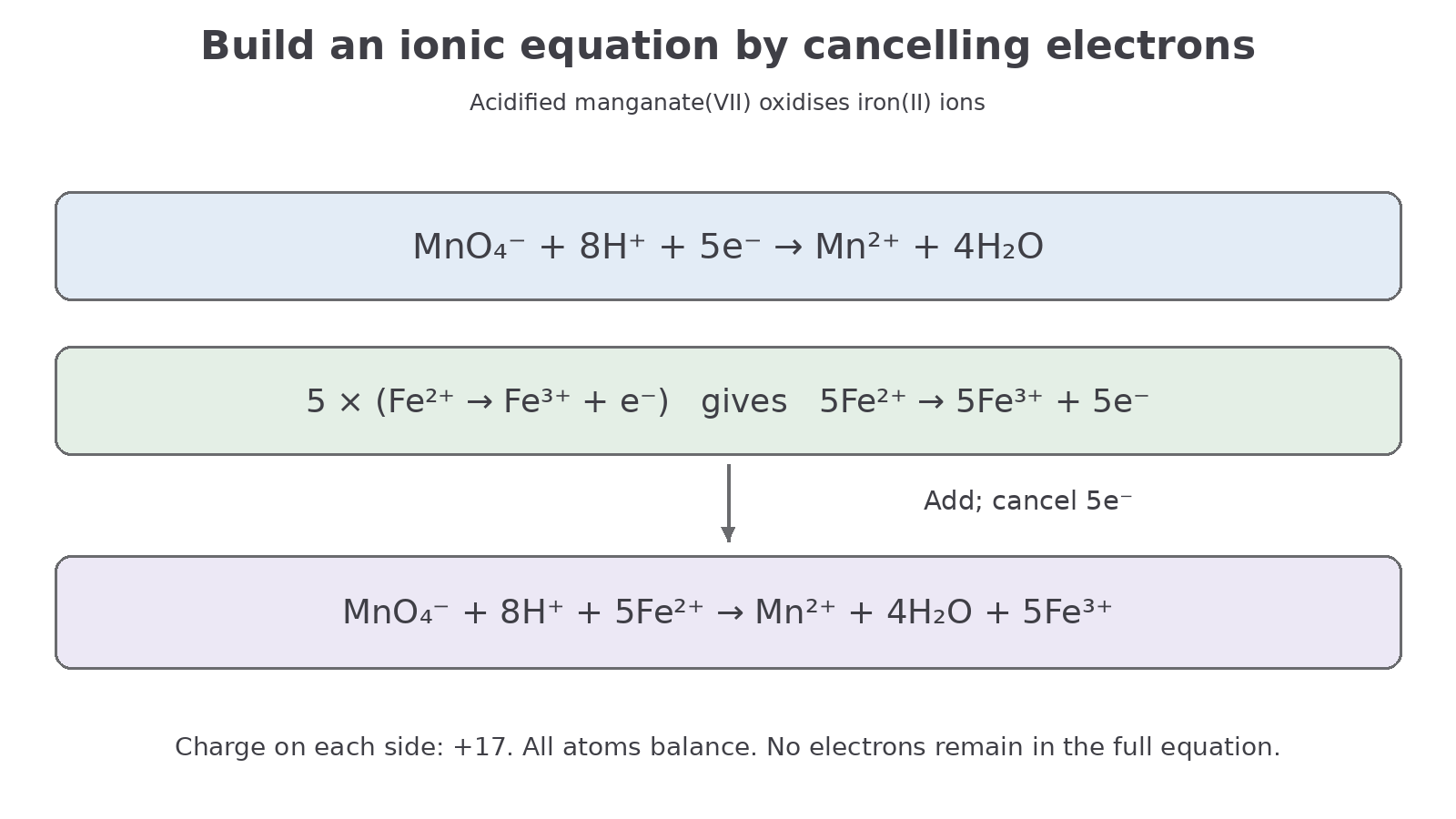
A full ionic redox equation is made by adding one oxidation half-equation to one reduction half-equation. The electrons must cancel because electrons transferred by one species are gained by another species.
[DIAGRAM: asset_name: Edexcel 9Ch0 Half Equation Cancellation; asset_slug: edexcel_9ch0_half_equation_cancellation; recommended_method: deterministic_code; description: Five iron(II) oxidation half-equations supply the five electrons consumed by manganate reduction; final charge +17 on each side. Pale 1600 by 900 diagram rendered with Pillow; technical geometry and Unicode chemical labels inspected.]
Use this route:
- Write the oxidation half-equation.
- Write the reduction half-equation.
- Multiply one or both half-equations so the number of electrons is the same.
- Add the two equations.
- Cancel electrons and any species that appear unchanged on both sides.
- Check atoms and total charge.
Worked example: chlorine oxidises iodide ions
Half-equation for chlorine being reduced:
Half-equation for iodide being oxidised:
The electron numbers already match. Add and cancel the electrons:
Check the charge: left side is -2; right side is -2. Atoms are balanced. This full ionic equation shows the electron transfer without spectator ions.
Worked example: acidified manganate(VII) oxidises iron(II) ions
Reduction half-equation:
Oxidation half-equation:
The manganate(VII) half-equation needs five electrons, but each iron(II) ion supplies one electron. Multiply the iron half-equation by 5:
Add the equations and cancel :
Charge check:
- left: -1 + 8 + 10 = +17
- right: +2 + 15 = +17
That charge check is not optional decoration. In equation questions, balanced atoms without balanced charge is still an incomplete ionic equation.
Guided practice
Use the half-equations below to write the full ionic equation:
Because both half-equations contain two electrons, add them directly and cancel electrons:
Magnesium is oxidised; copper(II) ions are reduced.
No electrons in the final equation
A full ionic equation describes the overall change. Electrons are transferred from the reducing agent to the oxidising agent, so the number produced by oxidation equals the number used by reduction and they cancel out.
Recap
For write questions, the answer is the formula, half-equation or ionic equation itself, with charges and balancing correct. For explain questions, link the symbol work to electron transfer: metals usually lose electrons and increase oxidation number, non-metals usually gain electrons and decrease oxidation number, and a redox equation is only complete when both atoms and charge balance.