18B.14-18B.17 - Condensation Polymers And Amino Acids
Build condensation-polymer repeat units, follow amino acids as their charge changes with pH and identify the peptide links broken during protein hydrolysis. Then plan the linked observations and deductions needed to analyse inorganic and organic unknowns in Core Practical 15.
Why Condensation Polymers Form
An alkene can make an addition polymer because a bond opens up. A dicarboxylic acid, a diol, a diamine or an amino acid usually has no bond to open, so the chain has to grow by a different route: two functional groups react, a new link forms, and a small molecule is eliminated.
Condensation polymerisation
Polymerisation in which many monomers join together and a small molecule, usually water, is eliminated as each link forms.
For a long chain to grow, the monomers must be bifunctional: each molecule needs two reactive ends so that it can link to two neighbours rather than stop the chain after one reaction.
The two link types in this lesson are:
| Link formed in the polymer | Functional groups that react | Small molecule eliminated |
|---|---|---|
| ester link, | carboxylic acid and alcohol | water |
| amide or peptide link, | carboxylic acid and amine | water |
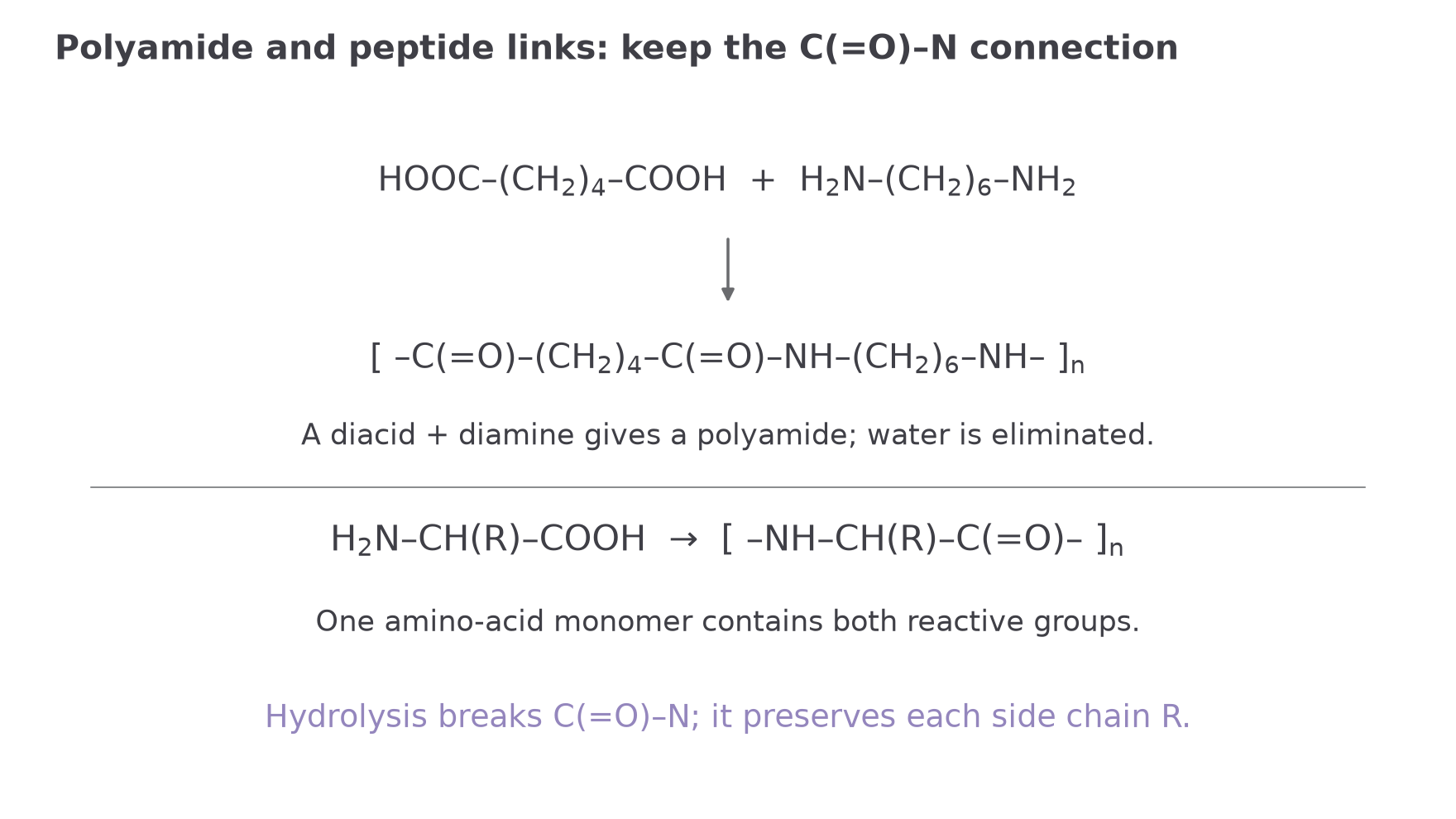
The formation of a polyamide is therefore a condensation polymerisation reaction. Each amide link is made by joining a carboxyl-derived carbonyl carbon to a nitrogen atom and eliminating water from and ends.
Common-error contrast
Addition polymerisation keeps all atoms from the monomer in the polymer chain and uses up a bond. Condensation polymerisation does not require a bond and does lose small molecules. If a question asks for a condensation repeat unit, look for the link group formed, not for a double bond to open.
Drawing Condensation Repeat Units
Condensation repeat-unit questions are structure questions. The features to get right are the correct link group, the correct order of atoms in the link, both residues from the monomers, brackets, continuation bonds and n.
Use a general dicarboxylic acid and diol:
dicarboxylic acid and diol
The acid and alcohol are removed as water, forming ester links. The repeat unit is:
Example:
- Monomers: and
- Repeat unit:
This is a polyester repeat unit because the chain contains ester links.
Route for a dicarboxylic acid and a diamine
Use a general dicarboxylic acid and diamine:
dicarboxylic acid and diamine
The acid and amine are removed as water, forming amide links. The repeat unit is:
Example:
- Monomers: and
- Repeat unit:
This is a polyamide repeat unit. The nitrogen atom is part of the amide link; do not draw an ester oxygen in its place.
Route for amino acids
A 2-amino acid contains both functional groups needed for condensation:
One molecule's group reacts with another molecule's group. The repeat unit is:
This is a polyamide because the peptide link is an amide link.
Worked example: choosing the right repeat unit
Question: Draw the repeat unit formed from and .
Model route:
- The first monomer is a dicarboxylic acid and the second is a diamine.
- Carboxylic acid plus amine forms an amide link, .
- Keep the carbon skeletons: from the acid and from the diamine.
- Put the repeating section in brackets and add n.
Chemical interpretation: the answer shows two amide links per repeat cycle when the repeat units join together. It also shows that the small molecule eliminated during chain formation is not part of the repeat unit.
No unreacted acid groups in the chain
is not a valid polyamide repeat unit: leaving groups inside the chain means the condensation step has not been represented. In the polymer backbone, the acid groups have become carbonyl parts of amide links, so the chain must contain , not unreacted groups.
[DIAGRAM: asset_name: Polyamide repeat from hexanedioic acid and hexane-1,6-diamine, and an amino-acid repeat showing peptide linkage; asset_slug: edexcel_9ch0_polyamide_peptide; recommended_method: deterministic_chart; description: Polyamide repeat from hexanedioic acid and hexane-1,6-diamine, and an amino-acid repeat showing peptide linkage]
Zwitterions And Acid-Base Behaviour
2-amino acids have an amino group and a carboxylic acid group on the same carbon skeleton. In simple neutral shorthand an amino acid can be written as:
In aqueous solution, simple amino acids near their isoelectric pH are represented predominantly as zwitterions:
Zwitterion
A species with both a positive charge and a negative charge in the same molecule, but no overall charge.
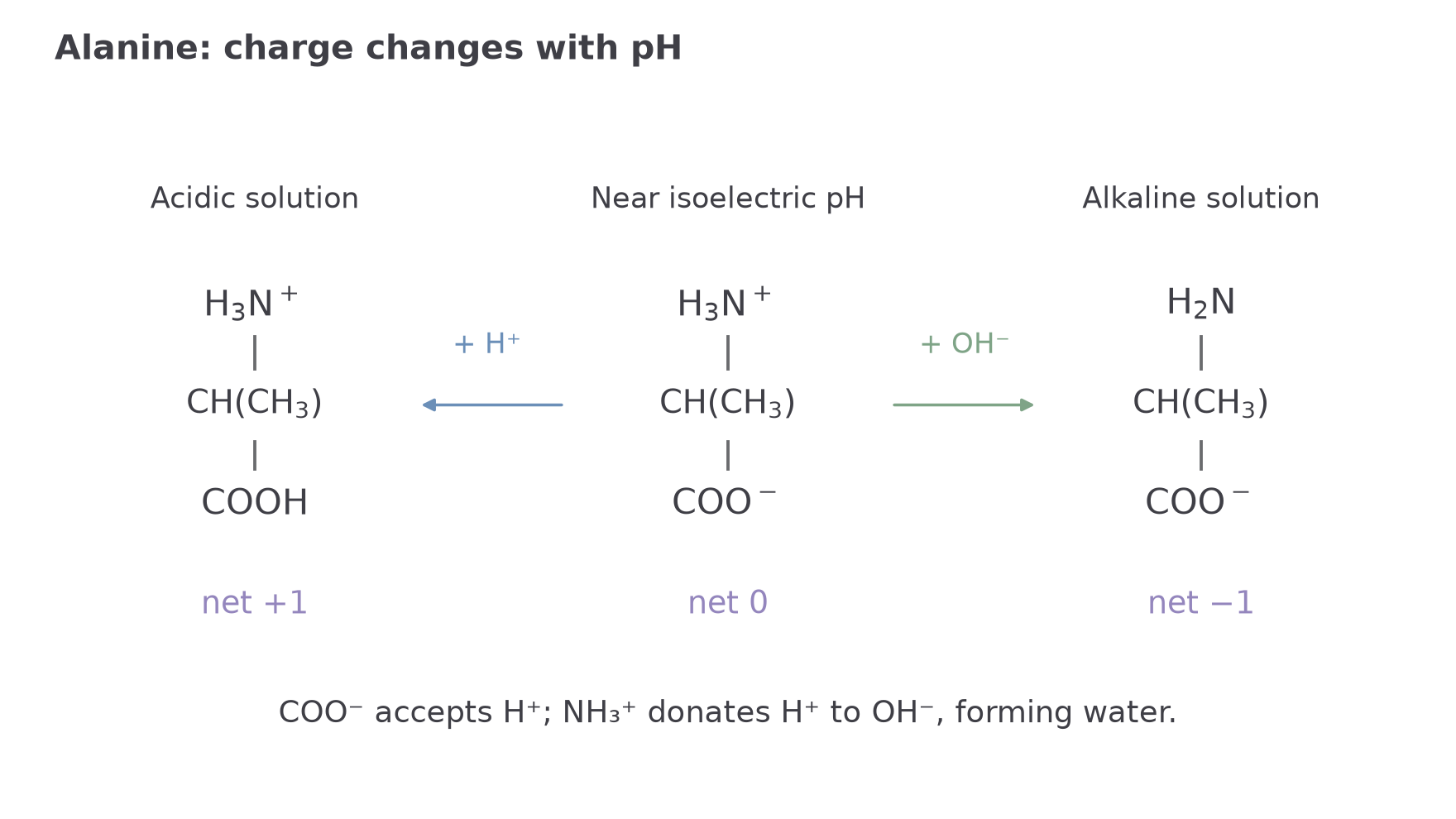
The carboxylic acid group donates a proton and becomes ; the amino group accepts a proton and becomes . This internal proton transfer explains why 2-amino acids can show both acidic and basic behaviour.
In acidic conditions, the carboxylate end can accept a proton:
In alkaline conditions, the ammonium end can lose a proton:
The important reasoning is not just "amino acids contain acid and amine groups". The zwitterion shows the two acid-base sites that exist together in solution, so amino acids can respond to both acids and alkalis.
Worked example: predicting the dominant charged form
Question: Glycine can be written as . Explain why glycine exists mainly as a zwitterion in aqueous solution near its isoelectric pH.
Model answer: the group can donate a proton and the group can accept a proton. Proton transfer gives . This species has a positive ammonium group and a negative carboxylate group, so it is a zwitterion with no overall charge.
Chemical interpretation: the molecule is not a simple neutral amine plus acid in water. Its internal acid-base reaction changes the charged groups present, which controls the acid-base behaviour and helps explain behaviour in separation methods.
[DIAGRAM: asset_name: Alanine cation, zwitterion and anion connected by acid-base reactions; asset_slug: edexcel_9ch0_alanine_charge; recommended_method: deterministic_chart; description: Alanine cation, zwitterion and anion connected by acid-base reactions]
Amino Acids And Plane-Polarised Light
Aqueous solutions of 2-amino acids can affect plane-polarised monochromatic light when the dissolved amino acid is optically active. The usual structural reason is a chiral centre at carbon-2: that carbon is bonded to four different groups.
For a typical 2-amino acid, the four groups around carbon-2 are:
- (or )
- (or )
If these four groups are different, the molecule can exist as two optical isomers. A pure sample of one optical isomer rotates the plane of plane-polarised monochromatic light. The opposite optical isomer rotates it in the opposite direction under the same conditions.
Glycine is . Its carbon-2 is bonded to two hydrogen atoms, so it does not have four different groups and is not chiral. Glycine does not rotate plane-polarised monochromatic light.
A racemic mixture is also not optically active overall because equal amounts of two optical isomers rotate the plane in opposite directions and the rotations cancel. Therefore the careful claim is: many 2-amino acid solutions are optically active when they contain an excess of one optical isomer, but glycine or a racemic mixture will show no overall rotation.
Common-error contrast
Do not say "all amino acids rotate light because they contain an amino group". Optical activity comes from chirality, not from the presence of nitrogen. The structural check is whether carbon-2 has four different groups.
Continue this lesson.
You’re previewing NovaLearn without an account. Create a free account to read the rest.
Create free account