17C.9-17C.13 - Carboxylic Acids And Their Derivatives
The carboxyl group connects acidity, oxidation and the synthesis of esters and acyl chlorides. Learn to track its carbon atom through each reaction and explain physical properties using intermolecular hydrogen bonds.
The Functional Group That Controls The Chemistry
A molecule labelled could be drawn in more than one way. In organic chemistry, the useful question is not just "what atoms are present?", but "which atoms are connected as the functional group?" Ethanoic acid is , and the group is what gives it its acid behaviour and its reaction pattern.
Carboxylic acid
A compound containing the carboxyl group, : a carbonyl group, , and a hydroxyl group, , attached to the same carbon atom.
The carbonyl carbon is part of the functional group, so the group is not just an alcohol stuck somewhere on the chain. For example:
| Compound | Functional group present | Why |
|---|---|---|
| carboxylic acid | has at the end of the chain | |
| carboxylic acid | has , with a two-carbon alkyl group attached | |
| alcohol, not carboxylic acid | has but no adjacent | |
| aldehyde, not carboxylic acid | has but no on that carbon |
The general formula is a compressed way of saying that is the carbon chain or aryl group, and is the reactive carboxyl group. In equations, keep the group together until a reaction tells you what changes.
Common-error contrast
and both contain an bond, but they are not the same functional group. In an alcohol, the is bonded to a saturated carbon. In a carboxylic acid, the is bonded to a carbonyl carbon, so the group is and the molecule can lose to form a carboxylate ion, .
Hydrogen Bonding And Physical Properties
Carboxylic acids have higher boiling temperatures than many molecules of similar size because their molecules can form hydrogen bonds with each other. The bond is polar, and the oxygen atoms have lone pairs, so one carboxylic acid molecule can attract another through intermolecular hydrogen bonding.
The important particle-level point is that boiling separates molecules from each other. It does not break the covalent or bonds inside the carboxylic acid molecule. A higher boiling temperature means more energy is needed to overcome the intermolecular attractions between molecules.
Compare the functional groups:
| Molecule type | Hydrogen-bond donor? | Hydrogen-bond acceptor? | Consequence |
|---|---|---|---|
| alkane | no | no | low boiling temperature for its size |
| aldehyde or ketone | no or bond | yes, at oxygen | can accept hydrogen bonds from water, but cannot hydrogen bond strongly to itself |
| alcohol | yes | yes | higher boiling temperature and water solubility for small molecules |
| carboxylic acid | yes | yes, primarily at the carbonyl oxygen | high boiling temperature and good solubility for short-chain acids |
Small carboxylic acids such as methanoic acid and ethanoic acid are soluble in water because they can form hydrogen bonds with water molecules. As the hydrocarbon chain gets longer, the non-polar part of the molecule becomes a larger fraction of the structure, so solubility in water decreases.
Worked explanation
Explain why ethanoic acid has a higher boiling temperature than ethanal.
Ethanoic acid, , contains an bond and oxygen atoms with lone pairs, so its molecules can form hydrogen bonds with each other. Ethanal, , has a polar carbonyl group but no bond, so it cannot act as a hydrogen-bond donor to another ethanal molecule. More energy is needed to overcome the stronger intermolecular attractions in ethanoic acid, so its boiling temperature is higher.
Name the attraction
"Carboxylic acids have relatively high boiling temperatures" needs three parts: intermolecular hydrogen bonds form between the of one molecule and an oxygen lone pair on another, and boiling must overcome these attractions. Covalent bonds inside the molecules are not broken.
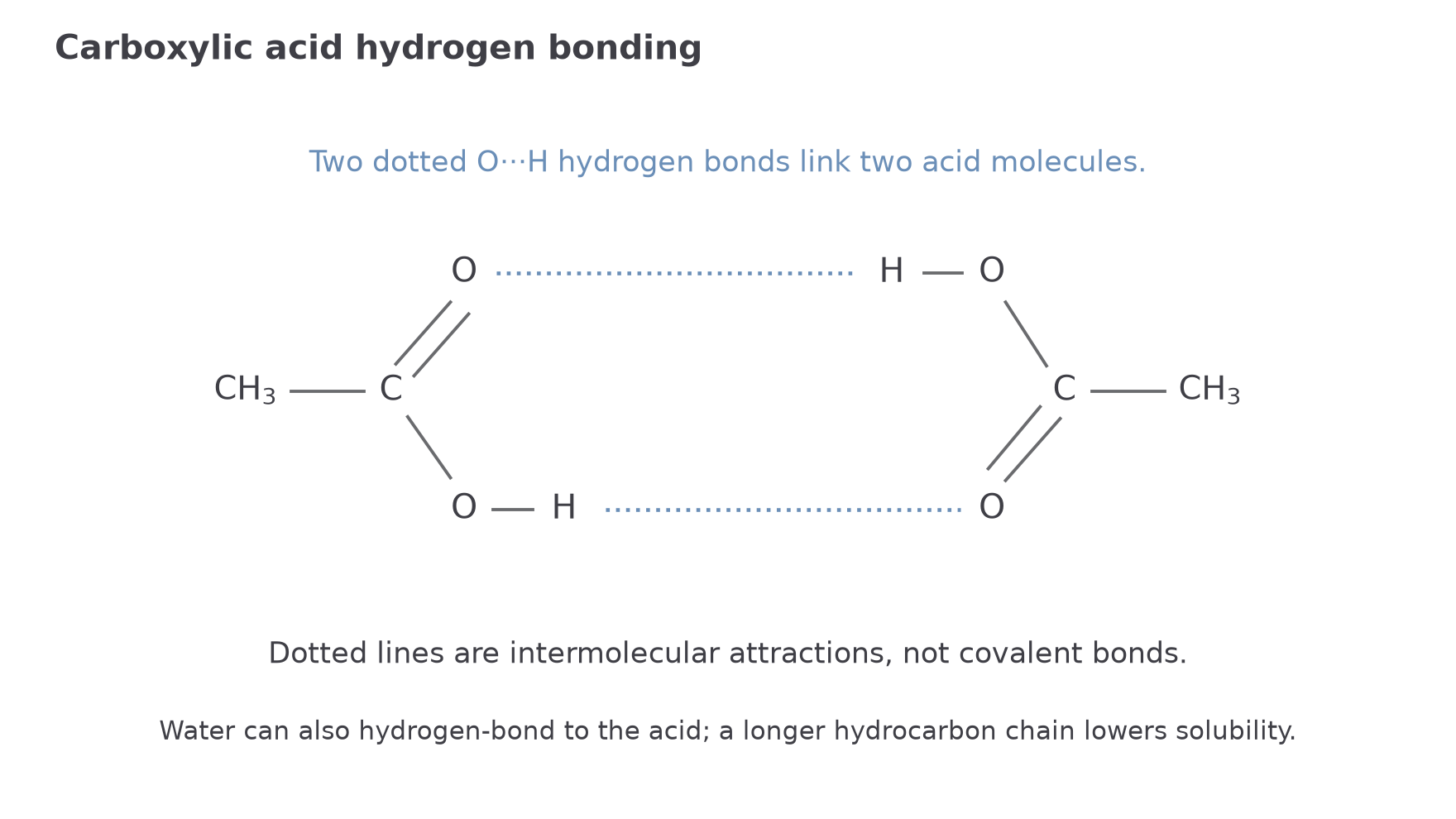
Two carboxylic acid molecules can form a cyclic dimer, held by two hydrogen bonds from an O–H hydrogen to the other molecule's carbonyl oxygen. This association is especially useful for understanding acids in the vapour or in non-polar solvents. Water competes for these hydrogen bonds in aqueous solution. A hydrogen bond is drawn as a dotted intermolecular line, not as another covalent O–H bond.
[DIAGRAM: asset_name: Ethanoic acid dimer with two O-H to carbonyl-oxygen hydrogen bonds; asset_slug: edexcel_9ch0_acid_dimer; recommended_method: deterministic_chart; description: Ethanoic acid dimer with two O-H to carbonyl-oxygen hydrogen bonds]
Preparing Carboxylic Acids
There are two main preparation routes in this lesson:
- oxidise a primary alcohol or aldehyde
- hydrolyse a nitrile
The oxidation route connects back to alcohols and carbonyl compounds. A primary alcohol can be oxidised to an aldehyde and then further oxidised to a carboxylic acid. In practice, reflux with acidified potassium dichromate(VI), using excess oxidising agent, favours the carboxylic acid rather than allowing the aldehyde to distil off.
Using for the oxidising agent:
For ethanol:
The hydrolysis route uses a nitrile, , and converts the nitrile carbon into the carboxyl carbon. This is useful in synthesis because nitriles are often made from halogenoalkanes using cyanide ions, which increases the carbon chain by one carbon atom.
In acidic hydrolysis, a nitrile is heated under reflux with dilute acid:
You may also meet alkaline hydrolysis, which first gives a carboxylate salt, ; acidification then produces the carboxylic acid, . The key idea is that hydrolysis of the group gives the group.
Worked route decision
A chemist wants to make butanoic acid, , from a nitrile precursor. Choose a suitable nitrile and reaction.
The nitrile carbon becomes the carboxyl carbon, so the nitrile must already contain four carbon atoms overall. Start with , butanenitrile. Hydrolysing it gives butanoic acid:
Chemical interpretation: the carbon in becomes the carbonyl carbon of the group. That is why nitriles are useful for building carboxylic acids in synthesis.
Guided practice
Complete the preparation route.
| Target acid | Oxidation route | Nitrile hydrolysis route |
|---|---|---|
| ethanoic acid, | oxidise ethanol, , or ethanal, | hydrolyse ethanenitrile, |
| propanoic acid, | oxidise propan-1-ol, , or propanal, | hydrolyse propanenitrile, |
Alkaline hydrolysis makes the salt directly:
Continue this lesson.
You’re previewing NovaLearn without an account. Create a free account to read the rest.
Create free account