S1 - Moments and equilibrium of rigid bodies
Find the turning effect of a force, draw the forces on an extended body, and use force and moment balance together. You will see why a beam can have no resultant force and still start turning, then calculate the reactions needed to keep it at rest.
Perpendicular moment arms
Can two equal and opposite forces still turn a beam? First think about a spanner: a downward push on a horizontal spanner has a larger turning effect when its line of action is further from the nut. Force alone does not tell the whole story; position matters too.
You already know
Weight is a force of magnitude , acting vertically downwards. In a right-angled triangle with hypotenuse , an angle above the horizontal gives horizontal length and vertical height . These results are not in the formula booklet: learn them.
Imagine a downward force on a horizontal rod. At from the pivot its turning effect is ; at it is . The relevant distance is measured at right angles to the force.
Moment of a force
The moment of a force about a specified point is its turning effect. The line of action is the straight line through the force arrow, extended in both directions. The moment arm is the perpendicular distance from the chosen point to that line.
A force acting through the chosen point has zero moment there, because its arm is zero. It can still matter in the force balance. The same force usually has different moments about different points.
Moment magnitude
Here is the force in newtons and is its perpendicular arm in metres. State the sense, clockwise or anticlockwise, as well as the magnitude in .
Not in the formula booklet: learn it.
For a vertical force the perpendicular arm is horizontal. For a horizontal force it is vertical. We can use this geometry directly, without resolving an angled force.
Worked example 1: a vertical force on an inclined rod
Question. A rod has length , inclined at above the horizontal, with to the right of . A force acts vertically downwards at . Find its moment about , giving an exact magnitude.
Plan. Find the horizontal distance from to the vertical force line, then multiply by the force.
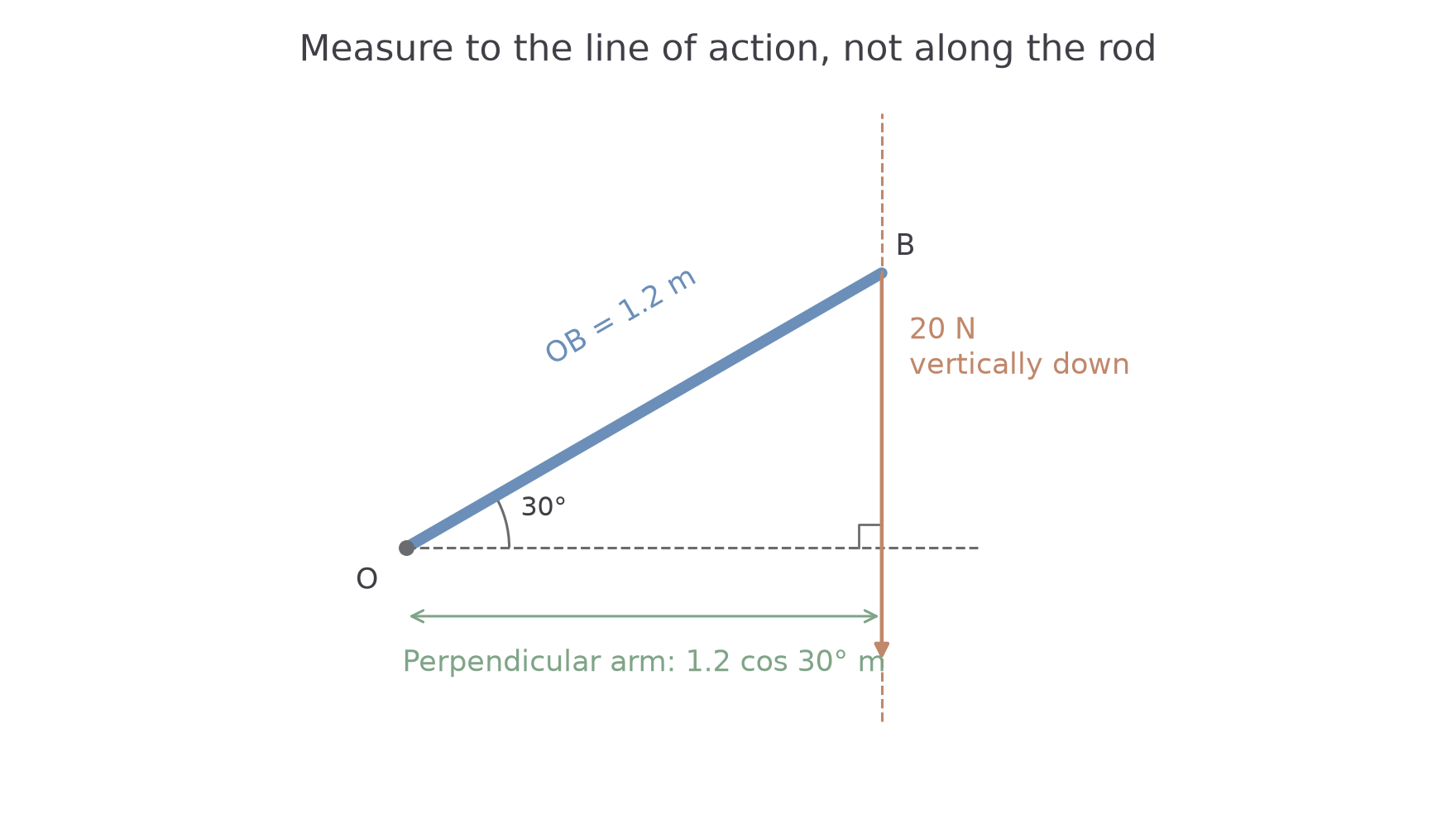
Why this distance? The shortest distance to a vertical line is horizontal; the rod length is not perpendicular to the force.
Answer. , clockwise, because the force tends to push the right-hand end down.
Check. , less than , as the horizontal arm is shorter than the rod.
Change only the force direction in Worked example 2. The point of application stays at , but the perpendicular arm changes.
Worked example 2: a horizontal force on the same rod
Question. The same rod has a force at , now acting horizontally to the left. Find its moment about .
Plan. Use the vertical height of , since the force line is horizontal.
Why change the arm? The force line changed from vertical to horizontal, so the perpendicular direction changed too.
Answer. , anticlockwise: a leftward push above tends to turn the rod anticlockwise.
Check. The arm is half the rod length, so the moment is half .
The moment's sense is a separate geometric decision. Try imagining a small rotation about the stated point.
Watch out
Wrong: for either inclined-rod force. The full rod length is not perpendicular to either force. Right: use for the vertical force and for the horizontal force.
For your turn the horizontal force points the other way. The arm stays the same; decide the sense again.
Signed resultant moments
Add moments algebraically by choosing a positive sense, just as you choose a positive direction when adding forces.
Take anticlockwise as positive. An upward force to the right of the chosen point is positive; an upward force to its left is negative. Upwards does not automatically mean positive. All the terms in one moment sum must refer to the same point.
Resultant moment
For a stated positive sense,
A negative result means the opposite sense. Vertical forces use horizontal arms; horizontal forces use vertical arms.
Not in the formula booklet: learn it.
The opening puzzle has a surprising answer: equal and opposite forces can have zero resultant force but a nonzero turning effect. Their separation is what matters.
Worked example 3: forces balance but moments do not
Question. Two vertical forces act on a horizontal rod: downwards to the right of , and upwards to its right. Find their resultant force and moment about .
Plan. Add signed forces, then add signed moments about the same point.
Why keep the two terms? Equal magnitudes cancel as forces, but their unequal arms prevent their moments cancelling.
Answer. The resultant force is zero; the resultant moment is anticlockwise. The rod is not in static equilibrium.
Check. About the point right of , the downward force has zero arm and the upward force has arm , again giving .
Such an equal and opposite separated pair is called a couple. When the total force is zero, moving the reference point changes the individual moments by amounts that cancel: the resultant moment is unchanged. For vertical forces at coordinates , shifting the reference from to changes to . The final term vanishes when . This is a derived result, not supplied in the formula booklet.
Worked example 4 changes only the magnitude of the upward force. The pair is no longer a couple, and the resultant moment now depends on the reference point.
Worked example 4: the same positions with unequal forces
Question. Keep the downward force at , but change the upward force at to . Find the resultant force and moment about .
Plan. Recalculate both balances with the new upward force.
Why calculate the force as well? A nonzero moment shows failure of equilibrium, but the nonzero resultant force is an additional failure here.
Answer. The resultant force is downwards; the resultant moment about is anticlockwise.
Check. About the point right of , the moment is , different from the moment about , as expected when the resultant force is not zero.
Signs come from the tendency to turn about the chosen point, rather than from the direction of the force arrow by itself.
Watch out
Wrong: two upward forces on opposite sides of both give positive moments. They turn the body in opposite senses. Right: for anticlockwise positive, an upward force on the left contributes , while one on the right contributes .
The check changes the upward magnitude again. Both arms still start at .
Rigid-body force diagrams
A rigid-body force diagram must show where forces act, because their positions determine the moments.
Continue this lesson.
You’re previewing NovaLearn without an account. Create a free account to read the rest.
Create free account