Q4 - Calculus for vector motion
Differentiate and integrate two-dimensional motion component by component, use vector conditions to determine constants, and interpret changing speeds and directions. You will distinguish acceleration from the rate of change of speed, and use a common time when solving a direction condition.
Differentiating vector position
Can a particle accelerate while its speed is momentarily not changing? Yes: acceleration changes velocity, which includes direction. Begin by finding that velocity correctly from a position vector, then we will measure how its magnitude changes.
You already know
Along a line, and . Differentiate each component of a vector separately. The magnitude of , for perpendicular unit vectors, is .
Let , where and are fixed perpendicular unit vectors. For example, differentiating gives : the component changes but the chosen axis does not.
Vector time derivatives
These relationships do not require constant acceleration. Not in the formula booklet: learn it.
Position is measured in metres, velocity in and acceleration in . Column-vector notation gives the same equations. The third Cartesian unit vector is not needed here. Velocity is tangent to the path; position points from the origin to the particle, which is a different direction in general.
Worked example 1: a curved path
Question. A particle has metres for , with in seconds. Find velocity and acceleration, then describe the vectors at .
Plan. Differentiate each position component twice, then substitute the same time in each vector.
Why differentiate before substituting? Substituting first would turn the position into a constant vector and erase its rate of change.
Answer. At second the particle is at , moving horizontally right at , with acceleration .
Check. The vertical position has derivative at , agreeing with the horizontal tangent below.
The diagram shows why position direction and motion direction must be kept separate.
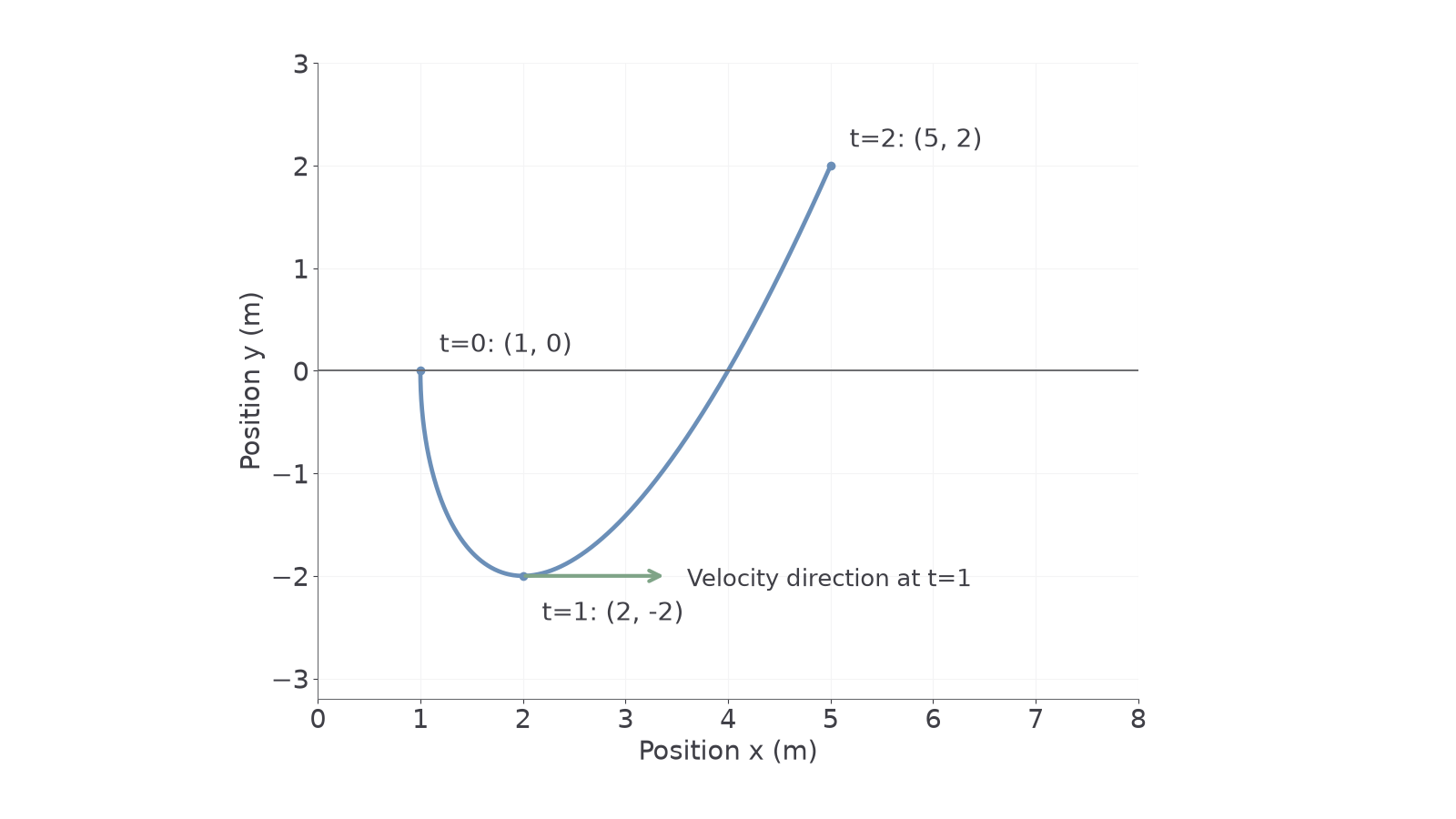
Worked example 2 changes the component functions to exponential and trigonometric ones. The componentwise method stays the same; the scalar calculus rules change.
Worked example 2: nonpolynomial components
Question. A particle has metres, with in seconds and the argument in radians. Find velocity and acceleration, and their values at .
Plan. Apply the appropriate scalar derivative to each component.
Why keep the unit vectors fixed? They describe the chosen Cartesian axes, not directions that turn with the particle.
Answer. The vector functions are those above; initial velocity is and initial acceleration is .
Check. Differentiating the vertical component twice takes to , then , as in scalar calculus.
The elementary power, sine, cosine and exponential derivatives are recall results; they are not printed in the formula booklet. Include chain-rule factors for arguments such as .
Watch out
Wrong: . That measures how fast the particle's distance from the origin changes, which is a different quantity. Right: differentiate to obtain , then calculate .
The next model changes the exponential rate and trigonometric frequency. Both components must retain their chain-rule factors.
Integrating with vector initial conditions
Each integrated component has its own constant, and a vector condition supplies one equation for each component.
Integrating gives . The constant is a vector, ; neither component is automatically zero. Integrating again introduces a separate position constant vector.
Vector integration
Integrate each component with respect to the common time:
Displacement over an interval is
Not in the formula booklet: learn it.
Use a velocity condition to find the velocity constants and a position condition to find the position constants. Each condition must be applied at the stated time, which need not be zero. Elementary antiderivatives are recalled from Pure Mathematics.
Worked example 3: two vector conditions
Question. A particle has , and metres. Find velocity and position.
Plan. Integrate twice, applying the matching vector condition after each integration.
Why are four constants needed? There are two component integrations for velocity and two more for position, each constrained by its own data.
Answer. and metres.
Check. Differentiating position twice recovers ; substituting zero recovers both given vectors.
Worked example 4 changes only the time at which the same velocity and position vectors are known. The constants must change to satisfy these later observations.
Worked example 4: conditions at a later time
Question. Suppose , but now and metres. Find velocity and position.
Plan. Use the same antiderivatives, substituting when determining each constant.
Why not copy the constants from the previous example? The same observed vectors at a different time describe a different motion.
Answer. and metres.
Check. At , these give components and , exactly the stated conditions.
Definite component integrals provide an alternative: start from the known vector at its known time and integrate the change from there. They produce the same constants implicitly.
Watch out
Wrong: for and , write , omitting the constant. This gives , contradicting the condition. Right: . A zero observed component still supplies a condition.
In the next task the condition is again given after the clock starts. Find both component constants at that time.
Continue this lesson.
You’re previewing NovaLearn without an account. Create a free account to read the rest.
Create free account