H3 - Definite integrals and areas
Evaluate definite integrals exactly and use them to measure regions under and between curves. Distinguish signed accumulation from geometric area, locate crossings before integrating and keep the correct horizontal direction for a parametric curve.
Evaluating definite integrals
Can an integral be zero when the graph encloses a positive area? Yes: opposite signed contributions can cancel. First learn to evaluate the signed integral accurately; then decide which signs describe the requested area.
You already know
An antiderivative satisfies . The Fundamental Theorem evaluates an integral by subtracting endpoint values. Power, exponential, sine and cosine antiderivatives are recall results, not supplied formulae; the general logarithmic rule is in the booklet.
For example, . The value is fixed by the two limits; an arbitrary constant would cancel in the subtraction.
Evaluating a definite integral
If is continuous on and ,
Not in the formula booklet: learn it.
Put each complete endpoint value in brackets. Check that the integrand is defined throughout the interval before using this theorem.
Worked example 1: positive limits and a root
Question. Evaluate exactly.
Plan. Integrate the two powers and subtract the lower endpoint value from the upper one.
Why this step? Both terms belong to the antiderivative at each limit, so brackets protect the subtraction.
Answer. .
Check. Differentiating recovers . Both limits are positive, so there is no undefined point in the interval.
Change only the upper limit from to . The antiderivative and lower endpoint contribution stay the same.
Worked example 2: a longer interval
Question. Evaluate exactly.
Plan. Use the same antiderivative and substitute the new upper limit.
Why this step? Extending an interval changes an endpoint value, not the integration rule.
Answer. .
Check. The added contribution from to is , and .
Adjacent intervals add because their shared antiderivative value cancels. Reversing the limits changes the sign: . These integral properties are not in the formula booklet: learn them.
Watch out
Wrong: . The minus applies to the whole lower endpoint value. Right: .
A numerical integration facility can check a decimal value, but an exact answer retains fractions, roots, logarithms or exponentials as appropriate. Change just the upper limit again below.
Signed integrals and total area
A region below the horizontal axis contributes negatively to an integral, but positively to geometric area. With increasing horizontal limits, the integral is area above the axis minus area below it.
Total geometric area
For a continuous function on , with , the total geometric area between its graph and the axis is
If throughout, this is . If throughout, it is . These area results are not in the formula booklet: learn them.
When the graph changes sign, find its roots and split the interval there. Add the positive magnitudes of the separate region integrals. Taking the absolute value after adding signed regions cannot undo cancellation.
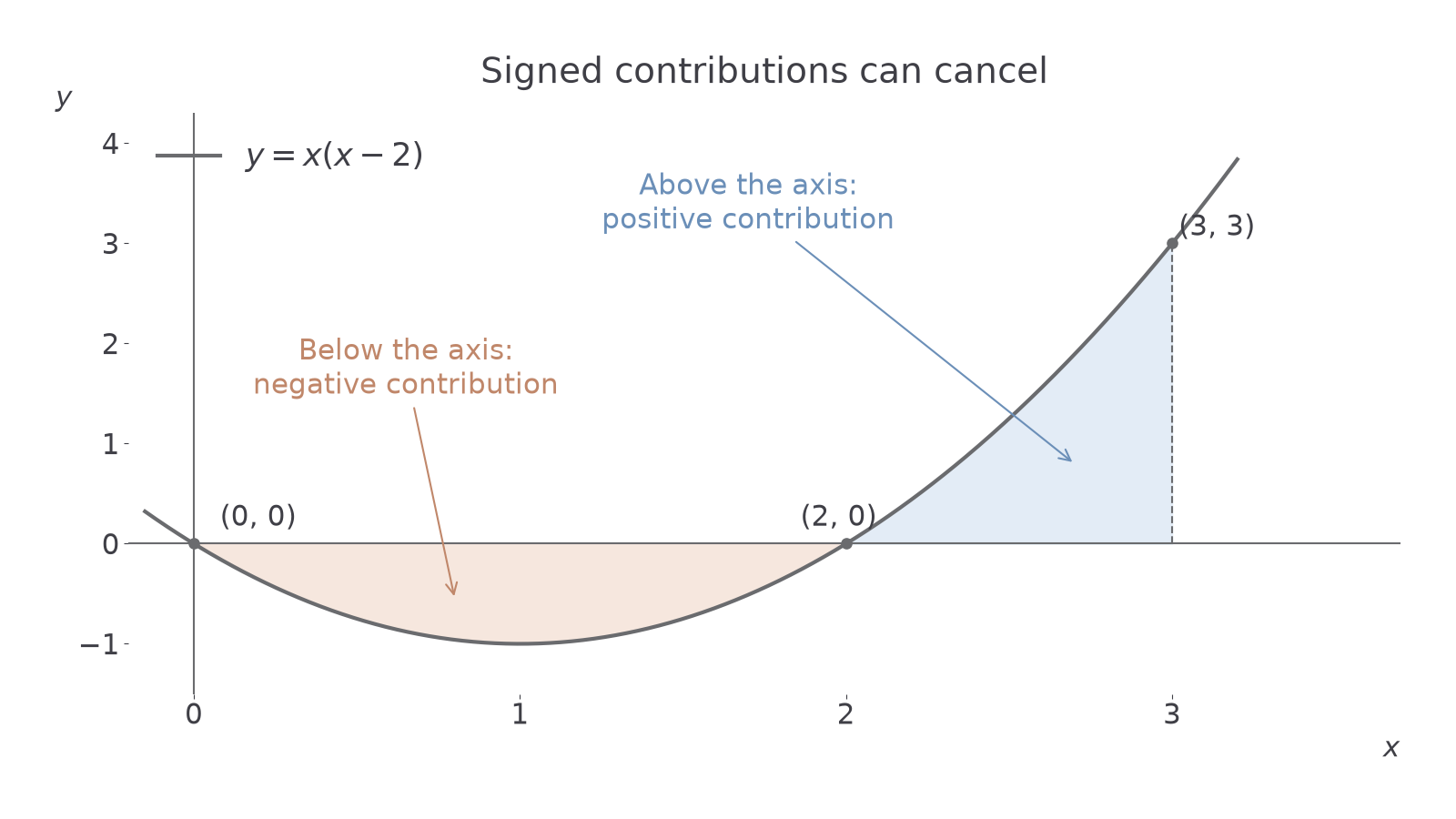
For this graph, the root is the change of sign inside the interval from to .
Worked example 3: zero integral, positive area
Question. For , find the signed integral and total geometric area from to .
Plan. Split at , then combine the two contributions with the required signs.
Why this step? The contributions have opposite signs in the integral, but both regions count positively towards area.
Answer. Signed integral ; total area square units.
Check. , confirming the signed value. The diagram still contains two positive-sized regions.
Change only the right endpoint from to . The negative region stays unchanged; the positive region grows.
Worked example 4: unequal contributions
Question. For , find the signed integral and total geometric area from to .
Plan. Reuse the negative region and calculate the larger positive contribution.
Why this step? The whole signed integral now happens to be positive, but it still subtracts the below-axis region.
Answer. Signed integral ; total area square units.
Check. . Total area exceeds the signed integral by , twice the below-axis area.
Area units are the product of the horizontal and vertical units. For ordinary unitless graph coordinates, use square units; a flow rate in integrated against seconds instead gives litres.
Watch out
Wrong: total area . Cancellation has already lost the two region sizes. Right: square units.
Change only the right endpoint once more. Locate the sign change even though the upper limit has moved.
Areas between intersecting curves
Between two graphs, a vertical strip's height is the upper function minus the lower function. The height is their separation, even when both graphs lie below the axis.
For example, graphs at heights and have separation . Subtracting the lower graph keeps this height positive.
Area between two graphs
If throughout , with ,
Find the intersections and split wherever the graphs change order, using upper minus lower on each interval.
Not in the formula booklet: learn it.
Equate the functions to find the boundaries. Then test a point between consecutive intersections, or factor their difference, to decide which is upper.
Continue this lesson.
You’re previewing NovaLearn without an account. Create a free account to read the rest.
Create free account