B4 - Simultaneous equations
Solve equations together using elimination and substitution, then interpret each solution as a shared point of two graphs. You will handle linear and quadratic relations, decide how many intersections exist and keep the answers that fit a stated context.
Elimination and substitution
A rectangle has perimeter and area . Is a by rectangle a different answer from a by rectangle? Equations can give two ordered pairs even when a physical question describes one object. We will learn how to keep the algebra and its meaning together.
Start with two linear equations. A pair such as is useful only if it makes both equations true; satisfying one equation is not enough.
Simultaneous solution
A simultaneous solution is an ordered pair satisfying every equation in the system at the same time. The first coordinate is , the second is . Unrelated values taken from different equations do not form a simultaneous solution.
Elimination removes a variable by adding or subtracting suitable multiples of the equations. Substitution replaces a variable by an equal expression from the other equation. Both methods preserve the common solutions when their algebraic steps are reversible. These methods are not in the formula booklet: learn them.
Worked example 1: eliminate a variable
Question. Solve and exactly.
Plan. Make opposite coefficients of , add, then substitute for the matching -value.
Why this step? Opposite -coefficients cancel on addition, leaving one equation in .
Answer. .
Check. and .
Change only the coefficient of in the first equation from to . Isolating is now especially quick, making substitution attractive.
Worked example 2: substitute an isolated variable
Question. Solve and exactly.
Plan. Write , substitute it into the second equation and recover .
Why this step? The minus sign multiplies the entire expression for , so .
Answer. .
Check. and .
For ordinary numerical linear systems, AQA expects you to use a suitable calculator and accepts correct solutions without working. Algebraic methods remain important for exact coefficients, parameters and questions requesting a method.
Elimination can also give , as for and : they describe the same line, with infinitely many solutions. A contradiction such as means no common solution, as for and . Two genuinely different nonparallel lines meet once.
Watch out
Wrong: replace by when . Right: . Substitute a whole bracket before expanding it.
The next system has a convenient variable to isolate. Check your pair in both equations.
A line with a quadratic equation
Substitution reduces a linear–quadratic system to one quadratic equation, and every root then needs its matching second coordinate.
You already know
Solve the resulting quadratic by factorisation, completing the square, the formula or a suitable calculator. A real quadratic can have two distinct roots, one repeated root or no real roots.
A quadratic relation in two variables can involve , or . It need not be written as . Use the linear equation to remove one variable; if its expression is squared, square the entire bracket. This substitution procedure is not in the formula booklet: learn it.
Worked example 3: a line and a circle
Question. Find the simultaneous solutions of and .
Plan. Substitute for , solve the quadratic in , then use the line for each .
Why this step? Each -root belongs with the obtained from that same root, rather than with any value in a separate list.
Answer. and .
Check. For the first pair, ; for the second, . Both also satisfy the line.
Now change the quadratic relation to one involving a product, keeping the line fixed. Substitution works just as well when replaces squared terms.
Worked example 4: a product relation
Question. Find the simultaneous solutions of and .
Plan. Replace in the product, solve for , then recover the corresponding -values.
Why this step? Replacing by its equal expression preserves the two relations together; solving just would leave infinitely many pairs.
Answer. and .
Check. Their products are , and , .
If the substituted quadratic has no real roots, there is no real ordered pair. A repeated root gives just one pair when the line fixes a unique for each .
Watch out
Wrong: from example 3 give and . Right: keep the pairs , . Correct coordinates with incorrect pairing are not simultaneous solutions.
Change only the product's value from to in the next system. The line and the substitution stay the same. When both equations are already written as , equating the right sides is also a substitution step.
Intersections and the discriminant
A shared solution is a point where the two graphs meet, so the discriminant of the substituted quadratic can count intersections.
For example, the line meets only where . At it just touches the parabola: it is a tangent. A parallel line moved upwards can cross twice; one moved downwards can miss entirely.
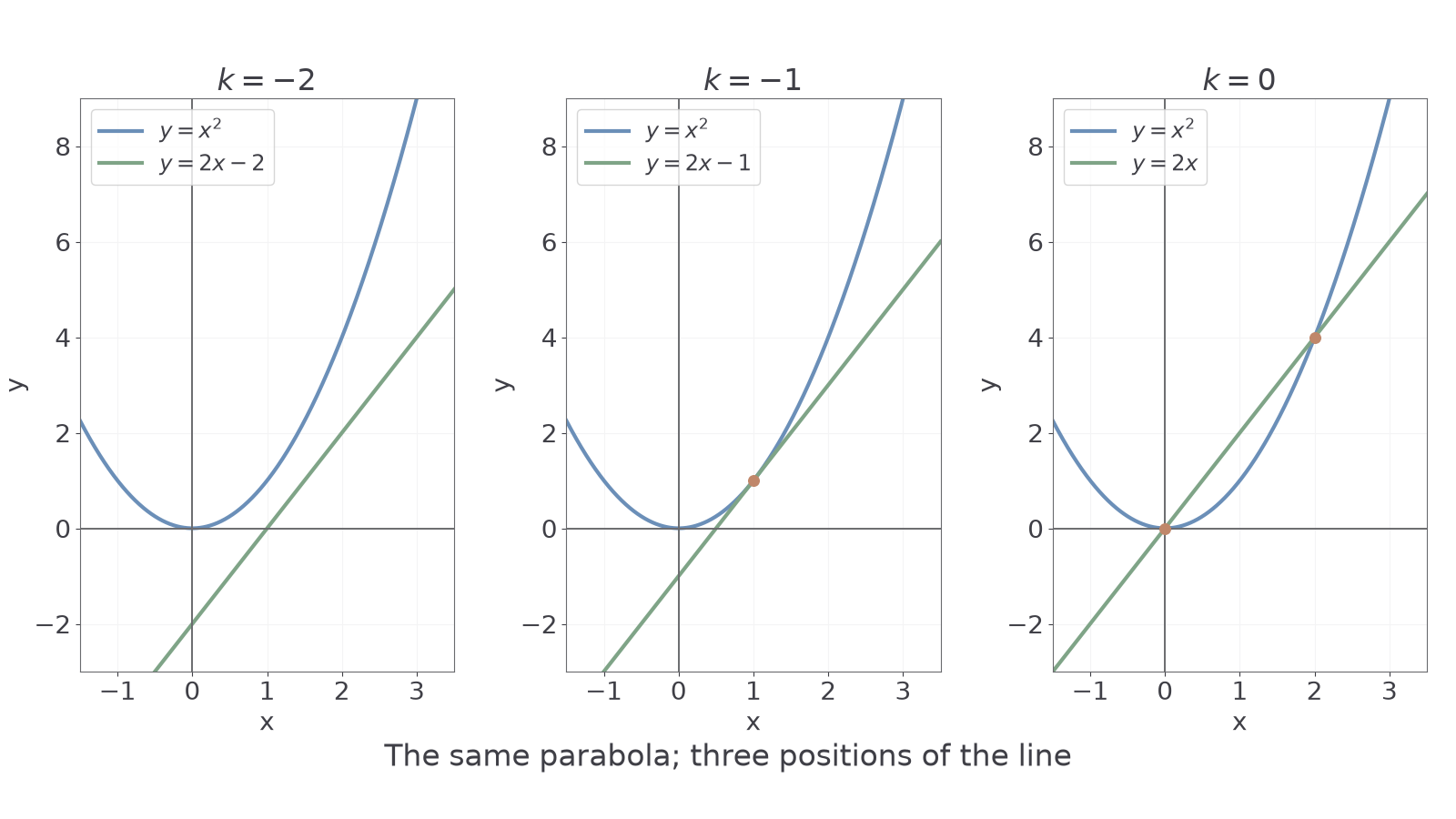
The quadratic discriminant test is not in the formula booklet: learn it. Apply it to the equation obtained by equating the curves, rather than to one graph's equation in isolation.
Worked example 5: count intersections as a line moves
Question. For real , determine the number of intersections of and .
Plan. Equate the expressions for , then classify the discriminant by .
Why this step? Each real -root produces exactly one -value on the line, so the distinct roots count shared points.
Answer. Two intersections if ; one if ; none if . At , the equation is , giving tangency at .
Check. The diagram's values give discriminants , matching its zero, one and two intersections.
The next example puts the parameter in the curve's squared-term coefficient instead of the line's height. The value now removes the quadratic term altogether.
Worked example 6: a parameter that changes the curve
Question. Find all real for which and have exactly one intersection.
Plan. Use a repeated root when , then inspect the nonquadratic case .
Why this step? A zero leading coefficient gives a line , so one intersection need not arise from a repeated quadratic root in that exceptional case.
Answer. or . For nonzero , the positive discriminant gives two intersections; for , there are none.
Check. At , touches at . At , the horizontal axis meets the line at .
The graph interpretation must respect the actual equation at each parameter value. A discriminant computed from a vanished squared term cannot certify tangency.
Watch out
Wrong: “Exactly one intersection always means set .” Right: first check that the substituted equation is genuinely quadratic. Handle a vanished leading coefficient in the original system.
Change the line's constant, keeping the exceptional leading-coefficient case in view.
Using equations in context
Defining variables turns words into equations and tells you which algebraic pairs answer the question.
Return to the opening rectangle. Let its length be and width be , with . The perimeter relation uses a sum; the area relation uses a product. These familiar rectangle formulae are not in the formula booklet: learn them.
Worked example 7: distinguish side values from labels
Question. A rectangle has perimeter and area . Find its length and width, taking length to be at least width.
Plan. Form the perimeter and area equations, substitute, then use .
Thus the algebraic pairs are and .
Why this step? The label condition chooses which side is called length; both positive pairs describe the same unlabelled rectangle.
Answer. Length , width .
Check. and .
Change only the area to . The perimeter equation and label condition stay the same.
Worked example 8: the same perimeter with a different area
Question. A rectangle has perimeter and area . Find its length and width, taking length to be at least width.
Plan. Reuse the perimeter relation, form the new product equation and select the labelled pair.
Why this step? A larger area does not change the available perimeter; it moves the two side lengths closer together.
Answer. Length , width .
Check. and .
In fact no rectangle with this perimeter can have area greater than . Since ,
Equality occurs at : the square has the largest area. This bound is derived here, not supplied in the formula booklet. Asking for area would produce no real side lengths, matching a negative discriminant.
Watch out
Wrong: reject a swapped pair just because it looks inconvenient. Right: use the variable definitions. Swapped side lengths describe the same unlabelled rectangle, but two variables representing different objects might give genuinely different outcomes.
Check positivity, units and any label conditions after solving. A plausible number is not enough unless it satisfies both relations.
Quick Recap
- Elimination and substitution find values satisfying both equations at once; check the original system.
- A linear–quadratic system reduces to a quadratic, and each real root needs its matching second coordinate.
- The resulting discriminant counts intersections when the equation remains quadratic; inspect exceptional parameter values separately.
- Translate the context, solve the system, then apply domains, units and variable labels.
The opening rectangle's two ordered pairs swap the side labels. With length at least width, the answer is one rectangle: length , width .