C3 - Parametric and Cartesian equations
Describe a curve using a shared parameter, trace it in the correct direction, and convert between parametric and Cartesian forms. You will retain the restrictions that distinguish the actual curve from an equation containing extra points.
Parameters and tracing
Can two descriptions give exactly the same curve but take you along it in opposite directions? For , the values give . Their order tells you how the point travels, as well as where it can go.
You already know
A function assigns an output to each input in its domain. A coordinate pair gives one point. Here you evaluate two functions at the same input to obtain that pair.
The input need not be time. It might be an angle, a distance or simply a convenient number.
Parametric equations
In , is a parameter and the equations are parametric equations. Each allowed value of gives the point . For example, gives at . Using different values in the two equations does not give the corresponding point.
The parameter interval is part of the description. Included endpoints give filled endpoints on a sketch; strict inequalities exclude them. A table locates points, but the equations must justify the shape between them. A parametric curve need not define a single-valued function : for , the values give and , with the same but different . The parametric descriptions and tracing methods in this lesson are not supplied in the formula booklet: learn the ideas.
Worked example 1: tracing a restricted parabola
Question. Describe and sketch , for , showing its endpoints, minimum and direction as increases.
Plan. Evaluate the endpoints and minimum, then use the fact that increases with .
Why this step? The minimum of occurs at , not necessarily at a parameter endpoint.
Answer. It is the parabola portion from through minimum to , moving from left to right. Both endpoints are included.
Check. At , satisfies the Cartesian equation and lies on the rising branch after the minimum.
The plot records direction with arrows as well as the set of points.
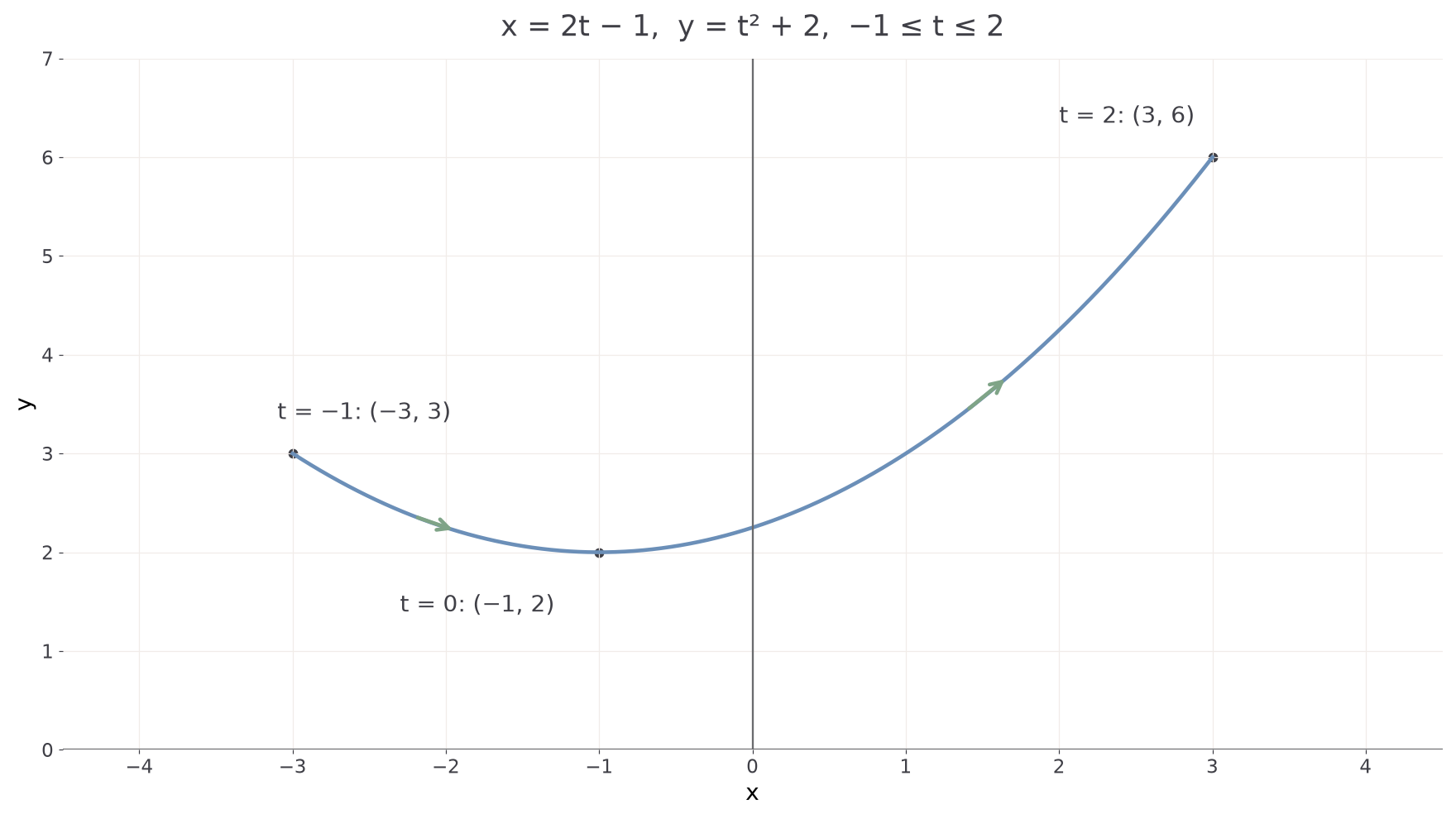
The next example changes only the parameter direction: replace the old parameter by its negative and reverse its interval accordingly.
Worked example 2: the same curve in reverse
Question. Describe , for , as increases. Compare it with Worked example 1.
Plan. Evaluate the endpoints and use to compare the descriptions.
Why this step? The substitution gives the same coordinate equations and allowed points, visited in reverse order.
Answer. It is the same parabola portion, traversed from right to left: to to .
Check. At , the point is , the old point for .
A Cartesian equation usually forgets this travel information. More surprisingly, a parameter can retrace its own path: , for , runs from to , then back to . Its exact locus is only . Every point with is visited twice, because and have the same square. The equations prove this without calculus.
Watch out
Wrong: the starting point always has the smallest . Right: the smallest allowed parameter determines the start. In Worked example 2, that start has the largest .
The next curve also moves towards smaller ; use its own parameter endpoints.
Eliminating parameters and restrictions
Eliminating a parameter relates and ; retaining its restrictions makes that relation describe exactly the same points.
For , the interval becomes . An unrestricted Cartesian parabola would include points that this parameter interval never reaches.
Cartesian equation and locus
A Cartesian equation relates coordinates directly, without the parameter. A locus is the set of points satisfying all stated conditions. For example, , describes only the right-hand half of a parabola; the inequality is part of its locus.
Isolate the parameter in whichever equation is easier. Substitute into the other, then translate the interval and any denominator or sign conditions. An implicit form such as is acceptable unless a form is specified. These elimination methods are not in the formula booklet: learn the reasoning.
Worked example 3: one branch of a rational curve
Question. Eliminate from , for , and state a restriction selecting the exact locus.
Plan. Rearrange for , substitute and translate .
Why this step? The equation alone also has a branch with , which the allowed parameter cannot produce.
Answer. , with ; equivalently with that restriction.
Check. Every gives , so no point on the stated branch is missing. At , both forms give .
The next example changes the elimination step to squaring. Squaring is useful, but it discards a sign unless you retain it separately.
Worked example 4: retaining a sign after squaring
Question. Find the exact Cartesian description of , for .
Plan. Use , then translate the interval before choosing a square-root branch.
Why this step? Writing would choose positive , excluded apart from zero.
Answer. ; equivalently .
Check. Each stated gives . The endpoints are and .
Check both directions: allowed parameter values must satisfy your Cartesian conditions, and every claimed Cartesian point must come from an allowed parameter. Dividing by an expression can also lose a genuine point; check its zero cases in the original equations.
Watch out
Wrong: implies for all real . Right: ; the original interval decides which sign or signs are allowed.
Change the negative interval and offset in the next question; keep the sign restriction visible.
Trigonometric parameterisations
An angle parameter describes circles and related curves naturally; identities eliminate the angle without choosing an inverse-trigonometric branch too early.
On a circle, coordinates relative to its centre are . The identity is Pythagoras on the unit circle. Scaling the coordinates differently gives an ellipse, a stretched circle. All angles in this part are in degrees.
Identities for eliminating an angle
Neither displayed identity is printed in the formula booklet. The sine addition formula is supplied; setting both angles equal derives the second identity.
Not in the formula booklet: learn it.
For positive , the form gives . This ellipse result is not in the formula booklet: learn to derive it by dividing out the scales, squaring and adding. The angle interval selects the portion and direction.
Worked example 5: the upper half of an ellipse
Question. Find a Cartesian equation and restriction for , . Describe its direction.
Plan. Normalise the coordinates, square and add, then use the sign of the sine.
Why this step? Squaring and adding gives the whole ellipse; the inequality removes the lower half.
Answer. . It runs from , through , to , anticlockwise.
Check. Angles give those three points. Each upper-half point has an angle in this interval.
The next example changes only the angle interval. The equation stays the same, while the selected half and endpoints change.
Worked example 6: selecting the lower half
Question. Find the exact Cartesian description of , for , and describe its travel.
Plan. Retain the ellipse equation and use the strict sign of the sine.
Why this step? The strict inequality excludes the two endpoints as well as the upper half.
Answer. The same ellipse equation with , traversed anticlockwise from near , through , towards . The endpoint limits are not included.
Check. At , the point is , satisfying the equation and restriction.
Sometimes the coordinate equations contain different angle multiples. Change the vertical expression to a double angle and use its identity first.
Worked example 7: a double-angle expression
Question. Show that , for , satisfies . State restrictions selecting the exact curve.
Plan. Expand the double angle, square and replace the squared sine using .
Why this step? The squared equation permits both signs of ; the given angles produce only the nonnegative sign.
Answer. , , , as required.
Check. At , , , giving . Conversely, choose the first-quadrant angle with the stated cosine to obtain each point of the nonnegative branch.
The angle interval does more than bound the coordinates: it chooses which signs occur together.
Watch out
Wrong: give only for the first-quadrant parameterisation. Right: retain and , removing the extra branches.
The next question changes only the vertical scale of the double-angle curve.
Constructing parametric forms
A Cartesian curve usually has many parameterisations; choose one that makes its whole required locus and travel easy to describe.
For , a simple choice is . Copy the graph's allowed interval to . Replacing by a linear expression changes the parameter's scale or direction. These construction methods are not in the formula booklet: learn to substitute and retain the domain.
Worked example 8: a convenient parameter start
Question. Parameterise , , using , and give the exact interval for .
Plan. Substitute the horizontal coordinate and solve the endpoint inequality.
Why this step? Without the interval, the formula would generate extra points beyond the prescribed graph.
Answer. , .
Check. The endpoints give , . Every required has in the stated interval.
The next example changes only the horizontal parameterisation, making the same graph run in the opposite direction.
Worked example 9: reversing a parameterisation
Question. Parameterise the same graph , , using . Describe its direction.
Plan. Substitute, then solve the inequalities carefully because the coefficient of is negative.
Why this step? Increasing decreases , so the larger endpoint comes first.
Answer. , , travelling from to .
Check. lies in for every required , establishing exact coverage.
A full circle is more conveniently parameterised by , for . Including would repeat the start without changing the locus. Using alone would require two square-root branches to cover its top and bottom. This circle parameterisation is not in the formula booklet: derive it from the sum-of-squares identity. Gradients and enclosed areas of parametric curves follow later in calculus.
Watch out
Wrong: gives . Right: solve both bounds, reversing inequalities when multiplying by , to obtain .
The next construction changes the graph but keeps a horizontal parameter that decreases.
Quick Recap
- Use the same parameter in both coordinate equations; its interval is part of the curve.
- A sketch needs the correct locus, endpoints and increasing-parameter direction.
- Eliminate by substitution or identities, then retain interval and sign restrictions.
- Check that each claimed Cartesian point comes from an allowed parameter.
- A graph can have many parameterisations, with different scales, directions or retracing.
Yes: replacing a parameter by its negative, with the corresponding interval, can trace the same curve in the opposite direction, as the opening parabola descriptions show.